 Society

Vietnamese Prime Minister meets Cambodian National Assembly President
1.
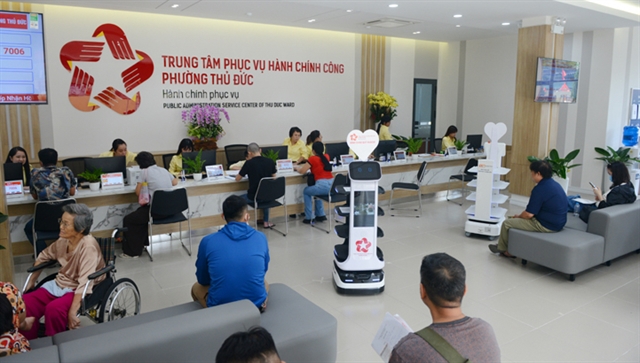 |
| Officials at the Thủ Đức City Public Administrative Service Centre in HCM City assist local residents with administrative procedures. — VNA/VNS Photo |
HCM CITY — HCM City is planning to pilot a socialist-model framework in at least five wards and communes, aiming to improve residents’ quality of life by turning socialist theory into practical governance and public services.
Lê Văn Cường, deputy director of the Institute for Party Building under the Hồ Chí Minh National Academy of Politics, said the initiative is a historic step for the dynamic and compassionate city.
The pilot scheme will help refine theoretical foundations while testing them through practical application, enabling authorities to draw timely lessons and promptly address emerging challenges, he said.
"Socialism, ultimately, is about liberating people, providing a prosperous, free and happy life, and creating conditions for comprehensive human development."
To achieve this, building socialist-model communes and wards must adhere to several core principles, he said.
Chief among these is maintaining the stability of the political system, which operates under the mechanism of Party leadership, State management, and people's ownership.
At the same time, local authorities must genuinely implement democratic principles ensuring that citizens are fully informed, consulted, and involved in public affairs, while also being able to inspect, supervise, and benefit from local development.
Digital governance and tailored indicators
Cường said the city should carefully select specific wards for the pilot programme rather than launching the model simultaneously across the entire city.
Within this framework, Party leadership will serve as the guiding core, while the State will manage and administer affairs effectively to ensure that "no one is left behind."
To ensure success under current conditions, the city must fully capitalise on the achievements of the Fourth Industrial Revolution and accelerate digital transformation, thereby building a service-oriented, transparent, and accountable government.
Meanwhile, the capital city of Hà Nội is also planning to implement its own socialist-model communes and wards.
Hà Nội’s approach involves merging two adjacent communes to create administrative units with populations ranging from 500,000 to 700,000 people.
Hà Nội has already translated the model into a set of 54 specific, measurable indicators across various categories, enabling residents to easily monitor and evaluate progress:
Political criteria: Focusing on political stability, security, public safety, and establishing mechanisms for citizens to exercise their rights locally.
Economic criteria: Defining the leading development model and establishing concrete measures for economic growth.
Social welfare criteria: Specifying residents' entitlement indicators, such as the frequency of medical examinations and treatments they are entitled to receive annually.
While Việt Nam’s two largest cities could share several common criteria, the city should develop a distinct set of indicators that reflect its own identity, Cường said.
"When people mention Ho Chi Minh City, they think of a dynamic, compassionate, and highly livable city."
These core values must be translated into measurable metrics.
Given the city's innovation-driven mindset and leadership in digital transformation, the city will require breakthrough, locality-specific criteria tailored to the unique conditions of each selected ward. — VNS
Society
 Society
 Society
 Society
 Society
 Society
 Society
 Society
 Society
 Society
 Society
 Society
 Society
 Society
 Society