 Society

High margin debt, weak liquidity put pressure on stock market recovery
1.
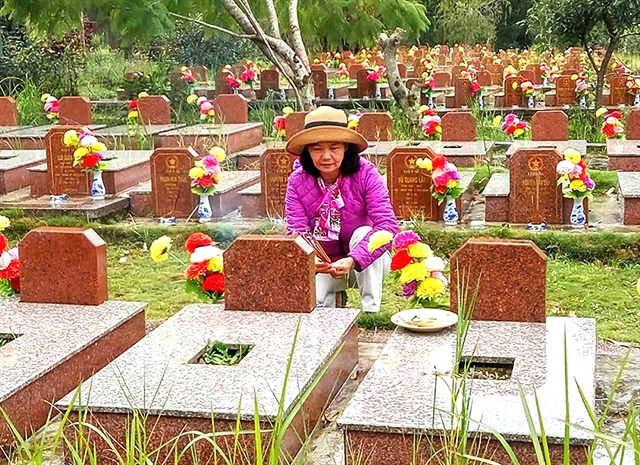 |
| Trần Thị Oanh Lan visits the Martyrs' Cemetery of Lâm Đông Province. VNA/VNS Photo |
HÀ NỘI —Helping martyrs' relatives identify remains or identities at cemeteries always gives Trần Thị Oanh Lan a feeling of relief.
For her, this is not just a job, but a never-ending journey of gratitude, the responsibility of those who stay behind to the comrades who have devoted their youth to the Fatherland.
Graves await relatives
These days, the office of the Việt Nam Martyrs' Family Support Association has become busier as Lan, deputy head of the association’s organisation and policy department, continuously meets with martyrs' relatives and answers phone calls offering guidance and advice.
At the office, Nguyễn Văn Xây, from Bắc Ninh Province, carefully flipped through each page of the yellowed death notice.
He came to ask for guidance on the procedures to find the remains of his brother, martyr Nguyễn Duy Trễ, who died on the battlefield in southern Laos in 1972.
After carefully reviewing the relevant documents, Lan guided Xây on the steps from contacting the current military unit to request an extract of information and coordinating with local authorities to carry out procedures for taking biological samples (DNA) in accordance with the law.
"Since the 500-day and night-long campaign to search, collect and identify the remains of martyrs who lack information in the mass media, many families have been given new hope,” said Lan.
“The number of relatives coming to the association to ask for information and advice has increased significantly. Because each martyr died in different contexts and battlefields, and the documents and storage addresses are also diverse, we have to meticulously review and compare each case to be able to give the most accurate instructions.
Talking about the process of being involved in the work of supporting the search for martyrs, Lan said: "I am a former Lieutenant Colonel of the Political Department, Armored Corps. I enlisted in 1975 and left the army in November 2010.
“Right when the association was established, I participated and became involved in the work of gratitude, supporting the search and connecting information, contributing to bringing many martyrs back to the embrace of their family."
Tears of reunion
On that arduous but also extremely meaningful journey of gratitude, there are stories that have been deeply engraved in Lan's heart, becoming the motivation for her to move forward.
The case of martyr Nguyễn Văn Miễn, from Yên Chinh Commune, former Ý Yên District of former Nam Định Province.
“At that time, the martyr's mother was old, weak, and had a dangerous heart disease. The last wish of a mother's life is to welcome her beloved son back to his motherland,” Lan said.
Thanks to financial help from a sponsor to cover costs, the remains of Miễn were picked up from the Martyrs Cemetery in Quảng Nam Province and returned to his hometown.
The last wish of the martyr's mother had come true. But as fate would have it, just three days after welcoming her son home in June 2015, that mother quietly passed away, taking with her the greatest consolation of her life to the next world.
Lan said: "There are no books or textbooks to guide you in finding martyrs' graves. It all has to come from the heart, perseverance and patience."
She and the members of the association have become the fulcrum and spiritual support of thousands of martyrs' families across the country.
Behind those trips, Lan is fortunate to have a strong support system. Her family always understands and encourages her to maintain her health to continue fully on the path of gratitude she has chosen.
A profile of martyrs often begins with very little data: a name, year of birth, hometown (usually an old place name), combat unit number, or a rotten death notice. For policy makers, those seemingly small and fuzzy pieces of information are the key to opening a long journey, according to Lan.
Policy officers, members of the association, along with veterans and volunteers, must search and follow every trace.
The search for relatives of martyrs is currently facing a number of obstacles.
“First, the lack and dispersion of information, as the war was a long time ago, archived records are lost and scattered in many different agencies and units, and many documents are seriously damaged over time.
Next is the change in administrative and residential locations. Many localities have changed names, split and merged. Martyrs' families also moved places of residence, their descendants are scattered everywhere, making verification and searching difficult.
The time factor and witnesses when comrades fought are becoming fewer. Memory declines due to old age and weakness. Many people have passed away before being able to provide information.
Finally, there are difficulties in DNA testing. This is the core scientific method today, but it is not always convenient. Many graves and remains are so decomposed that samples cannot be taken; or the martyr's immediate relatives no longer exist, or the family line is too far away.
"Finding a relative for a martyr sometimes requires years of patience and research. Sadly, sometimes, those who do gratitude work like us still have to face doubts and even unnecessary insults from society,” Lan said.
“To avoid misunderstandings, when sending any clues to the families of martyrs, the outside of the Association's envelope always clearly states the words: 'Searching and providing information is completely free'."
Each successful case of identity confirmation means a family's pain is eased, fulfilling the nation's deep love for the fallen. This work cannot be done alone, but requires the cooperation of the entire society.
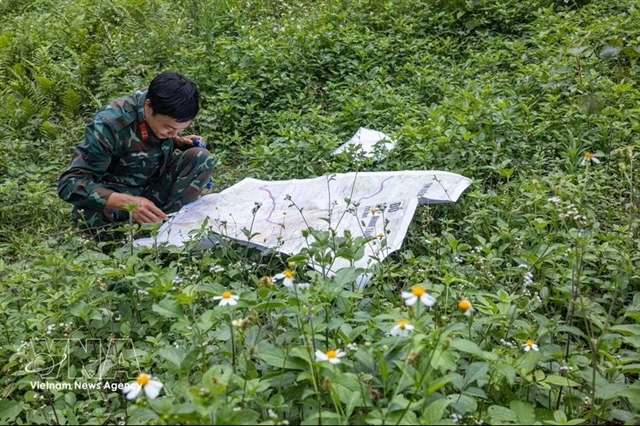
In recent years, many veterans have proactively donated battlefield diaries and combat maps.
Many young people and researchers have digitised information and established groups on social networks to share and connect data.
Many successful searches started with a photo of a tombstone shared widely on cyberspace.
In the past, data on martyrs and martyrs' graves in more than 3,000 cemeteries across the country were digitised by the Ministry of Labour, War Invalids and Social Affairs in coordination with Việt Nam Post Corporation, published at thongtinlietsi.gov.vn, which was of great help to the people.
However, the system later encountered problems and access was interrupted.
"From that reality, I realise that building and connecting a database of martyrs between authorities is urgent. When the data is synchronised, families and former comrades can look up and localise searches according to empirical methods, bringing much higher efficiency,” Lan said. VNS
Society
 Society
 Society
 Society
 Society
 Society
 Society
 Society
 Society
 Society
 Society
 Society
 Society
 Society
 Society