 Society

Ping An Digital Bank Completes HKMA’s Second GenA.I. Sandbox Cohort
1.
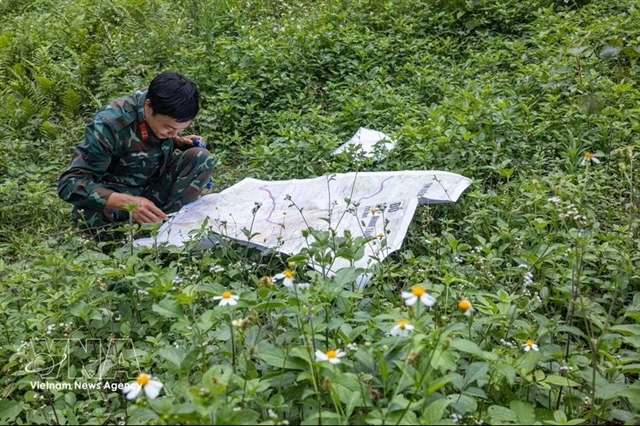 |
| An officer of Tuyên Quang Province's martyrs' remains search and recovery team actively searches for the remains of soldiers who laid down their lives in the defence of Việt Nam's northern border. VNA/VNS Photo |
HÀ NỘI – A nationwide review of archival records has uncovered a wealth of valuable information to support the search, recovery and identification of fallen soldiers' remains, according to the State Records and Archives Department of Việt Nam under the Ministry of Home Affairs.
Initial screening of records related to fallen soldiers, military campaigns, battles and key operational areas has identified numerous files that could provide crucial leads for the ongoing effort.
As part of the nationwide 500-day campaign to accelerate the search, recovery and identification of fallen soldiers' remains, National Archives Centre No. 2 has established a keyword database to streamline document searches, catalogued 1,456 archival units across five fonds and collections, and conducted archival research to verify two cases at the request of competent authorities.
National Archives Centre No. 3 has compiled inventories of relevant records and currently manages around 200,000 pages of documents on medals and decorations awarded to fallen soldiers, providing an important source for information retrieval and verification. Meanwhile, National Archives Centre No. 4 has reviewed and catalogued 220 files from five related archival fonds and collections.
Beyond reviewing and cataloguing records, the department has worked with relevant agencies to retrieve, verify and provide archival information. It has also assisted in examining records to verify information on fallen soldiers and their relatives, while supplying documents requested by competent authorities to support search and identification efforts.
According to the department, tasks assigned under the 500-day campaign have been carried out proactively and on schedule, reinforcing the role of the National Archives Centres in providing historical records for the recovery and identification of martyrs' remains.
The campaign has also strengthened coordination between the archives system and relevant agencies, while creating a practical foundation for stepping up digitalisation, data standardisation and the application of technology to unlock the value of archival records.
Despite the progress, the department noted that relevant information remains scattered across records created by different agencies over different periods. Much of the information is not reflected in file titles or document headings, making it difficult to locate using conventional search tools. As a result, archivists must manually examine files, cross-check multiple sources and verify information before compiling results.
The scale of the task is significant, with the National Archives Centres preserving thousands of metres of records that may contain relevant information. However, only a small proportion has been digitised, while many digital records have yet to undergo full-text recognition, data extraction and standardisation, limiting the use of advanced search technologies, data analytics and artificial intelligence (AI).
The work is further complicated by the ageing condition of many documents and historical changes in place names, military unit designations and operational codes, which make information verification and standardisation more challenging.
The department will continue reviewing, cataloguing, digitising and standardising archival materials while expanding information sharing to support the search, recovery and identification of fallen soldiers' remains. It also plans to strengthen data connectivity with relevant agencies and accelerate the adoption of digital technologies, AI and other data-processing tools to improve the retrieval, analysis and verification of archival information, helping speed up the nationwide campaign. VNA/VNS
Society
 Society
 Society
 Society
 Society
 Society
 Society
 Society
 Society
 Society
 Society
 Society
 Society
 Society
 Society
.jpeg)