 Society
HCM City mass wedding brings happiness to 52 disadvantaged couples
1.
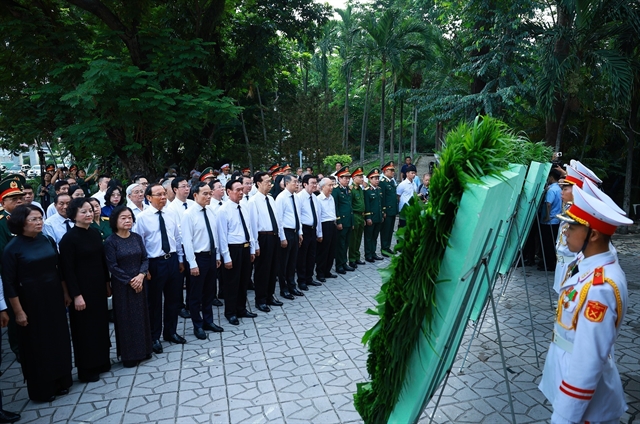 |
| Prime Minister Lê Minh Hưng lays flowers and offers incense at the monument to late Party General Secretary Trần Phú and the memorial stele dedicated to fallen soldiers at Lê Thị Riêng Park in HCM City’s Hòa Hưng Ward. — VNA/VNS Photo Dương Giang |
HCM CITY — Prime Minister Lê Minh Hưng on Monday reaffirmed that Việt Nam will continue searching for and recovering the remains of fallen soldiers until every martyr is brought home, describing the work as a sacred mission and a lasting responsibility of the nation.
The PM attended a ceremony to launch a search and recovery operation for the remains of fallen soldiers at Lê Thị Riêng Park in HCM City’s Hòa Hưng Ward.
The ceremony took place during the peak phase of the nationwide 500-day campaign to search for, recover, and identify the remains of war martyrs, launched on April 2, 2026, at the Quảng Trị Ancient Citadel in the central province of Quảng Trị.
The campaign is part of activities marking the 80th anniversary of War Invalids and Martyrs Day on July 27, 2027.
Before the ceremony, PM Hưng and delegates laid flowers and offered incense at the monument to late General Secretary Trần Phú and the memorial to fallen heroes at Lê Thị Riêng Park.
According to the city Steering Committee for the Search, Recovery and Identification of Martyrs’ Remains (the city Steering Committee 515), the current operation is based on years of research led by Nguyễn Xuân Thắng, a member of the Central Committee of the Việt Nam Association for Supporting Families of Martyrs.
By analysing photographs, satellite images, military maps and historical documents from both Vietnamese and international sources, the research team found evidence that the former Chí Hòa – Chợ Quán Cemetery, now Lê Thị Riêng Park, was used by the former Sài Gòn administration before 1975 as a mass burial site for liberation fighters and patriotic civilians killed during the 1968 Mậu Thân General Offensive and Uprising.
Ground-penetrating radar surveys identified unusual underground signals at suspected locations in the park, providing the basis for excavation.
Excavation at the first site uncovered a burial trench containing five sets of human remains, military ponchos, hammocks and bone fragments. Based on historical records and evidence at the site, officials believe it is Mass Grave No. 3.
The search will continue at other suspected locations in an effort to locate additional burial sites.
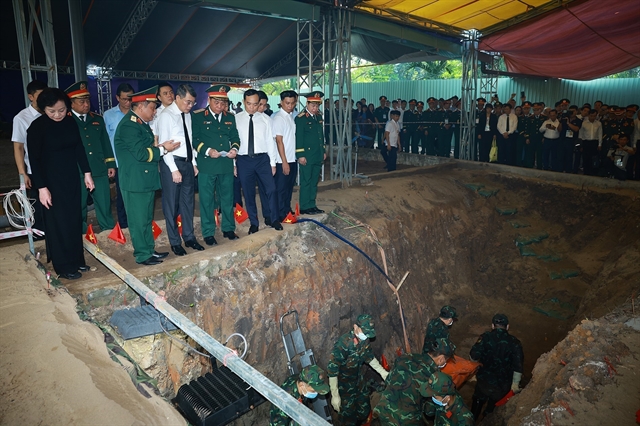 |
| Prime Minister Lê Minh Hưng inspects the search and recovery operation for fallen soldiers' remains at Lê Thị Riêng Park. — VNA/VNS Photo Dương Giang |
Speaking at the ceremony, PM Hưng said the event reflected the Party, State and people’s deep gratitude to those who sacrificed their youth and lives for national independence and freedom.
The PM stressed that searching for, recovering and identifying the remains of fallen soldiers would remain a major political task that embodies Việt Nam's traditions of gratitude and remembrance, as well as the responsibility of today's generations towards those who gave their lives for the country.
"This mission will continue until the remains of every fallen soldier have been recovered. For many martyrs’ families, the war has never truly ended because they are still waiting for news of their loved ones. We must make every possible effort to bring our fallen heroes back to their families and hometowns," he said.
The PM said the operation at Lê Thị Riêng Park was the result of many years of collecting information and studying historical records, including declassified military documents and materials provided by organisations and US veterans who served in Việt Nam during the war.
He instructed all participating forces to carry out the search and recovery work in a scientific, safe and meticulous manner, stressing that every clue preserved could help identify a fallen soldier and restore his or her name.
He also called on the city to work closely with the Ministry of National Defence and the Ministry of Public Security to mobilise maximum resources and expand the application of science and technology, particularly DNA analysis, to speed up the identification process.
He urged relevant agencies to quickly review and analyse records related to major battles, especially those fought in 1968 and 1972, while cross-checking historical documents, collecting witness testimonies and applying modern technologies to locate other possible burial sites.
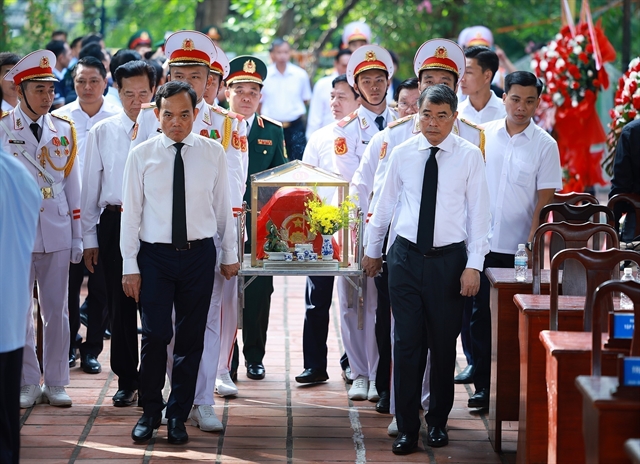 |
| Prime Minister Lê Minh Hưng carries the remains of a fallen soldier to the designated resting place at Lê Thị Riêng Park. — VNA/VNS Photo Dương Giang |
Following the ceremony, PM Hưng and delegates attended the launch of the recovery operation at the excavation site.
The recovered remains were draped with the national flag and transported to a funeral home in a solemn ceremony.
During this phase of the operation, authorities identified one of the fallen soldiers as Huỳnh Văn Quên from Long An Province. Following the ceremony, his remains were returned to his hometown for burial at the local martyrs' cemetery. — VNS
Society
 Society
 Society
 Society
 Society
 Society
 Society
 Society
 Society
 Society
 Society
 Society
 Society
 Society
 Society