 Society

AIMCONNECT 2026 Held in Singapore, Bringing Global Automotive Leaders Together to Explore the Future of AI, Trust and Connected Mobility
1.
|
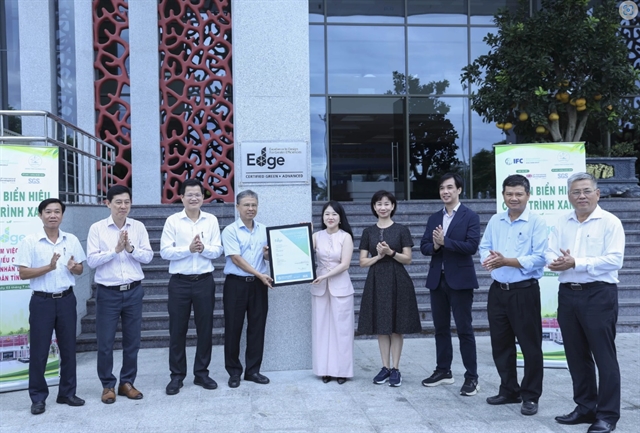
| The EDGE Advanced green building certification plaque is unveiled at Khánh Hòa Province’s political and administrative headquarters complex. — Photo baokhanhhoa.vn |
KHÁNH HÒA — Khánh Hòa Province’s new political and administrative headquarters has become the first provincial-level government building in Việt Nam to achieve EDGE Advanced green building certification, marking a shift in the adoption of international sustainability standards from the private sector to public infrastructure.
The certification, developed by the International Finance Corporation (IFC) and with support from the Australian Government, recognises buildings that achieve significant improvements in energy efficiency, water savings and the use of lower-carbon materials.
The headquarters complex, located at 1 Trần Phú Street in Nha Trang Ward, covers more than 2.3 hectares and required investment of over VNĐ544.6 billion (US$21 million). Construction began in April 2024 and was completed after nearly two years.
The complex now accommodates the provincial Party Committee, National Assembly Delegation, People’s Council and People’s Committee.
Provincial leaders said applying green building standards from the design stage reflected Khánh Hòa’s ambition to build a modern and sustainable urban centre as the province accelerates infrastructure development.
Trần Hòa Nam, vice chairman of the provincial People’s Committee, said the certification demonstrated Khánh Hòa’s commitment to improving resource efficiency, reducing emissions and pursuing sustainable development.
“The new headquarters is expected to become not only a modern workplace for public agencies but also a model green public building, reflecting a professional and service-oriented administration that is friendly to residents and businesses,” Nam said.
According to assessment results verified by international certification body SGS, the building is expected to reduce energy use by 45 per cent, water consumption by 43 per cent and embodied carbon in materials by 34 per cent through solutions such as efficient cooling and lighting systems, rooftop solar power, water-saving fixtures and lower-carbon construction materials.
These measures are estimated to cut around 488 tonnes of CO₂ emissions annually during operation, equivalent to the carbon absorption of more than 22,000 mature trees.
EDGE (Excellence in Design for Greater Efficiencies), used in more than 129 countries and territories, requires buildings to achieve at least 20 per cent savings in energy, water and materials. The EDGE Advanced level requires at least 40 per cent on-site energy savings.
IFC, a member of the World Bank Group, provided technical advisory support for the project with backing from the Australian Government. — BIZHUB
Society
 Society
 Society
 Society
 Society
 Society
 Society
 Society
 Society
 Society
 Society
 Society
 Society
 Society
 Society