 Society

AIMCONNECT 2026 Held in Singapore, Bringing Global Automotive Leaders Together to Explore the Future of AI, Trust and Connected Mobility
1.
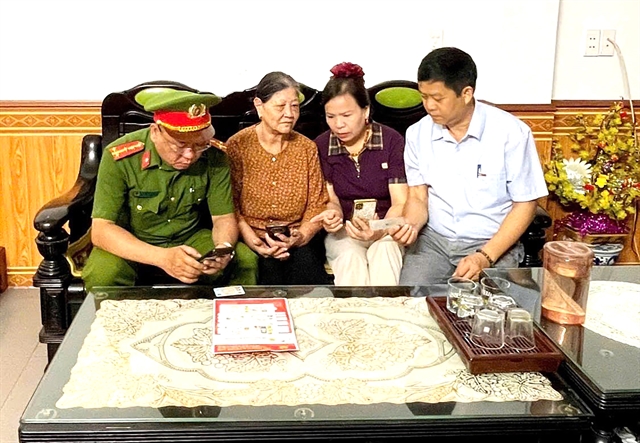 |
| Vũ Thị Thanh Thủy (second from right), deputy secretary of the Party Cell and head of the ward's Neighbourhood 1, works with police to help local residents use smartphones. — VNA/VNS Photo Minh Tâm |
TUYÊN QUANG — The use of digital technology in Hà Giang 1 Ward in the northern mountainous province of Tuyên Quang is spreading from State agencies to every neighbourhood, every local official and every resident through practical initiatives.
As each neighbourhood becomes a digital touchpoint, the gap between local authorities and residents narrows, while the quality of public services continues to improve.
Late each afternoon, after finishing her day's work, deputy secretary of the Party Cell and head of the ward's Residential Neighbourhood 1 Vũ Thị Thanh Thủy checks the neighbourhood's Zalo group on her mobile phone.
Meeting notices, information on newly issued policies, guidance on activating VNeID electronic identification accounts and updates on environmental sanitation are delivered to residents almost instantly.
Residents' feedback is also received and discussed via digital platforms before being consolidated and reported to relevant authorities.
Thủy said notifications once required officials to go door to door or distribute paper leaflets. Today, much of that information would be communicated through digital platforms.
Residents could access information more quickly, while neighbourhood heads would find it easier to manage local affairs, disseminate information and stay abreast of developments within the community.
Technology foundation
To serve the nationwide push for a digital transformation, the ward People's Committee has strengthened its Steering Committee for Science and Technology Development, Innovation, Digital Technology Application, Administrative Reform and Project 06.
It has also consolidated community digital technology teams, developed a 2026 digital transformation plan and assigned specific responsibilities to each relevant unit.
At the same time, communication campaigns have been rolled out across all 37 residential neighbourhoods through public meetings, Party cell activities, youth and mass organisation gatherings, the online public broadcasting system and the ward's official website, Facebook page and Zalo account, as well as other digital platforms.
In the first six months of the year alone, the ward held 154 public awareness sessions attended by more than 4,620 participants. It also produced, published and shared 570 news stories and articles documenting local digital transformation efforts.
Đinh Thúy Nga, head of the ward's Culture Office, said the most important aspect of the digital transformation was not the number of new software applications introduced, but ensuring that residents would understand how to use them and recognise their practical benefits.
For that reason, the ward has made public awareness campaigns, user guidance and training for local officials, neighbourhood heads and residents a long-term priority.
A clear example is the two training courses held over three days for all 74 Party cell secretaries and neighbourhood heads, covering computer literacy, document drafting, internet use, Zalo, Facebook and other digital platforms required for their daily work.
Through social funding, all 37 neighbourhoods have also been equipped with computers, gradually improving working conditions at the local level.
Putting people at the centre
Digital transformation in the ward extends beyond digitising administrative procedures. It aims to build a digital Government, digital society and digital economy, with citizens at its heart.
All residential neighbourhoods in the ward are now covered by fibre-optic broadband and mobile networks.
Electronic document management and administration systems are operating smoothly, while every official and civil servant has been issued an electronic document processing account and digital signature, enabling them to make effective use of specialised software systems.
Data digitisation has also accelerated across multiple sectors.
Personnel records for officials and civil servants have been synchronised with the national database, while population data continue to be integrated with databases maintained by the social insurance, taxation, healthcare, education and training sectors.
Nearly 90 per cent of residents aged 14 and above have activated Level 2 electronic identification accounts.
Meanwhile, almost 20,000 electronic health records have been created, laying the groundwork for expanding online public services and other digital services in the years ahead.
One of the ward's most notable achievements has been the implementation of the project.
During the first half of this year, local authorities received 16,237 online applications and successfully processed 16,235 of them, achieving a resolution rate of 99.98 per cent.
The ward has also launched the Digital Summer with VNeID campaign, helping residents make use of digital utilities.
Nguyễn Thành Long, Permanent Deputy Secretary of the ward’s Party Committee and Chairman of the local People's Council, said the local authority's objective was not only to meet digital transformation targets but, more importantly, to fundamentally improve the way it serves the public.
“When every residential neighbourhood has digital infrastructure, every local official is equipped with digital skills and residents are confident using services in the online environment, the digital transformation will truly become part of everyday life,” he said.
That is why, along with investing in infrastructure, the ward continues to prioritise workforce development, strengthen community digital technology teams, ensure cyber security and expand digital data resources.
Seemingly modest initiatives, such as helping residents activate their VNeID accounts, use online public services, make electronic payments or submit feedback through digital platforms, are gradually fostering new habits that are reshaping everyday community life. — VNS
Society
 Society
 Society
 Society
 Society
 Society
 Society
 Society
 Society
 Society
 Society
 Society
 Society
 Society
 Society