 Society
Deputy science minister highlights four criteria in Việt Nam-Australia tech cooperation
1.
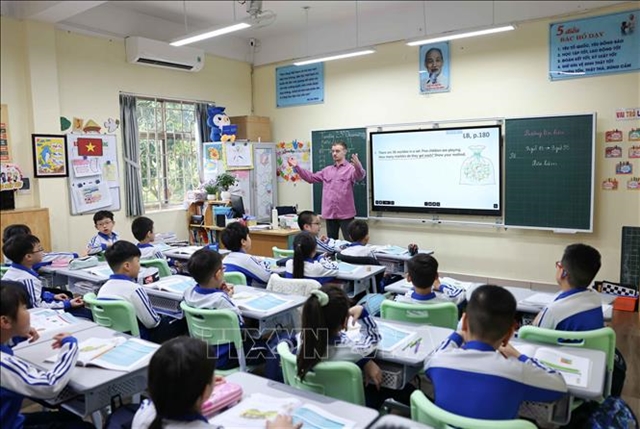 |
| CLASS ABOVE: Students learn English with foreign teachers, helping them develop more natural communication skills. — VNA/VNS Photo |
HÀ NỘI — Amid increasing international integration and the accelerating digital transition, improving English proficiency for Vietnamese students has become an urgent requirement in preparing the nation's future highly skilled workforce.
Last year, the Government approved a project to make English the second language in schools nationwide through 2035.
The goal of the initiative is to make English an effective and regular medium of teaching, communication, management and educational activities in schools across the country, thereby creating a widespread English-speaking ecosystem.
It also aims to improve the quality of English language education and, more broadly, expand teaching through English to help build a generation of global citizens capable of meeting Việt Nam's international integration needs.
For preschool, general, vocational and university education, the project sets different goals appropriate to students' age, learning effectiveness, and human and social development needs.
In Hà Nội, several schools have introduced new models of English teaching and learning to gradually make the language a tool for education, communication and integration for the city’s students.
Phúc Thịnh Commune has become the capital's first locality to implement the initiative, after signing a co-operation agreement with Hà Nội University.
Đặng Việt Hà, head of the commune's Culture and Social Affairs Division, says the project clearly identifies goals suitable for each education level. However, in practice, teaching English at preschools and primary schools has not received the same attention and emphasis as it has at higher education levels.
“We need to build from the ground up, starting with strong foundations, and based on the realities of facilities, staff, programmes and finances,” Hà says.
“Results will not come overnight, but a change in mindset among educators, teachers and students will make the use of English as a second language in schools much easier,” he says.
Starting early
Tây Tựu Kindergarten in Hà Nội's Tây Tựu Ward is run with the mindset of bringing English closer to children from the very beginning of their schooling.
The kindergarten has integrated English into its childcare and educational activities. From simple greetings to daily play and hands-on experiences, English is gradually becoming more familiar to the children.
Deputy principal Đỗ Thị Bích Ngọc says the school recognises that introducing English to preschool-aged children can be effective, because this is the stage at which children form and develop their language skills.
“English is used simply by the school's staff and teachers in greetings and short commands, mainly to show children the presence of English in the classroom and at school. This makes children feel more natural and confident when communicating,” Ngọc says.
Teaching English at the preschool level can help children become familiar with the language and form natural language reflexes.
Meanwhile, at the elementary level, many schools in Hà Nội are aiming to build an environment where English is used regularly in learning and daily activities. This is considered an important step towards making English truly a tool for communication rather than merely another school subject.
At Đoàn Thị Điểm Primary School, students learn English vocabulary and grammar, as well as essay writing and speaking about given topics, while the language is also treated as an important tool to help students confidently communicate, access knowledge and integrate globally.
The school has gradually built up a bilingual education environment where students have more opportunities to use English both in and out of the classroom.
Beyond lessons
School principal Đào Thị Thủy says that although there are no formal regulations, most of the security guards, janitors and kitchen staff can communicate with students in simple English, helping them develop natural language reflexes, build confidence in communication and gradually become part of a comprehensive bilingual learning environment.
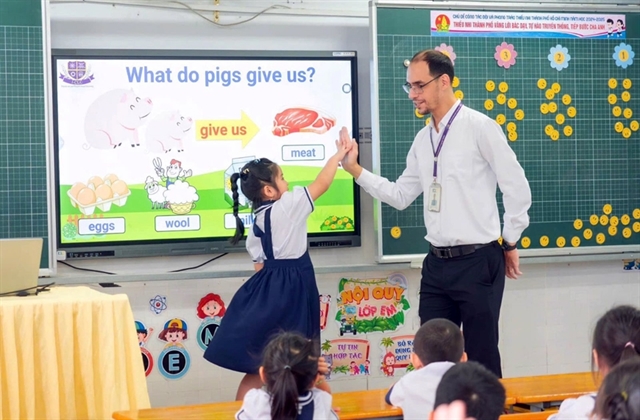 |
| HIGH FIVE: Learning English with foreign teachers can help students gain confidence speaking another language. Photo qdnd.vn |
Building an effective English environment is further strengthened through after-class activities, such as English clubs, and maths and STEM classes taught in English, Thủy says.
In particular, STEM teaching plays a particularly important role, creating real life contexts for students to use English naturally and meaningfully.
In STEM classes, students use English to ask questions, discuss ideas, present design solutions and findings, and evaluate products, the principal says.
“Language thus becomes a tool for solving problems instead of just an object of learning. This is the foundation that enables students to develop genuine English-language proficiency and supports the goal of making English the second language in schools,” she says.
At Đoàn Thị Điểm Primary School, using English in some classes is compulsory.
Meanwhile, in Phúc Thịnh Commune, schools have carried out several programmes to help make English a second language in many different classes.
Chairman of the Phúc Thịnh People’s Committee says there needs to be a supportive environment where English is used both at school and at home.
“Aside from the support and guidance of the commune government, the advisory role of scientists and experts, the pioneering efforts of teachers who teach directly, the strength and consensus of society, and the role of parents all have a great influence on the implementation of the project to make English a second language in schools,” he says.
Long-term vision
The commune plans to organise a series of 22 extracurricular events, clubs and festivals at the school and commune levels.
Goals have been set so that by 2028, 100 per cent of the commune's primary and secondary English teachers will reach CEFR Level B2 or higher, while 100 per cent of 9th graders will achieve CEFR Level A2, and at least 10 per cent will achieve CEFR Level B1 or an IELTS score of 4.0.
This will be a challenge, but authorities believe it is a goal worthy of the entire commune's political system's dedication and action.
As for the variety of English festivals held at educational institutions around the city, Nguyễn Văn Hiền, director of the Hà Nội Department of Education and Training, says they are not only useful platforms for learning and practice, but also help pave the way for making English a second language in schools.
“From simple everyday communication to English festivals and classroom activities, schools are gradually creating a modern, dynamic learning environment, helping students become more confident as they integrate with and engage with the world,” Hiền says.
With simple greetings in preschool classes, and English festivals and STEM classes in higher-level schools, many educational institutions have gradually built foreign-language environments where English is used daily by both students and teachers.
The challenge of making English the second language in schools nationwide remains considerable. Yet the practical initiatives already taking shape in Hà Nội demonstrate that, with sustained investment, committed teachers and strong community support, the Government's vision is steadily moving from policy into everyday classroom reality. VNS
Society
 Society
 Society
 Society
 Society
 Society
 Society
 Society
 Society
 Society
.jpg) Society
Society
 Society
 Society
 Society
 Society