 Society

Việt Nam, Denmark issue joint statement on establishment of Comprehensive Strategic Partnership
1.
|
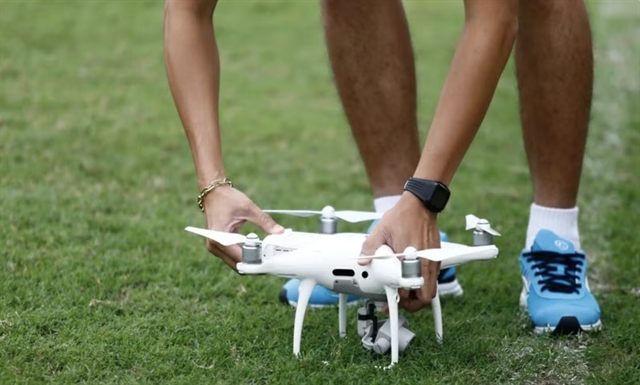
| By 2027, all airports across the country will deploy aviation security control forces capable of detecting and suppressing unmanned aerial vehicles (drones). — VNA/VNS illustration Photo |
HÀ NỘI— Permanent Deputy Prime Minister Phạm Gia Túc has just signed a decision approving a project to improve airport security in the new era.
Under the project, aviation security will be updated and improved based on risk assessment and the application of science, technology and innovation.
The project also emphasises the close connection between security control and facilitation of air transport activities and passenger services, helping ensure national security.
This year, all relevant agencies and units must develop plans to implement the project according to aviation security regulations and consistent work procedures.
One important task is to develop and promulgate a set of criteria for safe, smart and friendly airports to serve as a basis for evaluating, testing and replicating the model nationwide.
The project requires selecting and piloting this model at at least three international or key airports.
At the same time, 100 per cent of airports must complete a review and standardisation of aviation security assurance processes.
By 2027, the police, customs, aviation industry and related agencies will gradually connect and share data according to laws to serve security control and risk management and to help simplify aviation procedures.
More specifically, all airports across the country will deploy aviation security control forces capable of detecting and suppressing unmanned aerial vehicles (drones).
Between 2028 and 2030, Việt Nam will continue working to complete technical regulations for aviation security equipment, while modernising control systems to prevent, detect and handle security risks.
According to a goal set in the decision, over 80 per cent of airports will apply modern technologies, such as automatic controls, biometric recognition, smart monitoring or other appropriate technology solutions in security control, operations coordination and passenger support.
Việt Nam is aiming to see at least one airport follow the 'secure, smart, friendly' model to be listed among the 20 best airports in the world.
To realise this goal, the project proposes nine groups of key tasks and solutions, including completing the legal framework, strengthening inter-sectoral coordination mechanisms, improving risk assessment and risk management capacity and standardising passenger service journeys at 'touch points'.
Other crucial tasks include promoting the application of science and technology and digital transformation; strengthening information dissemination; workforce training; expanding international cooperation; and developing a set of criteria to evaluate and replicate effective models. — VNS
Society
 Society
 Society
 Society
 Society
 Society
 Society
 Society
 Society
 Society
 Society
 Society
 Society
 Society
 Society