 Society

Ping An Digital Bank Completes HKMA’s Second GenA.I. Sandbox Cohort
1.
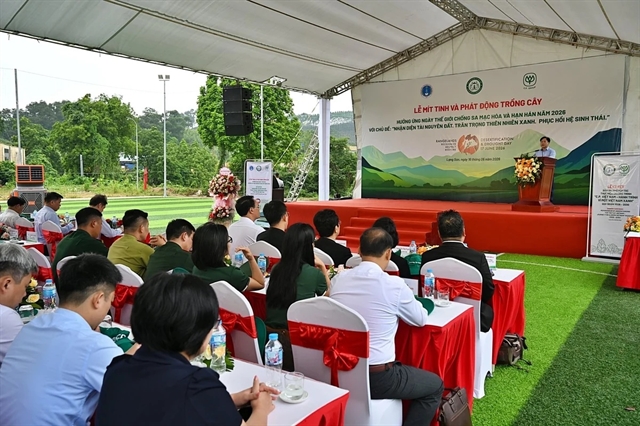 |
| The ceremony to launch a national tree-planting campaign on Tuesday. — Photo courtesy of the Ministry of Agriculture and Environment |
Trần Như
LẠNG SƠN — More than a third of Việt Nam's land surface, or nearly 11.8 million hectares, has been degraded, officials said at a national tree-planting campaign on Tuesday to mark the World Day to Combat Desertification and Drought.
The rally, held in the northern border province of Lạng Sơn, was organised by the Vietnam Forestry Administration alongside provincial authorities, a regional agricultural college and agribusiness giant C.P. Vietnam.
According to a 2021 national survey, roughly 11.8 million hectares have been degraded to some degree. Of that, more than 1.2 million hectares are severely damaged, nearly 3.8 million moderately so and around 6.8 million mildly affected.
The problem plays out differently across the country's varied terrain. In the northern highlands, erosion carves away hillsides, while along the central coast, chronic drought bakes the land.
In the Mekong Delta, saltwater intrusion from the sea and accelerating land subsidence are compounding one another, creating forms of degradation that are increasingly difficult to manage.
The northern midlands and mountains bear the heaviest overall burden, with more than 4.4 million hectares affected.
"Land is the foundation of life and socioeconomic development," said Trần Quang Bảo, director of the Vietnam Forestry Administration, in remarks at the ceremony.
"These challenges demand that the fight against desertification and land degradation be embedded in our broader national development strategy."
The event aligned with this year's theme chosen by the UN Convention to Combat Desertification (UNCCD): 'Rangelands: Recognise. Respect. Restore.'
The secretariat's messaging, shared at the ceremony, underscored an uncomfortable global reality: land supplies roughly 95 per cent of humanity's food, yet more than 40 per cent of the world's land has already been degraded, affecting an estimated 3.2 billion people and costing hundreds of billions of dollars in economic losses each year.
Grasslands, slopes and dryland ecosystems, which cover more than half of Earth's surface and sustain over two billion people, are among the most vulnerable, with roughly half of the world's grasslands already severely degraded.
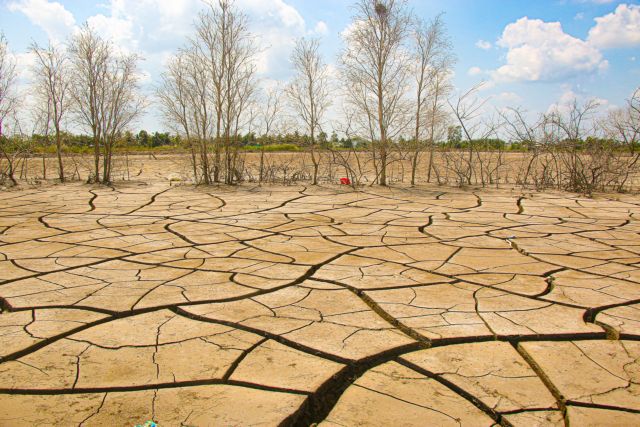 |
| A drought-hit rice field lies cracked and dry in the southern province of Cà Mau. — VNA/VNS Photo |
The agency estimates the world needs about US$355 billion annually to address desertification and drought, but argues the return on investment is compelling: every dollar spent on land restoration can generate up to $35 in economic value through ecosystem recovery, improved livelihoods, carbon sequestration and broader growth.
Việt Nam has made measurable progress on forest recovery. National forest cover climbed from around 37 per cent in 2005 to 42 per cent in 2025, above the global average of roughly 31 per cent.
A national programme launched in 2021 with a target of planting one billion trees over five years was completed ahead of schedule, contributing to reduced soil erosion and improved water retention across forested watersheds.
But Bảo cautioned that technical fixes and policy frameworks alone cannot reverse land degradation.
"This requires the participation of all of society," he said.
His department outlined six priority actions for 2026: accelerating surveys and risk mapping for desertification-prone areas; integrating land restoration goals into national development planning; rehabilitating natural and protective forests; deploying digital tools, including remote sensing, GIS and artificial intelligence to monitor land resources; securing livelihoods for communities most exposed to degradation; and expanding international cooperation while encouraging public-private partnerships in sustainable forestry.
Hoàng Văn Chiều, deputy director of Lạng Sơn's Department of Agriculture and Environment, said the province has more than 534,260 hectares of forest, giving it a forest coverage rate of roughly 64.3 per cent, among the highest in the country.
Even so, Lạng Sơn faces its own pressures: extreme weather events, wildfire risk, soil erosion, declining water sources and competing demands from economic development.
Local authorities of Lạng Sơn have promoted agroforestry models, farming systems that integrate trees with crops or livestock, to tie residents' livelihoods directly to the health of the land.
At the ceremony, C.P. Vietnam donated 10,000 forestry seedlings for ecosystem restoration in the province. The company also signed a memorandum of understanding with the Vietnam Forestry Administration to launch a five-year partnership called 'C.P. Vietnam-Journey for a Green Việt Nam,' running from 2026 to 2030.
Under the agreement, the two sides plan to plant 1.5 million trees nationwide at a projected cost of approximately VNĐ35 billion (US$1.3 million) in a bid to restore ecosystems, protect soil resources and bolster Việt Nam's climate resilience. — VNS
Society
 Society
 Society
 Society
 Society
 Society
 Society
 Society
 Society
 Society
 Society
 Society
 Society
 Society
 Society
.jpeg)