 Society

Ping An Digital Bank Completes HKMA’s Second GenA.I. Sandbox Cohort
1.
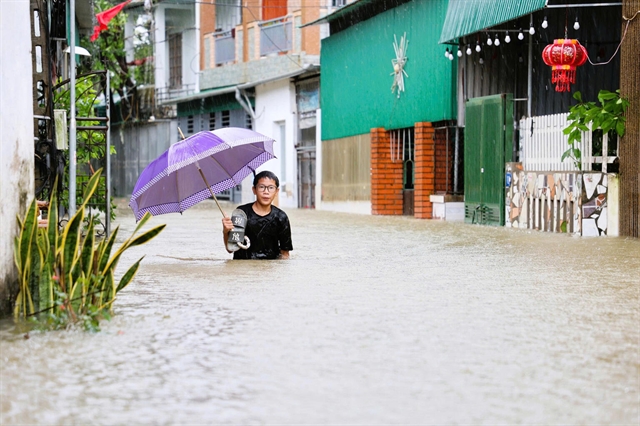 |
| A 15-year-old student stands in a flooded area in the central province of Nghệ An after tropical storm Bualoi that made landfall September 29, 2025, bringing widespread devastation across several localities in central Việt Nam. — Photo courtesy of UNICEF |
HÀ NỘI — More than 22.9 million children in Việt Nam are exposed to several overlapping climate hazards, underscoring the growing threat posed by climate change to children's health, education and wellbeing, according to a new UNICEF report released on Tuesday.
The Children's Climate Risk Report 2026 found that 82.16 per cent of Vietnamese children face climate threats – including drought, extreme heat and heatwaves, flooding, and tropical storms.
The report also found that nearly every child in the country is exposed to tropical storms, making them one of the most pervasive climate risks facing children in Việt Nam.
UNICEF said the most common combination of hazards affecting Vietnamese children involves tropical storms, drought, heatwaves and extreme heat, impacting more than 4.5 million children, followed by more complex combinations involving river flooding.
Another 2.7 million children are exposed to a combination of tropical storms, drought, and heatwaves.
The findings reflect a wider global trend. Worldwide, around 1.1 billion children – nearly half of all children – are exposed to at least three overlapping climate hazards. More than four million children globally face as many as six simultaneous climate threats.
Beyond climate hazards, the report highlights air pollution as a major concern in Việt Nam. UNICEF estimates that around 24.2 million children, equivalent to 86.77 per cent of the country's child population, are exposed to unhealthy levels of air pollution.
The report assigns Việt Nam an air pollution risk score of 8.82 out of 10, indicating a high level of exposure.
Malaria – also a type of risk sensitive to climate change's effects – on the other hand remains a relatively limited risk, affecting an estimated 44,557 children, merely 0.16 per cent of all children nationwide.
UNICEF Executive Director Catherine Russell said children's lives worldwide continued to be disrupted by climate-related disasters.
"The lives of children continue to be upended by the impact of heatwaves, wildfires, droughts, and floods," the official noted, adding that half of the children worldwide are dealing with threats from at least three types of climate problems on a day-to-day basis.
UNICEF called on governments to accelerate emissions reductions including urgent phase-out of fossil fuels, strengthen climate adaptation measures, improve disaster preparedness and ensure essential services such as schools, healthcare and water systems are resilient to climate shocks.
The agency also urged greater investment in climate education and youth participation in climate-related decision-making, as well as enhancing of decision makers and experts to respect children's rights to be heard and freedom of expression. — VNS
Society
 Society
 Society
 Society
 Society
 Society
 Society
 Society
 Society
 Society
 Society
 Society
 Society
 Society
 Society
.jpeg)