 Sci-Tech

Boat capsizes while carrying people across river in Nghệ An, no casualties reported
1.
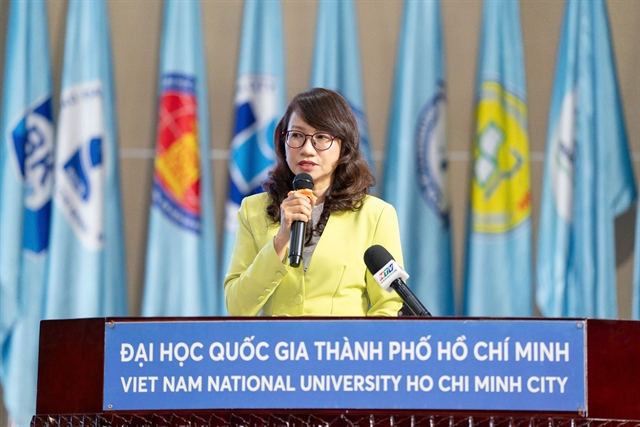 |
| Nguyễn Thị Thanh Mai, chancellor of the Việt Nam National University-HCM City, delivers a speech at the conference on May 16, where the university announced its 2026-30 science, technology, and innovation strategy alongside a major postgraduate funding scheme.— Photos Courtesy of VNU-HCM |
HCM CITY — Việt Nam National University-HCM City (VNU-HCM) has announced its strategic roadmap for science, technology, and innovation for the 2026–30 period, alongside a major funding initiative to back postgraduate researchers.
The announcements were made during a conference held on May 16, which focused on the university's transition from knowledge creation to driving actionable innovation.
The strategy aims to elevate VNU-HCM into the ranks of Asia's leading higher education institutions.
Under the new 2026–30 vision, science, technology, and innovation are designated as central drivers for growth, with a primary focus on cultivating elite research teams and strategic research hubs.
Tangible solutions for national challenges
Nguyễn Thị Thanh Mai, chancellor of VNU-HCM, said the university’s future research output will shift toward creating practical solutions, technologies, and development models to address critical socio-economic challenges facing the city, the southern region, and the country as a whole.
The university reported a strong start to 2026, recording 1,500 Scopus-indexed papers in the first five months of the year.
Funding has been secured for five basic science laboratories integrated with strategic technologies.
Furthermore, three strategic technology frameworks have been established for microchips and semiconductors, artificial intelligence (AI), and biotechnology.
The university is also advancing a national shared-use laboratory system for microchips and semiconductors while modernising its digital governance via platforms like the IOC operating system and the Project Management System (PMS).
A key component of the strategy is the development of the VNU-HCM Innovation Hub (VIH).
Integrated into the VNU-HCM Urban Area, the hub will feature large-scale research and innovation infrastructure.
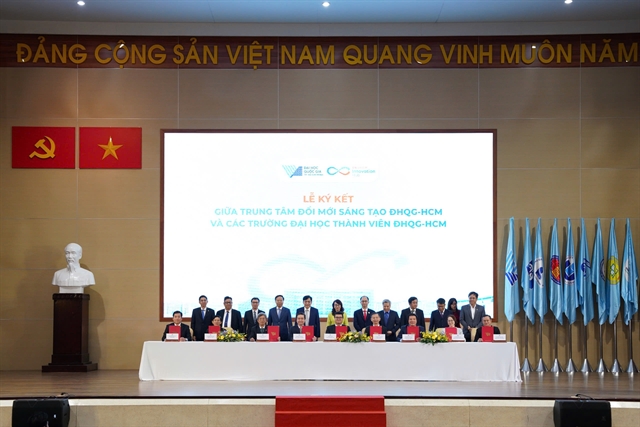 |
| Representatives from the VNU-HCM Innovation Hub and eight member universities of VNU-HCM sign a comprehensive cooperation agreement for the 2026-30 period during a conference held in HCM City on May 16. |
Planned shared platforms and laboratories include renewable and nuclear energy; net-zero and carbon technologies; quantum technology and digital technology; advanced biotechnology and biomedicine; a high-performance computing centre funded by the city’s government.
To bolster this ecosystem, the university has signed a cooperation agreement for 2026–30 with eight of its member universities.
The partnership establishes a regular operational mechanism to commercialise research, connect with international venture capital, and provide seed funding for spin-offs and startups through the upcoming "V-Link" platform.
The university will also operationalise the VNU-HCM Strategic Advisory Council for Innovation (SACSTI) to advise university leadership and municipal authorities on regional socio-economic policies.
Massive funding boost for postgraduates
In a separate move to support its high-tech ambitions, VNU-HCM approved the "VNU Excellence Graduate Programme" (VNU-EGP) on May 13.
The programme introduces an integrated "Training–Research–Innovation" model where postgraduates are embedded directly into professional research groups.
VNU-HCM aims to increase its postgraduate cohort – comprising specialised engineers, master’s students, and PhD candidates – to account for at least 30 per cent of its total student body, with doctoral researchers making up 40 per cent of that postgraduate segment.
Key financial incentives for PhD Candidates include a maximum support package of up to VNĐ560 million (US$21,245) per person over the standard duration of their programme, and up to VNĐ160 million ($6,070) per person for Master's Students: Eligible for up to
The funding is applicable to both Vietnamese and international students who commit to full-time study and research, adhere to standard graduation timelines, and link their dissertations directly to registered national science and technology tasks.
Eligible projects and academic vacancies will be published transparently on the VNU-EGP portal, allowing students to connect directly with project leads and supervisors.
Participating institutions are required to co-manage the students and enforce a strict refund mechanism should a recipient breach their full-time commitment or withdraw from the programme without justification. — VNS
Sci-Tech
 Sci-Tech
 Sci-Tech
 Sci-Tech
 Sci-Tech
 Sci-Tech
 Sci-Tech
 Sci-Tech
 Sci-Tech
 Sci-Tech
 Sci-Tech
 Sci-Tech
 Sci-Tech
 Sci-Tech
 Sci-Tech