 Sci-Tech
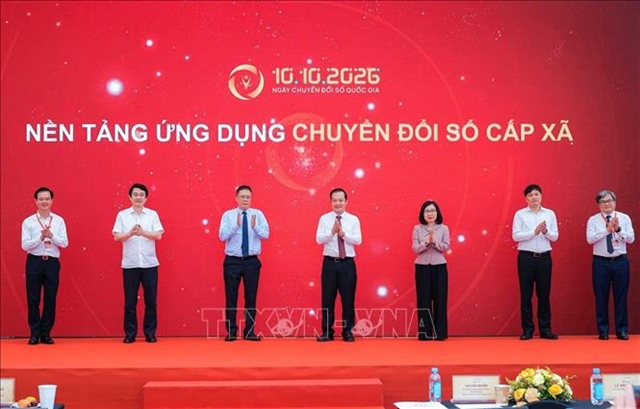
Commune-level digital transformation app launched
1.
HÀ NỘI – The Ministry of Education and Training has released a draft circular for public consultation on the application of technology in higher education, aiming to establish a unified legal framework for deploying digital technologies, artificial intelligence (AI) and related solutions across the sector.
The draft applies to higher education institutions, organisations and individuals involved in teaching, research, management and support services, as well as enterprises providing digital platforms and AI solutions.
Under the draft, technology adoption will be implemented comprehensively across training, assessment, research, institutional governance and student services. Universities may proactively select suitable technological solutions aligned with their development strategies and conditions, while ensuring controlled implementation and academic integrity.
In training activities, institutions may apply digital technologies and AI through various modes, including technology-assisted in-person teaching, fully online learning, blended learning, and data- and AI-driven personalised education. These applications are intended to support teaching organisation, learning management, progress tracking, academic advising, career guidance, and data analytics to improve curricula and teaching methods.
The draft emphasises that AI must serve as a support tool rather than replace lecturers, ensuring transparency, accountability, and compliance with academic integrity standards without distorting learning outcomes.
For testing and assessment, higher education institutions are permitted to use digital technologies and AI, provided they ensure accuracy, objectivity, transparency and fairness, in line with programme learning outcomes. Applications may include question bank development, exam administration and grading, monitoring assessment processes, analysing learning outcomes and competencies, and managing assessment data.
The draft also requires strict identity verification of learners, robust monitoring mechanisms, and the integrity, traceability and secure storage of assessment data. Institutions must publicly disclose assessment criteria and provide mechanisms for explanation and review of results. The use of AI in assessment must likewise support, not replace, academic roles and must not compromise evaluation integrity.
A key component of the draft is the emphasis on safeguarding academic integrity in digital environments. It stipulates that the use of digital technologies and AI in teaching, assessment and research must ensure honesty, objectivity and transparency, respect intellectual property rights, and accurately reflect learners’ capabilities and research outcomes.
Violations include using AI for cheating, plagiarism, unauthorised use of materials, falsifying data, outsourcing academic tasks, or failing to disclose AI use when required.
Higher education institutions must establish internal regulations, define violations and handling procedures, implement monitoring systems, and raise awareness of academic integrity.
In governance, the draft calls for comprehensive digital transformation, with data serving as the foundation for management and decision-making, ensuring transparency and accountability. Institutions are required to develop integrated, standardised and secure data systems to support administration, teaching, research, forecasting and AI applications.
It also requires synchronised digital infrastructure and stronger digital and AI competencies among students, lecturers and administrators.
Once issued, the circular is expected to provide a key legal basis for promoting responsible technology adoption, advancing digital transformation and AI in higher education, while strengthening quality assurance, data protection and academic integrity in the digital era. VNA/VNS
Sci-Tech
 Sci-Tech
 Sci-Tech
 Sci-Tech
 Sci-Tech
 Sci-Tech
 Sci-Tech
 Sci-Tech
 Sci-Tech
 Sci-Tech
 Sci-Tech
 Sci-Tech
 Sci-Tech
 Sci-Tech
 Sci-Tech