 Sci-Tech

Việt Nam has five Halal certification bodies recognised by Malaysia
1.
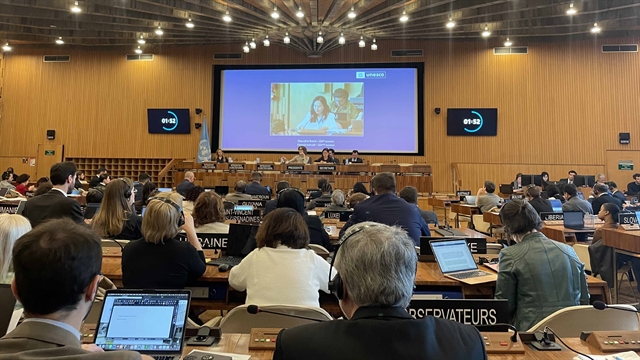 |
| Phan Thị Hà Dương, director of Việt Nam's International Centre of Research and Postgraduate Training in Mathematics (ICRTM) speaks at the UNESCO's 224th session in Paris on behalf of the Vietnamese delegation. — VNA/VNS Photo |
PARIS — The UNESCO Executive Board on Wednesday approved decisions to extend the status of two Vietnamese Category II centres under UNESCO’s auspices for a further eight years during its 224th session in Paris.
These include the International Centre of Research and Postgraduate Training in Mathematics (ICRTM) and the International Centre for Physics (ICP), both operating under the Việt Nam Academy of Science and Technology (VAST).
Under the adopted decisions, the Executive Board authorised the Director-General of UNESCO to sign bilateral agreements with the Government of Việt Nam, along with memoranda of understanding with VAST.
This represents a key activity for the Ministry of Science and Technology in 2026, as it coordinates with VAST and the Việt Nam National Commission for UNESCO to submit proposals to the Government for the signing of the agreements for the 2026-34 period, in line with the 2026 Law on International Treaties.
Earlier independent evaluations conducted by UNESCO in September 2025 for ICRTM and October 2025 for ICP yielded positive results. International experts recognised the significant progress made by both centres in fulfilling their missions, including conducting high-level research, providing postgraduate training, strengthening partnerships at national, regional and international levels, and establishing robust governance, financial and operational frameworks.
The assessments confirmed that the legal and operational frameworks of the two centres in Việt Nam are aligned with UNESCO’s current standards.
With the next eight-year extension cycle, Việt Nam aims to expand cooperation with international scientific centres, as well as with ASEAN countries and African partners, positioning ICRTM and ICP as regional centres of excellence in fundamental sciences. These efforts are expected to contribute meaningfully to national development and to the implementation of the United Nations’ International Decade of Sciences for Sustainable Development (2024-2033), led by UNESCO.
According to Deputy Minister of Foreign Affairs Ngô Lê Văn, chairman of the Việt Nam National Commission for UNESCO, the extension demonstrates the country’s governance capacity and strong commitment to the development of fundamental sciences.
In line with the Politburo’s Resolution No 57-NQ/TW on breakthroughs in science, technology, innovation and national digital transformation, and Resolution No 59-NQ/TW on international integration in the new situation, the two centres are not only serving national interests but are also emerging as knowledge hubs, promoting South–South cooperation within ASEAN and the Asia-Pacific region, thereby positioning Việt Nam as an active node in the global scientific network.
VAST President Professor Trần Hồng Thái affirmed that the academy will continue to prioritise mathematics and physics, including ensuring staffing for scientists, attracting young talent, expanding international cooperation and inviting foreign experts for long-term engagement in Việt Nam.
The goal is to develop ICRTM and ICP into core institutions driving Việt Nam’s scientific advancement, contributing not only to fundamental research but also to practical applications such as data modelling, weather forecasting and emerging technological systems.
Ambassador Nguyễn Thị Vân Anh, permanent representative of Việt Nam to UNESCO, described the development as a significant milestone, reaffirming the reputation, standing and substantive contributions of Việt Nam’s fundamental sciences on the international stage. It also forms part of the commemorations marking 50 years of cooperation between Việt Nam and UNESCO (1976–2026).
The continued operation and enhancement of these centres reflect Việt Nam’s policy of positioning science, technology and innovation as key drivers of development, while closely linking scientific advancement with deeper and more substantive international integration in the current context, she said. — VNA/VNS
Sci-Tech
 Sci-Tech
 Sci-Tech
 Sci-Tech
 Sci-Tech
 Sci-Tech
 Sci-Tech
 Sci-Tech
 Sci-Tech
 Sci-Tech
 Sci-Tech
 Sci-Tech
 Sci-Tech
 Sci-Tech
 Sci-Tech