 Sci-Tech

OPPO Find X10 Pro Max to Debut Globally with MediaTek’s 2nm Flagship Dimensity 9600 Pro
1.
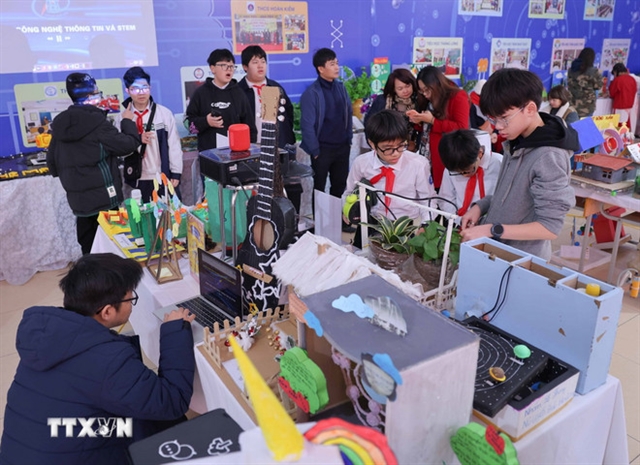 |
| A STEM space for high school students in Điện Biên Province. — VNA/VNS Photo |
ĐIỆN BIÊN — Amid comprehensive reforms, the education sector of Điện Biên Province has identified STEM (science, technology, engineering and mathematics) education as an important direction to develop scientific thinking, creative capacity and train workers for the locality.
Creating STEM education spaces has opened up opportunities for students to build knowledge and inspiration for scientific research, especially for students in remote mountain areas.
Earlier this year, the northern mountainous province put into use three modern STEM classrooms at Thanh Xương Primary and Secondary School, Mường Nhé Ethnic Boarding High School and Lê Quý Đôn Gifted High School.
These are modern learning spaces equipped with a comprehensive range of equipment to support teaching and learning in STEM subjects.
At Thanh Xương School, the STEM classroom is designed to be open and flexible and is equipped with interactive screens, computers, 3D printers and educational robotics kits.
The learning space is organised into thematic groups including areas for AI, IoT and the natural sciences, allowing students to easily access topics according to their interests.
Ninth grader Bùi Long Vũ said that he was surprised by the modern learning equipment when entering the STEM classroom for the first time.
“I was very excited to participate in the activities in the new learning space, especially the robotics group,” he said.
“I have developed my thinking skills and creativity through assembling and programming robots."
Phạm Thị Vân Ngọc, a natural sciences teacher at Thanh Xương School, said that integrating STEM into teaching allows students to learn theory while directly operating equipment and assembling kits to create practical products.
This learning environment encourages students to develop creative ideas from basic instructions, Ngọc said.
For students at the Mường Nhé Ethnic Boarding High School in the mountainous border commune of Mường Nhé, the STEM classroom is truly a breath of fresh air.
The modern and flexible learning space allows students to get involved in subjects like programming, robotics, AI and scientific research, helping them develop digital skills and igniting scientific aspirations.
Mường Nhé School Principal Phạm Văn Hạ said: “The most impressive part of the STEM classroom is its open design with modern learning equipment suitable for many different levels of students.”
“The learning environment helps students develop their digital, problem-solving and teamwork skills,” Hạ added.
“This is also a place for nurturing scientific research ideas to participate in science and technology contests and gradually cultivate scientific dreams for students in border areas."
At Si Pa Phìn Primary and Secondary Boarding School, one of the first 248 integrated schools in the inland border communes to be completed, STEM and robotics educational spaces have also recently been opened.
Nguyễn Hồng Hạnh, a representative of a unit supporting STEM education for the school, said that through training courses, teachers can quickly access new teaching methods, including programming and robot assembly instructions.
The aim of STEM learning is to help students in remote mountainous areas to gradually gain skills in technology and develop their creative ability, Hạnh said.
Si Pa Phìn School student Giàng A Lử said that being directly exposed to robot models and engaging in novel experiences has made him more interested in learning and helped him understand technology better.
Learning opportunities
STEM education is an integrated teaching model that combines the fields of science, technology, engineering and mathematics, linking theory with practice.
Over the years, this model has been implemented in many educational institutions in the province through integration into subjects and experiential activities.
Currently, 295 schools in the province have STEM activities, with 596 experiential activities contributing to the development of scientific thinking, problem-solving skills and teamwork for students.
Investing in STEM classrooms with modern spaces, standardised equipment and structured content helps schools build more effective teaching and learning programmes.
Two students at Điện Biên Phủ High School recently won the fourth-place prize for their work building a machine to separate and strip the bark of the Tế tree in the National Science and Technology Research Competition for High School Students.
This achievement proves the effectiveness of developing scientific research and creative capabilities for students.
Investing in the construction of STEM classrooms is crucial to this effort, representing a breakthrough and opening up opportunities to improve the quality of teaching and learning.
From these initial steps, STEM education in Điện Biên is expected to continue expanding, helping build a skilled workforce to meet the region's sustainable development requirements in the future. — VNS
Sci-Tech
 Sci-Tech
 Sci-Tech
 Sci-Tech
 Sci-Tech
 Sci-Tech
 Sci-Tech
 Sci-Tech
 Sci-Tech
 Sci-Tech
 Sci-Tech
 Sci-Tech
 Sci-Tech
 Sci-Tech
 Sci-Tech