 Sci-Tech

OPPO Find X10 Pro Max to Debut Globally with MediaTek’s 2nm Flagship Dimensity 9600 Pro
1.
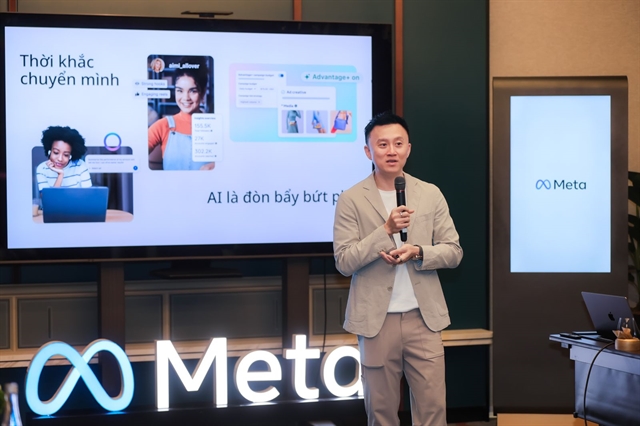 |
| Khôi Lê, country director of Meta in Việt Nam, speaks at the event. — Photo courtesy of Meta Vietnam |
HÀ NỘI — Global technology firms are stepping up efforts to roll out AI-driven commerce tools in Việt Nam, as the market moves into a new phase of 'social commerce 2.0' driven by automated messaging and personalised sales.
Social commerce in Việt Nam has developed rapidly over the past decade, driven by small- and medium-sized businesses (SMEs) using platforms such as Facebook, Instagram and Tik Tok to sell directly to customers. Transactions are built around conversations, with users discovering products, messaging sellers and completing purchases within the same platforms.
This model, often referred to as 'business messaging', is now expanding beyond Southeast Asia into Europe and the United States. However, Việt Nam remains one of the most mature markets, where chat-based transactions are already a core part of consumer behaviour.
At Meta Growth Day in Việt Nam on Wednesday, Meta has begun piloting a new suite of AI-driven business solutions in Việt Nam, including Business AI on Messenger, an assistant currently in beta in Vietnamese, alongside new creative and video tools for businesses and content creators.
“With AI, businesses are not only reducing costs but also creating opportunities for growth,” Khôi Lê, country director of Meta in Việt Nam, told Việt Nam News, adding that AI systems can operate in multiple languages, helping firms serve both local customers and international tourists.
 |
| Business AI on Messenger. |
Early testing shows faster response times and improved conversion rates, with some businesses also reporting higher order values. AI is also being applied to customer targeting, advertising optimisation and re-engagement, with payments increasingly integrated into chat-based transactions.
At the same time, AI is expected to reshape the labour market, reducing repetitive tasks while enabling workers to focus on higher-value roles such as strategy, content and customer experience.
Việt Nam’s strong adoption rates are a key reason for this focus.
A 2025 study by Kantar found that 89 per cent of online adults in Việt Nam message businesses at least once a week, while 78 per cent say responses from AI-powered chatbots are helpful.
On the business side, research by Deloitte shows that 86 per cent of Vietnamese SMEs report direct revenue gains from personalised advertising. The market is moving beyond the experimental phase and scaling rapidly.
“Việt Nam is in a strong position to lead this shift. The model started here, and with AI, it can scale globally,” Khôi Lê said.
 |
| A livestream sales session on e-commerce platforms. — VNA/VNS Photo |
Data from Meta also highlights the scale of social commerce activity, with six in ten users searching for products on its platforms, more than half researching items and nearly half completing purchases within the ecosystem.
Globally, competition is intensifying. Google and Shopee are developing AI shopping agents, while Meta is expanding automation across marketing, customer service and transactions. The shift marks a move from support tools to AI agents capable of performing tasks independently.
According to recent estimates by McKinsey & Company, generative AI could add hundreds of billions of US dollars annually to retail and consumer sectors, with industry reports in 2025–26 showing continued acceleration in AI-driven commerce.
Social commerce is set to expand as direct business-to-customer engagement plays a bigger role in purchasing decisions. Việt Nam is well placed for this shift, supported by high social media usage, digitally engaged consumers and rapid business adoption.
As competition intensifies, firms face growing pressure to adopt these tools. Việt Nam is not only keeping pace but is emerging as a key player in shaping social commerce in the AI era. — BIZHUB/VNS
Sci-Tech
 Sci-Tech
 Sci-Tech
 Sci-Tech
 Sci-Tech
 Sci-Tech
 Sci-Tech
 Sci-Tech
 Sci-Tech
 Sci-Tech
 Sci-Tech
 Sci-Tech
 Sci-Tech
 Sci-Tech
 Sci-Tech