 Sci-Tech

Vietnamese Prime Minister meets Cambodian National Assembly President
1.
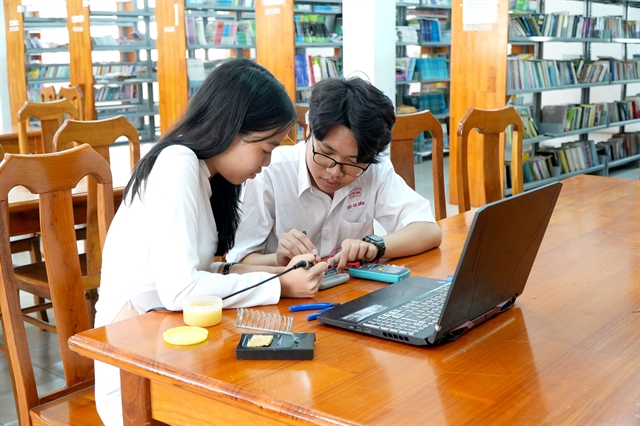 |
| Nguyễn Tô Thiên Duyên and Nguyễn Ngọc Chi Dân, students at Lương Thế Vinh High School for the Gifted, successfully developed the ACUIRPEN device for acupuncture point detection. — VNA/VNS Photo Lê Xuân |
ĐỒNG NAI — A group of students from Lương Thế Vinh High School for the Gifted in Đồng Nai City has developed a device designed to support the identification of acupuncture points in traditional medicine healthcare treatment, combining modern sensor technology with data-processing algorithms to improve accuracy in clinical support.
Named ACUIRPEN, the device applies the Hampel filter algorithm to improve the precision of acupuncture point detection and has already attracted attention in student research circles.
The project won first prize at the National Science and Engineering Competition for lower and upper secondary school students in March 2026.
The student team includes Nguyễn Tô Thiên Duyên, a Grade 12 English-major student, and Nguyễn Ngọc Chi Dân, a Grade 11 IT-major student, under the supervision of teacher Vũ Thị Phương from the school’s Informatics-Biology Department.
Duyên said the idea came after observing her grandmother receive effective acupuncture treatment while noticing that the procedure still depended heavily on the practitioner’s experience and subjective judgement.
“From there, Dân and I began studying traditional medicine materials,” she said.
“During the research process, we realised that accurately locating acupuncture points is the key factor determining treatment effectiveness. So we focused on studying the scientific foundations related to acupuncture points and traditional medicine.”
Because the field remains relatively new in student scientific research, the team faced considerable challenges in sourcing reference materials.
“Thanks to my strength in foreign languages, I was able to access documents in English and Chinese and build the theoretical foundation for the project,” Duyên said.
Through their research, the students found that acupuncture points tend to show slightly higher temperatures than surrounding areas. Based on this observation, the team combined infrared sensors with data-processing algorithms to detect temperature differences and identify acupuncture points more precisely.
“We chose infrared sensors to measure temperature variations at acupuncture points,” Duyên said. “Because the temperature difference on the human body is only around 0.5 to 0.7 degrees Celsius compared to nearby areas, the sensors needed to be highly precise while also compact in design.”
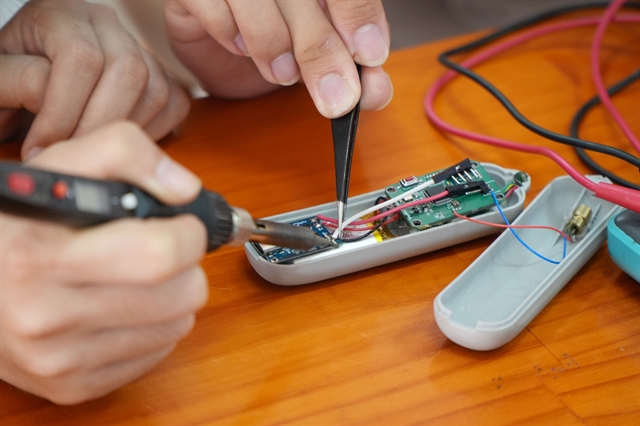 |
| The ACUIRPEN device, which uses the Hampel filter, is compact, user-friendly and achieves an accuracy rate of up to 98 per cent. — VNA/VNS Photo Lê Xuân |
After establishing the theoretical basis, the group went on to research algorithms, design both software and hardware and integrate the systems into a complete product.
During development, the students repeatedly tested the device and consulted experts to refine the design before successfully creating ACUIRPEN, which uses the Hampel filter to improve the accuracy of acupuncture point identification.
The device is designed for simple operation. Users only need to gently move the pen-shaped sensor across the skin while the system automatically collects and analyses data before signalling the detected acupuncture point through lights and sounds.
Experimental results showed the device achieved an accuracy rate of more than 98 per cent across different user groups.
With strengths in algorithmic thinking, Dân said his primary role in the project was identifying the most suitable algorithm for the device.
“I spent a lot of time researching and comparing different approaches before finding the most appropriate algorithm for the product,” he said.
“At first, there were many difficulties. But after a lot of research and repeated testing, we finally found the algorithm that worked best for our project.”
Teacher Vũ Thị Phương said the students demonstrated strong passion and enthusiasm for scientific research throughout the project.
“I mainly guided them on the foundational knowledge they needed while they independently explored additional knowledge in programming, traditional medicine and acupuncture points to complete the project accurately,” she said.
“The students were extremely proactive, enthusiastic and versatile throughout the process from circuit design and 3D modelling to finalising the product. Most stages were completed by the students themselves which is highly commendable.”
Nguyễn Văn Cư, vice principal of Lương Thế Vinh High School for the Gifted, described the project as a meaningful innovation demonstrating how students can apply classroom knowledge to solve real-world problems.
“That is exactly the goal modern education aims for,” he said.
“The school is delighted not only because the students won a prize but more importantly because they have matured, developed research-oriented thinking and shown the potential to contribute to society in the future.”
Cư added that the school considers scientific research an important part of student development. Each year, the school organises training sessions, idea-orientation activities and advisory teams to support student research projects.
Projects considered highly feasible are then given deeper guidance and connected with experts and scientists to further improve and complete the research, he said. — VNS
Sci-Tech
 Sci-Tech
 Sci-Tech
 Sci-Tech
 Sci-Tech
 Sci-Tech
 Sci-Tech
 Sci-Tech
 Sci-Tech
 Sci-Tech
 Sci-Tech
 Sci-Tech
 Sci-Tech
 Sci-Tech
 Sci-Tech