 Politics & Law
Vietnamese Prime Minister meets Cambodian National Assembly President
1.
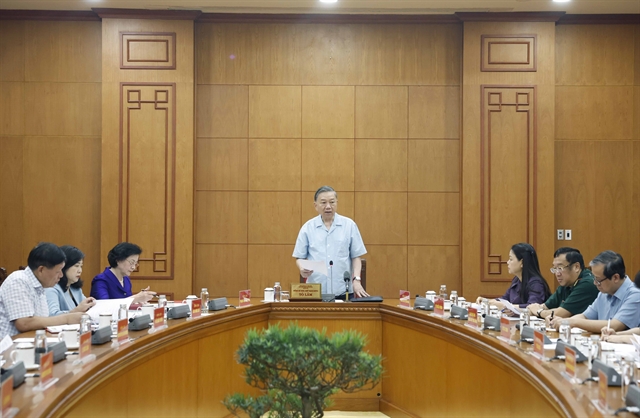 |
| Party General Secretary and State President Tô Lâm had a working session with the Party Committee of the Ministry of Health on Vietnamese traditional medicine. —VNA/VNS Photo |
HÀ NỘI — Party General Secretary and State President Tô Lâm has stressed that developing traditional medicine is not only about preserving the heritage left by previous generations, but also about turning it into a resource for national development and better public healthcare in the new era.
Addressing a working session with the Party Committee of the Ministry of Health on Vietnamese traditional medicine in Hà Nội on Wednesday, General Secretary and President Lâm said the sector is facing major opportunities as Việt Nam enters a new development stage that requires improvements in population quality, human resources and the biotechnology industry.
He called for new mindset, vision and approaches to create a historic transformation for Vietnamese traditional medicine. He underscored that developing traditional medicine does not mean returning to outdated and manual practices, but inheriting and promoting traditional values on the foundation of modern science and technology so that traditional medicine becomes a part of the national medicine and a resource for national development.
Highlighting strategic orientations for the sector, the top leader requested that traditional medicine be incorporated into the country’s overall development strategy in the new era. He called for the building of a national traditional medicine ecosystem linked to the development of the health economy and national soft power.
He also proposed expanding pilot models such as healthcare centres, wellness areas, medicinal herb villages and medicinal plant cultivation regions associated with sustainable poverty reduction and eco-tourism.
He emphasised the need to shift from a treatment mindset to comprehensive healthcare, promoting the role of traditional medicine in disease prevention, rehabilitation, elderly care, treatment of chronic diseases and mental healthcare.
Traditional medicine should be brought closer to communities, he said, calling for the standardisation of non-drug healthcare models such as acupuncture, massage and acupressure at commune and ward levels.
He held that integrating technical services and authentic traditional remedies into the national health insurance payment system would encourage people to proactively choose traditional medicine services from grassroots healthcare facilities.
He underlined the importance of promoting science, technology, digital transformation and intellectual property protection to standardise and digitalise Vietnamese traditional medicine. He called for the urgent digitalisation of traditional remedies and valuable indigenous knowledge of ethnic groups, along with the completion of a national database on traditional medicine.
The leader also requested the development of key national research programmes on medicinal herbs and valuable remedies, while linking research with commercialisation and markets through close coordination among research institutes, universities, hospitals, enterprises and localities.
He proposed establishing and strengthening several major traditional medicine centres at national and regional levels that would serve not only for treatment but also for research, training, preservation, technology transfer and product development.
He stressed that the medicinal herb industry must be developed into a full-fledged economic sector with synchronised supply chains from seed selection and cultivation to processing, branding and export markets.
General Secretary and President Lâm highlighted the need to integrate traditional and modern medicine on the basis of evidence-based medicine, saying the two systems should complement rather than oppose each other.
He requested the Ministry of Health’s Party Committee to coordinate with relevant ministries and sectors to improve institutions and soon develop and submit a strategy for the development of Vietnamese traditional medicine through 2030, with a vision to 2045. — VNA/VNS
Politics & Law
 Politics & Law
 Politics & Law
 Politics & Law
 Politics & Law
 Politics & Law
 Politics & Law
 Politics & Law
 Politics & Law
 Politics & Law
 Politics & Law
 Politics & Law
 Politics & Law
 Politics & Law
 Politics & Law