 Politics & Law
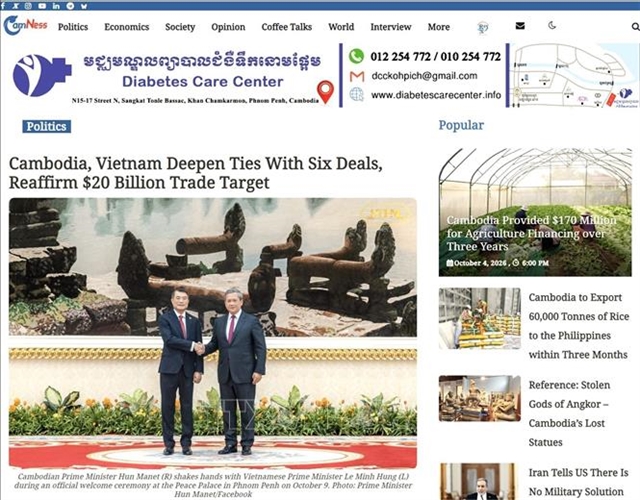
Cambodian media give heavy coverage to Vietnamese PM’s visit
1.
 |
| Johan Ndisi is the Swedish Ambassador to Việt Nam. Photo courtesy of the Swedish embassy in Hà Nội |
Johan Ndisi
On my visits across Việt Nam – from the bustling energy of Hồ Chí Minh City to the innovation hubs emerging in Hà Nội – I am struck by a familiar spirit: curiosity, ambition and an unwavering belief in the power of ideas. It is a spirit that Sweden knows well.
In Resolution 57, Việt Nam aims to advance Science, Technology, Innovation and Digital Transformation to achieve economic growth and prosperity, with the goal of becoming a high-income country by 2045. These priorities resonate deeply with Sweden’s own journey from a resource-based economy to one of the world’s most innovative-driven societies. Sweden is proud to be a committed, long-term partner to Việt Nam in realising these ambitions.
Last year, Sweden and Việt Nam upgraded our relationship to a Sectoral Strategic Partnership in Science, Technology, Innovation and Digital Transformation. This step was taken during former Prime Minister Phạm Minh Chính’s visit to Sweden, together with my Prime Minister Ulf Kristersson. It reflects not only political will, but a shared recognition that our futures are increasingly shaped by science, technology and innovation.
Both countries understand the importance of Science in addressing global challenges such as pandemics and climate change. Sweden has a special legacy in this area as the home of the Nobel Prize. This heritage reflects our enduring belief in knowledge, research, and international collaboration. I sincerely hope to one day celebrate a Vietnamese Nobel laureate in the coming years!
Sweden and Việt Nam are engineering nations and strong Technology is central for many of our enterprises. It is telling that machinery and equipment is the biggest export from Việt Nam to Sweden, and second biggest the other way. Among the more than 70 Swedish companies present in Việt Nam, many rely on cutting-edge technology, including Astra Zeneca, Ericsson Hitachi Energy and ABB. These companies not only invest in Việt Nam. They transfer knowledge, develop local talent, and build long-term capacity.
Innovation also thrives in vibrant entrepreneurial ecosystems. Việt Nam’s dynamic cities are alive with startups and bold new ideas. My hometown, Stockholm, shares this energy. It has the highest concentration of unicorn startups per capita outside of Silicon Valley. This shared entrepreneurial spirit creates fertile ground for deeper collaboration in scaling new solutions.
We are also two countries eager to embrace new technology. Today, this is expressed through Digital Transformation, where challenge is not only to innovate, but to innovate responsibly to ensure security, trust, and resilience. This is an area where Sweden offers particular strengths, combining technological leadership with strong governance and transparency.
Today, Sweden and Việt Nam will hold the first Joint Committee Meeting under our Sectoral Strategic Partnership on Science, Technology, Innovation and Digital Transformation. Representatives from government, industry and academia will gather in Hà Nội, at the Ministry of Science and Technology of Việt Nam, as well as online to discuss three key themes.
The first theme is secure and trusted connectivity. As Việt Nam advances its digital transformation, reliable and resilient digital infrastructure is essential. Swedish companies such as Ericsson have already contributed to the rollout of 4G and 5G in Việt Nam. Looking ahead, there is strong potential to expand cooperation in areas such as 6G, data governance and cybersecurity. Ensuring secure and trusted systems is not only a question of national security, but also a key factor in attracting high-quality international investments.
The second theme is nuclear energy. Việt Nam is exploring nuclear power as part of its long-term energy strategy. Sweden brings decades of experience in nuclear safety, regulation, radiation protection and monitoring systems. While cooperation in this field is still developing, there is strong potential to expand collaboration in research, safety and institutional capacity building.
The third theme is research and development. Sweden ranks second in the Global Innovation Index and invests 3.7 per cent of the state budget to research and development. This is supported by close collaboration between state, industry, academia and civil society. Many Vietnamese students, researchers and professionals have already chosen Sweden for their higher education and advanced training. One example I am particularly proud of is the many Vietnamese PhD students from Karolinska Institute, one of the world’s leading medical universities. Expanding these partnerships continues to be important for fostering talent, advancing knowledge, and driving innovation.
In a time of rapid technological change and evolving global dynamics, cooperation based on trust and reliability is more important than ever. In this regard Sweden and Việt Nam share a unique bond. In 1969, Sweden became the first Western country to establish diplomatic relations with Việt Nam. It is therefore fitting that Sweden’s delegation at this year’s Joint Committee Meeting is led by an old friend of Việt Nam: Director-General for Trade Policy Camilla Mellander, who also served as Sweden’s Ambassador to Việt Nam from 2012 to 2016.
Now is the moment to elevate our cooperation even further. The Joint Committee Meeting aims not only to showcase ongoing collaborations, but to shape future opportunities. By combining Việt Nam’s dynamism and growth with Sweden’s experience in innovation and sustainability, we can build solutions that benefit both our societies.
I am certain that the next chapter of Sweden-Việt Nam relations will not only be closer, but stronger, smarter and well placed to deliver concrete and forward-looking results in the years ahead. VNS
Politics & Law
 Politics & Law
 Politics & Law
 Politics & Law
 Politics & Law
 Politics & Law
 Politics & Law
 Politics & Law
 Politics & Law
 Politics & Law
 Politics & Law
 Politics & Law
 Politics & Law
 Politics & Law
 Politics & Law