 Economy

Việt Nam seeks to remove barriers to intellectual property valuation, research commercialisation
1.
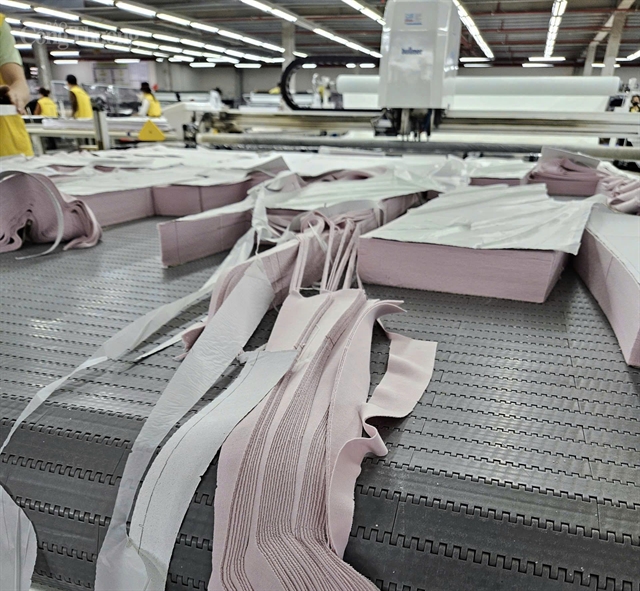 |
| The country is now home to around 7,000 textile and garment enterprises, generating significant waste volumes. — Photo congthuong.vn |
HÀ NỘI — Scrap fabric from garment factories and discarded clothing are increasingly being collected and recycled into new fashion products, as Việt Nam’s textile waste stream - estimated at over two million tonnes a year- emerges as a potential raw material base for an industry heavily reliant on imports.
The country is now home to around 7,000 textile and garment enterprises, generating significant waste volumes. A 2025 survey by Deutsche Gesellschaft für Internationale Zusammenarbeit (GIZ) GmbH revealed that foreign-invested firms alone produce about 250,000 tonnes of fabric scraps annually during cutting and sewing, excluding domestic producers.
Roughly 60 per cent of this waste is downcycled into low-value products such as cleaning cloths, gloves, stuffing materials and upholstery, while about 40 per cent is sent to landfills or incinerated for energy recovery, the report said.
Industry experts say peer recycling - from yarn to yarn and textile to textile - accounts for only about 12-18 per cent in Việt Nam.
Meanwhile, higher-value recycling, or upcycling, remains limited, with only a small number of firms converting textile waste into handbags and other premium products.
Out of 200 textile waste treatment facilities, only 17 are recycling plants, mostly handling polyester, cotton and polycotton blends. However, the network remains fragmented and lacks transparency, making waste traceability and quality assessment difficult.
Việt Nam could risk importing waste to meet European Union sustainability requirements unless it strengthens domestic recycling capacity and reduces dependence on imported raw materials, according to Cao Quốc Khánh, chief operating officer of Corèle, a lingerie, swimwear and sportswear brand under the French B’Lao-Scavi-Corèle Group.
Recycling projects expand
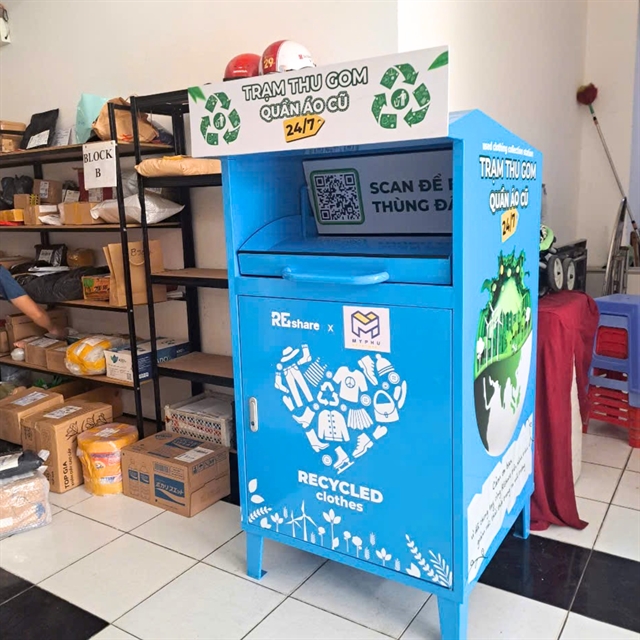 |
| A REshare collection station. — Photo courtesy of the company |
In August 2024, Spanish recycling group Recover opened a subsidiary at Nhơn Trạch II Industrial Park in Đồng Nai Province. RVN Fibers has registered capital of about $20 million and annual capacity to recycle 10,000 tonnes of cotton fibre from textile scraps.
Swedish textile recycling company Syre is also accelerating plans to develop a global network of recycling plants, with its first large-scale factory expected to break ground in Gia Lai Province in 2027.
The $1 billion project will recycle polyester textile waste into high-quality PET pellets used as raw materials for spinning and garment production.
Among domestic firms, REshare is one of the few companies operating across the full textile recycling chain.
According to founder and chief executive Nguyễn Trung Nghĩa, Việt Nam generates substantial volumes of fashion waste, with around 30-40 per cent of collected used clothing proving unsuitable for reuse or recycling after sorting.
Founded in 2022, REshare works with Corèle to organise used clothing and school uniform collection drives. The company operates more than 40 collection points nationwide, some receiving more than one tonne of used clothing daily, saigontimes.vn.
Collection stations are located at stores operated by Decathlon, Biti's and Corèle, as well as at apartment complexes and office buildings.
Collected items are sorted for low-cost resale, while non-reusable materials are processed into carpets, gloves and stuffing materials or sent for energy recovery at cement and steel plants through regional recycling partners. — VNS
Economy
Economy
 Economy
 Economy
 Economy
 Economy
 Economy
 Economy
.jpg) Economy
Economy
 Economy
 Economy
.jpg) Economy
Economy
 Economy
 Economy
 Economy