 Economy


Deputy PM asks for highest education quality, safety for students
1.
.jpg)
|
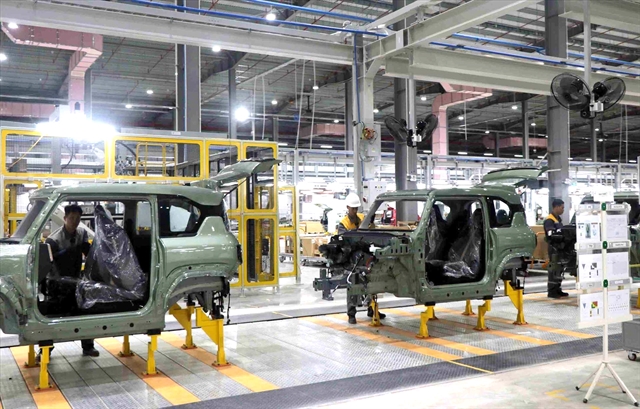
| Shipbuilding at Bạch Đằng Shipbuilding Industry Company Limited in Hải Phòng City. — VNA/VNS Photo |
HÀ NỘI — Việt Nam is positioning shipbuilding as a strategic pillar of its marine economy, with experts saying the industry could become a powerful new engine for economic growth, logistics and national security amid rising global competition and supply chain pressures.
Speaking at a seminar on Việt Nam’s marine economy and shipbuilding on Monday, Nguyễn Tiến Đạt, deputy general director of the Shipbuilding Industry Corporation (SBIC), said a recent Party Conclusion No.18-KL/TW had reaffirmed shipbuilding as a key national industry, reflecting a shift in development thinking, with shipbuilding no longer viewed solely as a specialised manufacturing sector.
“If shipbuilding was once viewed mainly from the perspective of industrial production, it is now being integrated into the country’s overall development strategy as the backbone of the marine industry,” Đạt said.
“A strong shipbuilding industry helps enhance maritime sovereignty protection, strengthens the country’s shipping autonomy, reduces dependence on foreign markets, lowers logistics costs and plays an important role in the green economy and global energy transition.”
According to Đạt, Việt Nam’s shipbuilding industry currently stands at the intersection of three strategic pillars: economy, logistics and national security. With appropriate support policies, the sector could emerge as a new industrial growth engine contributing directly to the country’s goal of achieving double-digit economic growth in the coming years.
Despite its potential, the industry has faced persistent challenges over the past decade, including limited financial capacity, fragmented production, weak supporting industries and low localisation rates.
Many domestic shipyards have yet to establish large-scale supply chains, while international competitiveness remains modest.
Phạm Ngọc Linh, vice president of the Vietnam Union of Science and Technology Associations (VUSTA), said although the industry has undergone strong restructuring efforts, it still faces major obstacles in accessing capital, mastering advanced technologies and attracting high-quality human resources needed for green and smart shipbuilding.
He added that the competitiveness of Việt Nam’s shipping fleet remained limited, while the country’s maritime transport market continued to rely heavily on foreign shipping lines.
However, after nearly three decades of difficulties and restructuring, Việt Nam’s shipbuilding industry has gradually regained momentum.
Đạt noted that domestic enterprises are now capable of building high-technology and environmentally friendly vessels, while also mastering the construction of modern military ships.
These achievements have helped place Việt Nam among the world’s top 10 shipbuilding nations in terms of capacity despite ongoing financial and technological constraints.
“Shipbuilding is no longer simply a manufacturing sector. In today’s context of geopolitical competition and global instability, it has become an instrument of national power,” Đạt said.
He stressed that the industry could also help Việt Nam gain greater control over logistics supply chains, sustainably reduce logistics costs and contribute more significantly to GDP growth through manufacturing and export activities if adequate support mechanisms are introduced.
Representatives from the Vietnam Maritime and Inland Waterways Administration said the Ministry of Construction had submitted a proposal to the Government aimed at enhancing the capacity of domestic shipbuilding enterprises.
The proposal includes a range of financial, tax and planning policies designed to support the development of the shipbuilding industry.
At the same time, revisions to the Maritime Code and Inland Waterways Law are expected to introduce additional incentives related to taxes, fees and investment, while encouraging greater domestic and foreign participation in shipbuilding development and prioritising locally made shipbuilding products. — VNS
Economy
 Economy
 Economy
 Economy
 Economy
 Economy
 Economy
 Economy
 Economy
 Economy
 Economy
 Economy
.jpg) Economy
Economy
 Economy
 Economy