 Economy


Việt Nam seeks to remove barriers to intellectual property valuation, research commercialisation
1.
|
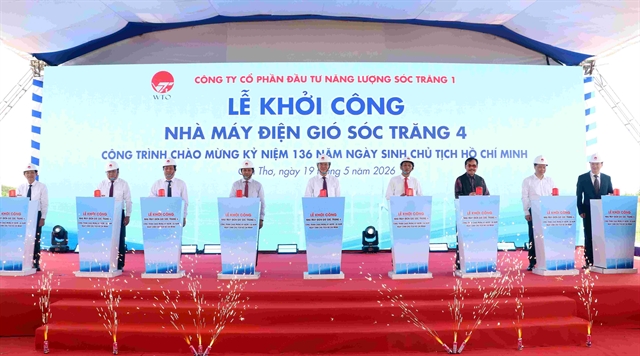
| Groundbreaking ceremony of the Sóc Trăng Wind Power Plant No4 project. —VNA/VNS Photo |
CẦN THƠ — Cần Thơ City has launched a series of major wind power projects worth nearly VNĐ24 trillion (US$940 million), marking a major step in the Mekong Delta’s push towards renewable energy and green economic growth.
The projects, launched on May 19, have a combined capacity of 550MW and are expected to contribute significant volumes of clean electricity to the national grid while creating new momentum for the local economy.
The first project cluster includes the Phú Cường 1A and 1B Wind Power Plants, located in the Lai Hòa, Khánh Hòa and Vĩnh Phước areas of Cần Thơ City. The projects have a combined capacity of 200MW with an estimated investment of around VNĐ9.1 trillion.
Construction is scheduled for completion in 2027, with contributions to the city budget expected to begin in 2028.
A representative of REE Corporation said that once commercial operations begin, the Phú Cường 1A and 1B projects would contribute approximately VNĐ200 billion annually to Cần Thơ City’s budget.
The second project launched is Sóc Trăng Wind Power Plant No. 4, with a capacity of 350MW. The project requires an investment of roughly VNĐ14.5 trillion and is being developed by Sóc Trăng 1 Energy Investment JSC.
The simultaneous rollout of the large-scale projects highlights the southwestern coastal region as an increasingly attractive destination for green investment capital.
Speaking at the groundbreaking ceremony, Chairman of the Cần Thơ City People’s Committee Trương Cảnh Tuyên urged investors and contractors to mobilise resources to ensure construction progress, technical quality and operational safety.
City leaders also instructed relevant departments and agencies to coordinate closely in resolving issues arising during implementation.
While wind power development in previous years was concentrated mainly along Việt Nam’s South Central Coast, the southwestern coastal corridor is now gaining prominence thanks to stable wind conditions, flat terrain and abundant land resources.
Areas such as Lai Hòa and Vĩnh Hải are gradually transforming into vast wind turbine fields, reshaping the region’s energy infrastructure landscape.
Notably, wind power projects in the Mekong Delta are evolving beyond their role as energy infrastructure. In localities such as the Vĩnh Châu area, turbine fields have also become tourist attractions promoting experiential tourism.
The integration of green economic development with sustainable livelihoods and the preservation of local cultural identity is emerging as a new strategic direction for regional authorities.
Cần Thơ City is Việt Nam’s fourth-largest city, covering an area of 6,360sq.km with a population of approximately 4.2 million people.
Strong investment in renewable energy is viewed as a strategic move to reinforce the city’s position as a key economic hub of the region. — VNS
Economy
 Economy
 Economy
 Economy
 Economy
 Economy
 Economy
 Economy
 Economy
 Economy
 Economy
.jpg) Economy
Economy
 Economy
 Economy
 Economy