 Politics & Law
Data centre market faces energy challenges
1.
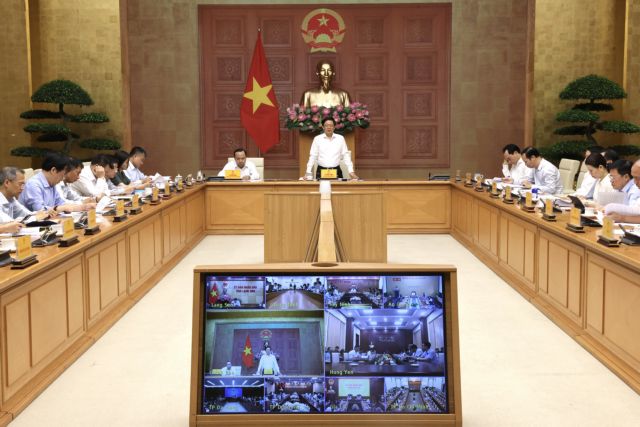 |
| Deputy Prime Minister Hồ Quốc Dũng speaks at the hybrid conference on Tuesday with ministries, sectors and 10 localities on accelerating 2026 public investment disbursement in science, technology, innovation and digital transformation. VNA/VNS Photo |
HÀ NỘI — Deputy Prime Minister Hồ Quốc Dũng has called for urgent measures to remove bottlenecks and accelerate the disbursement of public investment capital for science, technology, innovation and digital transformation projects, describing the task as a key and urgent political priority for 2026.
Speaking at a hybrid conference on Tuesday with ministries, sectors and 10 localities on accelerating 2026 public investment disbursement in science, technology, innovation and digital transformation, Dũng said the current disbursement rate stood at only 14.78 per cent, while the Government’s target is to fully disburse 100 per cent of allocated capital this year.
At the meeting, Minister of Science and Technology Vũ Hải Quân reported that VNĐ8.42 trillion (US$.319.4 million) in funding for science, technology, innovation and digital transformation had been carried over from the 2025 supplementary budget into 2026.
Total funding allocated for 2026 amounts to VNĐ103.44 trillion ($3.92 billion).
The Ministry of Science and Technology has issued guidance documents to ministries, sectors and localities for implementing approximately VNĐ51.86 trillion($1.96 billion) worth of projects this year, including VNĐ27.74 trillion from the central budget and VNĐ24.12 trillion from local budgets.
The remaining unallocated funding totals VNĐ20.35 trillion ($772.1 million).
So far, the ministry, in coordination with the Ministry of Finance, has allocated VNĐ998.3 billion ($37.8 million) to ministries, sectors and localities with eligible applications for 22 out of 46 registered digital platforms and administrative procedure information systems.
An additional VNĐ2.47 billion has been allocated to 35 out of 52 registered databases.
As of May 12, total disbursed capital had reached VNĐ7.94 trillion ($301.2 million), equivalent to 14.78 per cent of the plan assigned by the Prime Minister.
To further improve the institutional framework, the ministry proposed revisions to several legal documents and decrees, while also suggesting that the Government issue special resolutions where necessary to address obstacles faced by ministries, sectors and localities.
At the conference, representatives from ministries and local authorities openly pointed out the difficulties behind the slow disbursement rate.
According to local officials, one of the biggest obstacles is the lack of economic-technical norms and pricing frameworks for emerging technology products and services such as artificial intelligence, big data, digital twins and data warehouses.
Some current procurement regulations, including requirements for at least three price quotations, are considered impractical for specialised technology products or newly developed research solutions.
Localities also reported confusion regarding the operation of science and technology development funds due to overlapping and inconsistent legal regulations.
Representatives from the Ministry of Finance noted that although sufficient capital had been allocated, disbursement rates at many ministries and central agencies remained at zero per cent.
The ministry said the current Law on Public Investment had already decentralised considerable authority to ministries and sectors to make project decisions, meaning that most bottlenecks now stemmed from implementation and specialised legal regulations.
The Ministry of Finance pledged to coordinate closely with the Ministry of Science and Technology to resolve regulatory difficulties.
Participants also pointed out that public investment procedures remain too slow compared to the pace of technological development, with many devices and software systems becoming outdated by the time procurement procedures are completed.
In addition, payment ceilings for technology consultants are currently far below market levels, making it difficult to attract high-quality experts for AI and big data projects.
To accelerate implementation, participants proposed that the Government and ministries quickly issue detailed guidance on technical norms and evaluation tools for technology projects.
They also suggested further decentralisation, allowing local authorities to take responsibility for projects that comply with Việt Nam’s Digital Government Architecture Framework.
Other proposals included prioritising shared digital platforms and introducing ‘lease-to-own’ mechanisms for digital assets to avoid fragmented and wasteful investment.
Concluding the meeting, Deputy PM Dũng stressed that public investment disbursement progress this year remained very slow.
He instructed ministries, sectors and localities to seriously review their responsibilities, identify the causes of delays and directly supervise project implementation.
Authorities were also asked to comprehensively review all science, technology, innovation and digital transformation projects, classify those ready for immediate implementation and focus resources on priority tasks.
Projects facing legal or procedural difficulties beyond local authority should be promptly reported to the Government and Prime Minister for resolution, he said.
He also called for prioritising resources for national databases, AI development, strategic technology products, innovation centres and start-up ecosystems, ensuring that projects produce measurable and concrete outcomes.
The Ministry of Science and Technology, Ministry of Finance and Ministry of Justice were instructed to fundamentally resolve policy and regulatory bottlenecks by June 2026, particularly those related to procurement, investment and financial regulations.
The ministries were also tasked with improving the legal framework, revising problematic decrees and circulars, and preventing prolonged delays so that disbursement progress can significantly improve in the second half of the year.
Highlighting two key priorities moving forward, Dũng called for upgrading and investing in national laboratory systems to strengthen scientific research capacity, while concentrating resources on strategic technology tasks and products capable of delivering clear and practical results within 2026.
He also encouraged local authorities to make effective use of surplus government office buildings by converting them into innovation centres and start-up support spaces that can foster research, collaboration and the application of science and technology.VNS
Politics & Law
 Politics & Law
 Politics & Law
 Politics & Law
 Politics & Law
 Politics & Law
 Politics & Law
 Politics & Law
 Politics & Law
 Politics & Law
 Politics & Law
 Politics & Law
 Politics & Law
 Politics & Law
 Politics & Law