 Society

Sơn La holds second coffee festival, targeting stronger businesses in future
1.
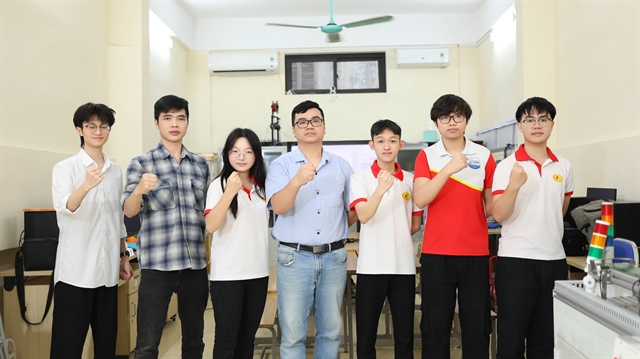 |
| Dr Ngô Quang Vĩ (centre) and the student team behind the Parkinson’s disease diagnosis system. VNS Photo Hoa Lan |
By Lê Hương
Amid the growing use of artificial intelligence (AI) in everyday life, innovations emerging from university classrooms are increasingly demonstrating tangible real-world impact, with student-led projects in Việt Nam beginning to contribute directly to healthcare solutions.
At Thủy Lợi University (Water Resources University), two notable initiatives — a system for early Parkinson’s disease diagnosis and a robotic rehabilitation glove — demonstrate not only students’ research capabilities but also how image processing and AI algorithms can be applied to improve community healthcare quality.
Both projects were developed by separate student teams under the guidance of Ngô Quang Vĩ, PhD, a lecturer from the Faculty of Electrical Engineering. While each takes a different technical approach, they share a common goal: bringing practical technology closer to people and supporting more accessible healthcare services.
Diagnosing through data
Recognising that many Parkinson’s patients are not diagnosed at an early stage due to high diagnostic costs, a student team developed a support system based on image processing and signal analysis to improve accessibility.
The team of four students from the Faculty of Electrical and Electronics Engineering worked under the supervision of lecturer Vĩ and Nguyễn Đức Minh, MA. They initiated the project after identifying the challenges patients face in accessing affordable early diagnosis.
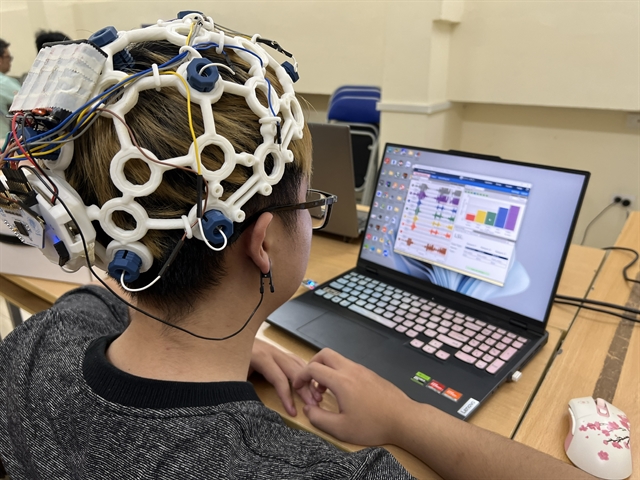 |
| A student wears a brainwave testing device. VNS Photo Hoa Lan |
The system uses a standard camera to capture hand movements, identifying 21 key points corresponding to joints and fingertips to reconstruct motion in three-dimensional space, from which the algorithm tracks tremors over about 20 seconds.
“We wanted to build a low-cost system that allows users to conduct initial self-checks instead of relying entirely on expensive diagnostic methods,” Nguyễn Thị Quỳnh, the team’s representative, said.
“We based our model on a key characteristic of Parkinson’s patients, tremor frequencies ranging from 4 to 7 Hz, to develop the recognition algorithm,” Quỳnh said.
The signals are processed using a Butterworth filter to remove noise, then analysed using the Fourier transform to determine tremor frequency, allowing differentiation between physiological and pathological tremors.
The system also integrates brainwave analysis.
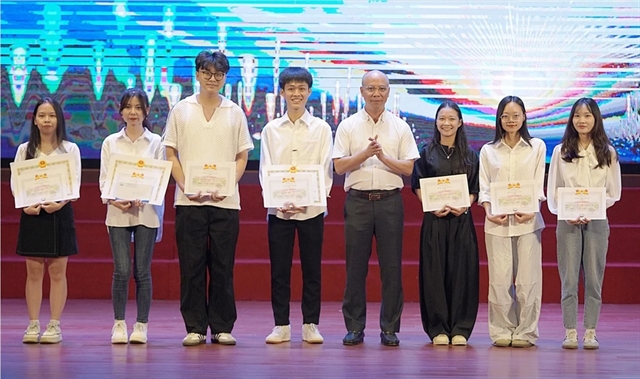 |
| Assoc Prof Dr Nguyễn Hữu Huế, secretary of the Communist Party Committee and chairman of the Thuỷ Lợi University Council (fourth right), presents awards to students for ministerial-level research in the 2023–24 academic year. VNS Photo Bảo Thắng |
“In addition to visual signals, we analyse brainwaves to detect abnormalities in the gamma range, thereby improving diagnostic reliability,” Quỳnh said.
"The entire process is designed with a user-friendly online interface. Users can perform self-checks at home and connect with medical facilities when necessary.”
With its strong practical potential, the project was selected as one of 11 outstanding research topics presented at the university level for the 2024–2025 academic year, reflecting a growing trend of student research closely aligned with societal needs.
Associate Professor Dr Hồ Sỹ Tâm, head of the Department of Science, Technology and International Cooperation, said: “We don’t just want students to create laboratory models. What matters is that these projects can evolve into startups or community solutions, as the Parkinson’s diagnosis system is already showing strong potential.”
Rehabilitation innovation
While the Parkinson’s project focuses on early detection, another student team pursued treatment support with their robotic rehabilitation glove, Hand of Hope.
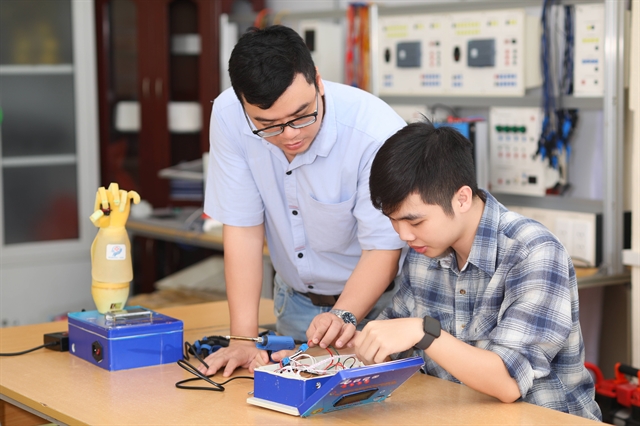 |
| Lecturer Vĩ and student Dương Văn Vũ work on the robot glove. VNS Photo Song Toàn |
The idea stemmed from lecturer Vĩ’s personal experience.
“A relative of mine was paralysed after a stroke… I realised how difficult rehabilitation was, and that inspired the idea of creating a support device,” Vĩ said.
The team subsequently developed a device that allows patients to carry out rehabilitation exercises at home. The robotic glove uses image processing and AI to learn human movements.
“The glove operates based on image processing and AI algorithms… it can mirror movements from the unaffected hand to train the paralysed one or support remote therapy under a doctor’s supervision,” Vĩ said.
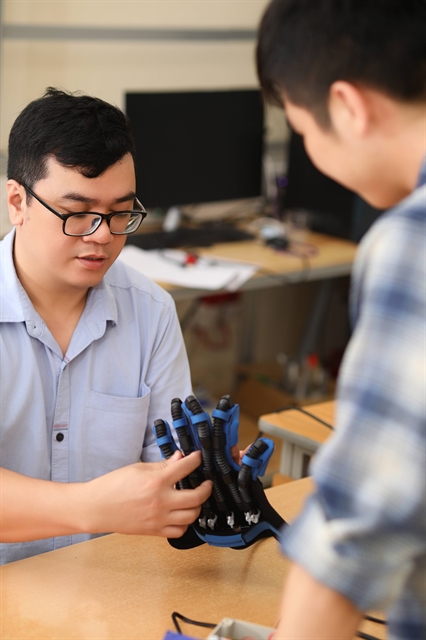 |
| The glove operates using image processing and AI algorithms. VNS Photo Song Toàn |
According to Phạm Đức Đại, vice dean of the Faculty of Electronics and Computer Science, the product’s key strength lies in its AI-driven therapeutic application.
“The device can collect user data during operation, allowing doctors to design personalised treatment plans tailored to each patient,” Đại said.
He also emphasised its suitability for domestic users:
“We use data from Vietnamese users to create a product that better matches local physical characteristics and movement patterns,” he added.
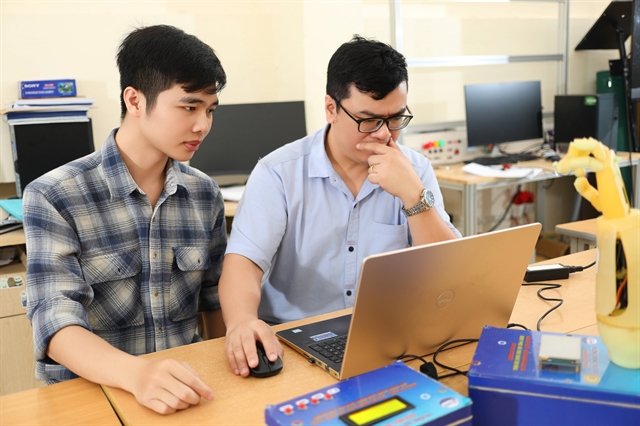 |
| The robotic glove integrates image processing and AI to “learn” human movement. VNS Photo Song Toàn |
From lab to impact
Beyond research, the robotic glove project has been developed with a startup orientation and has achieved notable success. It won First Prize at the 6th Students with Startup Ideas – SV-STARTUP competition, organised by the Ministry of Education and Training in May 2024.
Dương Văn Vũ, the team leader, said: “Our goal is to help patients rehabilitate at home while staying connected with doctors to build appropriate treatment plans.”
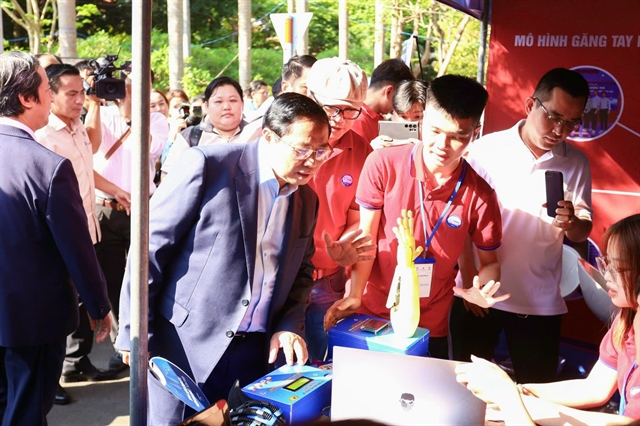 |
| Prime Minister Phạm Minh Chính visits the team’s booth at the 2024 National Startup Day for Students at Cần Thơ University. VNS Photo Song Toàn |
Nguyễn Thị Phương Thanh, in charge of finance and marketing, added: “Through this project, I learned teamwork and time management skills… The biggest challenge was funding, but we leveraged competitions to seek investors.”
She also outlined the team’s future direction. “We aim to expand and develop rehabilitation devices for other body parts, such as legs or half-body support,” she said.
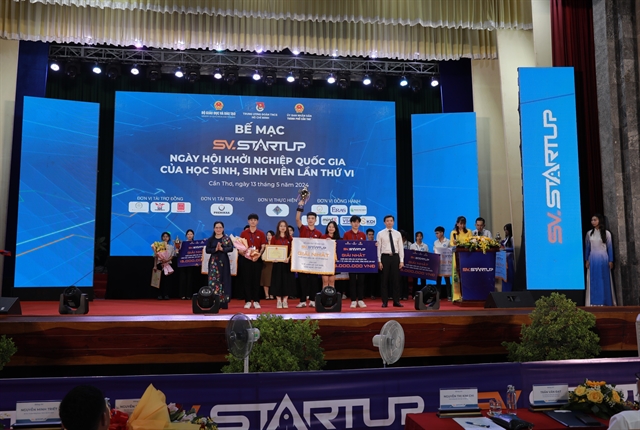 |
| The student team won First Prize at the SV-STARTUP 2024 finals. Photo Song Toàn |
Two initiatives, two different approaches: one focused on early diagnosis, the other on rehabilitation support. Yet both are built on the same technological foundation: image processing and AI. From tiny data points, these student teams are developing solutions with real healthcare impact.
More importantly, the projects reflect a clear shift in higher education: research is no longer confined to theory but is increasingly directed towards addressing real societal needs.
Along this journey, young innovators from Thủy Lợi University are demonstrating that when technology is applied thoughtfully, it can become a powerful tool for human care, beginning with the smallest details: a hand movement or a subtle tremor that might otherwise go unnoticed.
The two research directions are now being further developed with a focus on depth and practical applicability.
For the robotic glove, the team is expanding its functionality to support grasping in patients with impaired hand mobility in the early stages, integrating this with existing rehabilitation features to create a unified system that both assists movement and promotes neuromuscular regeneration.
For Parkinson’s diagnosis, the team is collaborating with Phương Đông Hospital to build a standardised clinical dataset, which serves as a foundation for training and optimising AI models, thereby improving diagnostic accuracy and reliability. — VNS
Society
 Society
 Society
 Society
 Society
 Society
 Society
 Society
 Society
 Society
 Society
 Society
 Society
 Society
 Society