 Society
HCM City tops national Chinese chess championship in Bắc Ninh
1.
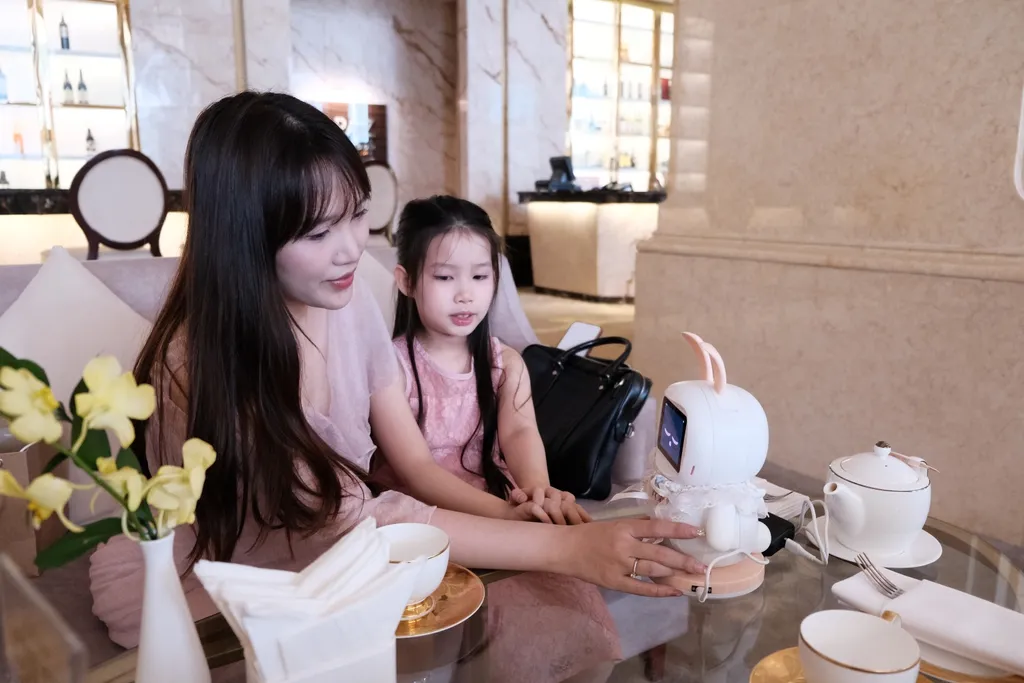 |
| Nguyễn Thanh Huyền, Mochi’s mother, is the founder of the rabbit-shaped robot. Photo courtesy of Nguyễn Thanh Huyền |
By Khánh Linh
HÀ NỘI — As Việt Nam accelerates its push for science, technology and innovation, the impact of that shift is no longer confined to labs or start-ups, but is beginning to take shape inside ordinary homes.
In one apartment in Hà Nội, there's a child, a mother and a small rabbit-shaped robot.
On a quiet afternoon, a young girl named Mochi sits at her desk, speaking English to a soft-voiced companion perched in front of her.
“Hello Gigi, how are you today?” she asks.
The robot replies, gently: “I’m Gigi, an AI robot made from a mother’s love. I’ll grow up with you, in a world full of wonders.”
It is an unusual scene, not because of the technology, but because of where it came from. Gigi was not built in a lab, nor designed by a company. It was created by Mochi’s mother.
From a simple need
Nguyễn Thanh Huyền, 34, did not follow a conventional path into technology. Trained in mathematics and informatics and later educated at the National Economics University, she now works in AI applications for education and digital content.
But Gigi did not begin as a professional project.
It began as a question many parents quietly ask: how to help a child learn more naturally.
In February 2025, Huyền set out to build a speaking companion for her daughter, a tool that could support one-on-one English practice.
“I didn’t start with a business plan,” she said. “It was just a very ordinary day when I thought: maybe I can make a robot as a gift for my daughter.”
What followed was anything but simple.
She taught herself to code, selected electronic components, designed the casing and had parts 3D-printed. She even bought a soldering machine, but burned her first circuit board trying to use it.
“I thought I could just watch YouTube and do it,” she said. “But it didn’t work like that.”
After six to seven months of trial and error, Gigi was completed. The first version cost around VNĐ6 million (US$227), a significant investment for something initially meant for just one child.
“If I looked at it as a business decision, spending that much time would have been a mistake,” she said.
“But emotionally, it gave me something I will never regret.”
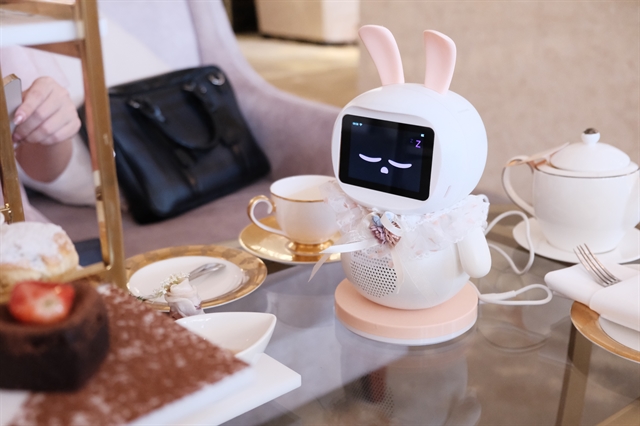 |
| Gigi, the rabbit-shaped robot, is designed as an AI companion for children to help them learn English. Photo courtesy of Nguyễn Thanh Huyền |
More than a robot
Gigi is not positioned as a conventional learning device. Huyền describes it as “an AI companion for children, designed to help them learn English through conversation, interaction and emotion, rather than through screens alone.”
“Gigi doesn’t just provide knowledge,” she said.
“It listens, responds, plays with the child and encourages them to use language in natural situations.”
Rather than replacing parents or teachers, Gigi is designed to support them, introducing language learning in short, structured interactions.
Each session lasts just five to 10 minutes, what Huyền describes as a 'golden window' of attention for children.
“It’s not about watching,” she said. “It’s about responding.”
More importantly, the design begins not with performance, but with how children feel.
“For young children, if there is no sense of safety and emotional connection, learning is very hard to sustain,” she said.
“So my priority is to create an experience that feels safe first and then warm enough for them to want to come back.”
As AI tools become more accessible, concerns about children’s exposure to technology are growing, from misinformation to overuse.
For Huyền, safety is not an afterthought but the foundation.
Gigi operates within what she describes as a 'closed garden', with multiple layers of content filtering to ensure responses remain appropriate for children.
The robot also avoids a common hardware risk: it does not contain an internal battery, instead running on a 5V power source to reduce concerns over overheating or damage.
As both a developer and a mother, Huyền said she understands these concerns deeply.
For her, the issue is not whether children should interact with AI, but how that interaction is designed.
“AI must support a child’s development, not replace the role of parents or teachers,” she said.
“AI for children must be designed with a real understanding of children. It needs appropriate interactions, emotional elements and respect for their natural pace of development.”
More than one child’s story
For months, Gigi remained a personal project until messages began to arrive.
“Can my child have one too?” one parent asked.
“My child loves English but has no one to speak with,” another wrote.
Those messages marked a turning point.
“I realised what I was struggling with as a mother was not just my own story,” Huyền said.
A major milestone came when Gigi was featured on national television, drawing widespread attention.
“That was when I truly felt this was no longer just a home experiment,” she said. “It had become something people were expecting and placing trust in.”
The transition, however, brought new challenges.
“The hardest part was stepping out of my own perspective as a mother,” she said. “Every child is different, and every family has different expectations.
“Making something for your own child is already difficult. But making something for many families carries a much greater responsibility.”
What began as a solo project has since grown into a small team of engineers, educators and designers.
“It still carries a very ‘family’ spirit,” she said. “But to become a real product, it needs a team with shared expertise and belief.”
Nguyễn Vân Anh, a mother of a seven-year-old girl in Hà Nội, said her daughter was immediately excited when first speaking with Gigi, having long looked forward to a companion like her.
After a period of use, she said improvements were gradual but noticeable.
“I wouldn’t say there was a dramatic change,” she said, “but my child has been exposed to more topics, and her listening and speaking reflexes have become more natural.”
She also acknowledged concerns about children using AI, but noted that Gigi’s design helped address some of them.
“Gigi will end the session when it feels it’s enough,” she said.
“If my child shifts topics, Gigi can still respond appropriately without going too far off track.
“In that sense, the child can still lead the conversation, and Gigi follows in a way that suits them.”
Still, she noted that not every feature worked equally well.
“The storytelling feature hasn’t been my child’s favourite so far,” she added.
A small story within a larger shift
Huyền and her team are continuing to refine Gigi, aiming to improve quality while reducing the price to around VNĐ2.8 million ($106). Feedback from a growing community of parents is also shaping its development.
Her journey reflects a broader transformation in Việt Nam’s technology landscape.
“I think it shows that technology is becoming closer to everyday life,” she said.
“Before, AI felt distant, something only large companies or labs could do. Now, even a mother with a very ordinary problem can start learning, experimenting and building something real.”
“It’s a positive sign that innovation doesn’t only come from big models. It can start from very small, very real needs.”
Gigi is still evolving, with new versions under development and ongoing feedback from users.
But for Huyền, its meaning is already clear.
“I want her to remember Gigi as part of her childhood,” she said, “not just as a tool, but as a small companion who once talked, played and grew up with her.” — VNS
Society
 Society
 Society
 Society
 Society
 Society
 Society
 Society
 Society
 Society
 Society
 Society
 Society
 Society
 Society