 Society

European higher education week opens new opportunities
1.
|
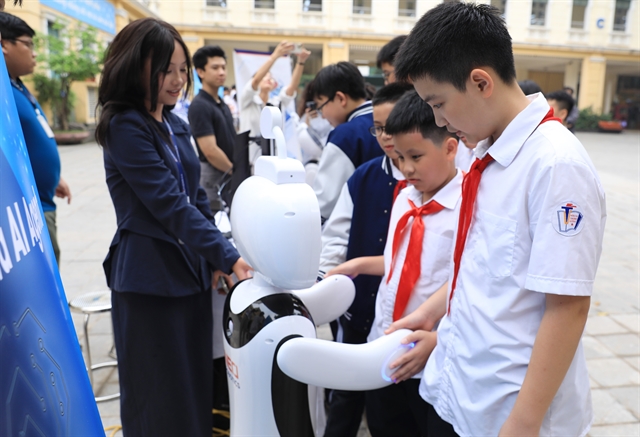
| Students of the Trưng Vương Junior Secondary School in Cửa Nam Ward, Hà Nội, experience robots as part of a pilot programme applying artificial intelligence in teaching. — VNA/VNS Photo Nguyễn Cúc |
HÀ NỘI — Artificial intelligence (AI) is rapidly moving from the margins to the mainstream of education in Việt Nam, reshaping how schools are run, how students learn and how research is conducted as the country pushes ahead with digital transformation.
In the context of rapid digital transformation, the rise of AI is creating a new turning point for education.
Beyond a support tool, AI is driving comprehensive restructuring across administration, teaching, and research, building a more flexible, adaptive educational ecosystem for the digital age, in line with Resolution 71-NQ-TW on breakthroughs in education and training development.
Nguyễn Sơn Hải, deputy head of the Department of Science, Technology and Information under the Ministry of Education and Training of Vietnam, said digital transformation in education in recent years had delivered positive results, including the deployment of nationwide systems such as the education sector database, online registration for high school graduation exams and university admissions.
He said that while earlier digital transformation focused on digitising educational activities, AI marks a shift towards the comprehensive restructuring of teaching and educational administration.
For school management, developing unified education management platforms alongside building databases will enable institutions to move from manual, fragmented systems to data-driven and more intelligent governance.
This, in turn, will support faster, more accurate and more effective decision-making.
However, alongside these opportunities, the application of AI in education also raises challenges in management and academic integrity.
Hải said the ministry’s approach was neither to impose extreme restrictions nor to be lax, but to establish an appropriate legal framework so that AI can be applied effectively, safely and under control.
At present, the ministry is implementing a plan to execute the Artificial Intelligence Law in the field of education, while also developing a broader strategy for AI application in education and training.
To ensure digital technology becomes an equalising tool for all learners, coordinated action is required from the State, schools, families and society as a whole.
Hải highlighted three key groups of tasks: developing digital skills and AI competencies for learners, building shared digital platforms and data, and improving infrastructure and access conditions.
The ministry has issued Circular 02/2025/TT-BGDĐT, which integrates AI-related competencies. At the same time, an AI education programme for junior secondary school pupils is being piloted and is expected to be officially introduced in the 2026–2027 academic year.
Local authorities and educational institutions are continuing to invest in IT infrastructure and learning equipment, while implementing policies to improve access to the internet and digital devices, particularly in disadvantaged areas, helping ensure equal access to digital education.
Innovative educational ecosystem
Associate Professor Nguyễn Phong Điền, deputy director of Hà Nội University of Science and Technology, said AI is driving a fundamental shift in higher education globally.
The university sees AI not only as a field of study and research but also as a strategic driver of comprehensive innovation across training programmes, teaching and learning methods, research activities and management models.
Điền said that in the AI era, universities must rethink how they fulfil their core mission in a more profound, substantive and responsible way.
The institution has set out five key orientations for the period ahead: innovating training programmes, updating teaching and learning methods, reforming assessment approaches, building a digital university ecosystem and innovation environment, and developing human resources while upholding core educational values.
Addressing shifts in research and training to adapt to the digital age, Associate Professor Đỗ Thị Thúy Phương, deputy rector of the University of Economics and Business Administration under Thai Nguyen University, said the university has in recent years changed its research mindset and approach.
Moving away from a model focused primarily on academic output, it is now prioritising research that addresses practical development challenges faced by localities and businesses.
Research projects are expected not only to support publication but also to identify clear beneficiaries, application pathways and potential to be developed into models, policies or management solutions. Priority areas include digital transformation in businesses, value chain development, the circular economy and sustainable development.
To achieve meaningful breakthroughs, people are seen as the central factor.
One key solution, Phương said, is to develop research human resources at an early stage. Students are encouraged to engage in scientific research from their second or third year, with access to funding support and opportunities to participate in competitions in science, innovation and entrepreneurship.
Research activities are increasingly linked to business practice, helping to build a creative academic ecosystem in which both lecturers and students act as drivers of knowledge creation and innovation.
New technologies and AI are steadily shaping a more intelligent and personalised education system aligned with societal needs. The combination of policy direction and institutional innovation is expected to play a decisive role in building a modern, effective and equitable education system. — VNS
Society
Society
 Society
 Society
 Society
 Society
 Society
 Society
 Society
 Society
 Society
 Society
 Society
 Society
 Society