 Society

ECO Expo Asia opens at Hong Kong AsiaWorld-Expo in late October
1.
|
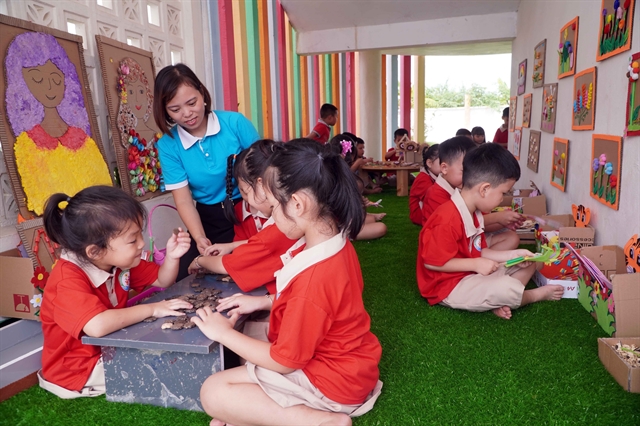
| A teacher and children at Trần Cao Kindergarten in Quang Hưng Commune, Hưng Yên Province, take part in experiential learning activities. VNA/VNS Photo Nguyễn Công Hải |
HÀ NỘI — Improving access to quality childcare is vital to sustaining women’s participation in Việt Nam’s industrial workforce, experts said at a workshop on Wednesday.
The event, organised by the Việt Nam National Institute of Educational Sciences, the Ministry of Education and Training’s Early Childhood Education Department, and the World Bank, brought together policymakers, researchers and development partners to discuss how strengthening early childhood care systems can support economic growth and social development.
Speaking at the workshop, Professor Dr Lê Anh Vinh, Director General of the institute, stressed that early childhood education should be seen not only as an education issue but also as one of care, nurturing and protection.
“This is a foundational stage that has a decisive impact on human development,” he said, noting that early access to quality care influences long-term learning outcomes, lifelong learning capacity and productivity. “Early childhood education must be about early access, early opportunity and early investment, not only within the education sector but as part of the broader socio-economic development strategy.”
|
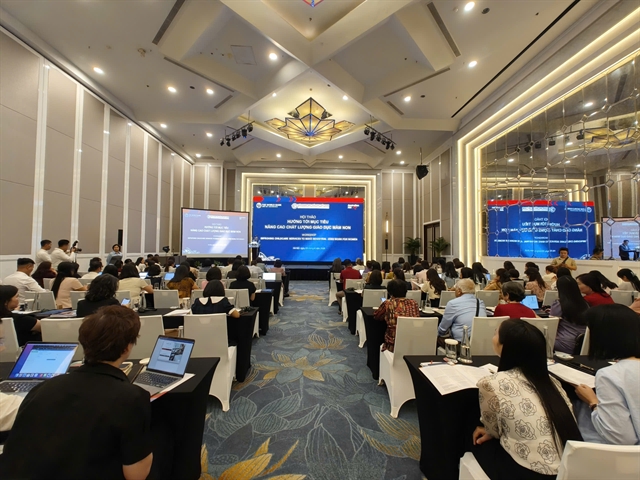
| A view of the workshop held in Hà Nội on Wednesday. VNS Photo Khánh Linh |
Việt Nam has introduced several key policies in recent years, including the national education development strategy to 2030, which aims to expand preschool access for children aged three and above and improve quality in disadvantaged areas and industrial zones.
From 2026, a pilot early childhood education programme featuring seven major reforms will also be rolled out. The programme adopts a competency-based approach aligned with the 2018 General Education Curriculum, with a stronger focus on children’s emotional and social development while granting greater autonomy to localities and reducing pressure on teachers.
However, Vinh acknowledged persistent challenges, particularly in urban areas and industrial parks where population density is high and childcare demand continues to outpace supply.
“This must be seen as a comprehensive issue requiring coordinated efforts from multiple stakeholders to ensure social security and sustainable national development,” he said.
Echoing this view, Cathy McWilliam, First Secretary at the Australian Embassy, said gender equality remains a core priority in Australia’s development cooperation with Việt Nam.
She noted that while women play a central role in industrial and manufacturing sectors, they continue to bear the majority of unpaid care work, limiting their ability to fully participate in paid employment.
“Care is often seen as a private issue. In reality, it is a core economic issue,” she said. “When childcare is unavailable, unaffordable or of poor quality, women leave the workforce, firms lose experienced workers and productivity suffers.”
“When childcare systems function well, women can remain in work, employers retain staff and children benefit.”
McWilliam emphasised that investment in childcare is also an investment in future human capital.
|
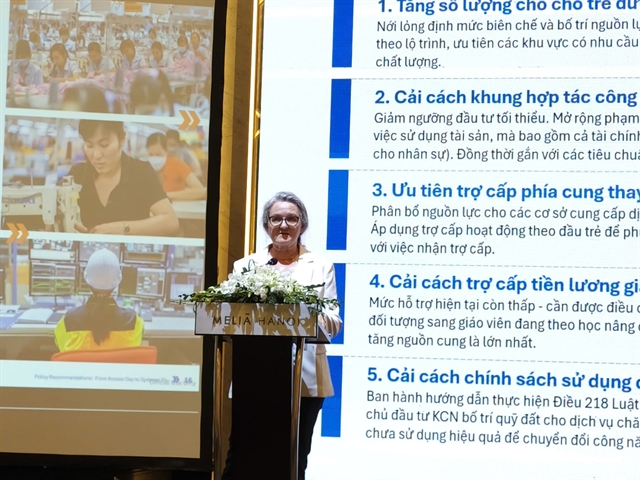
| Helle Buchhave, global gender lead at the World Bank, presented the report Care for Growth – Making Industrial Jobs Work for Women. VNS Photo Khánh Linh |
At the workshop, Helle Buchhave, global gender lead at the World Bank, presented the report Care for Growth – Making Industrial Jobs Work for Women, highlighting the economic importance of childcare.
The report shows that women make up around 58 per cent of the workforce in industrial parks, with approximately 4.8 million female workers, nearly one in five employed women nationwide.
Yet access to childcare remains a major constraint. Only about one-third of children under three are enrolled in formal early childhood care, despite strong demand, while an estimated 560,000 young children come from industrial worker households.
The report finds that after childbirth, women’s likelihood of holding a wage-paying job drops by 8.1 percentage points, and household income per capita declines by 27 per cent. In contrast, access to childcare increases women’s chances of holding paid jobs by 25 percentage points.
Expanding childcare services could generate annual economic benefits of up to US$3.02 billion, far exceeding the estimated cost of $660 million, the report notes.
Despite this, affordability, limited supply, particularly for children under two, and barriers facing migrant workers continue to restrict access.
Looking ahead, the report warns that without reform, Việt Nam could face a decline of 8–12 per cent in female labour force participation by 2045 due to population ageing and rising care responsibilities.
To address these challenges, the World Bank calls for coordinated reforms to expand affordable childcare supply, improve quality standards and better align labour policies with family needs.
“Families are ready, but the system is not,” the report concludes, urging policymakers to turn existing commitments into effective action.
Hoàng Thị Dinh, Deputy Director General of the ministry’s Early Childhood Education Department, said ensuring equitable access and improving quality remain key priorities, especially in industrial zones.
She highlighted a national programme on enhancing early childhood education quality in urban and industrial areas for 2025–2035, with a vision to 2045, focusing on care and education for children aged six to 36 months.
As Việt Nam continues its industrial growth, participants agreed that strengthening childcare systems will be critical to supporting women workers, improving productivity and securing long-term economic sustainability.
Commenting further on the report, McWilliam said care systems must work for both those who receive care and those who provide it.
She noted that recognising childcare as a constraint to women’s workforce participation marks an important step forward, as without accessible and reliable services, both women’s employment and the sustainability of industrial growth are affected.
“It also signals a broader shift toward recognising care as a shared responsibility of the State, employers and society rather than a burden carried primarily by women and families,” she said. — VNS
Society
 Society
 Society
 Society
 Society
 Society
 Society
 Society
 Society
 Society
 Society
 Society
 Society
 Society
 Society