 Society
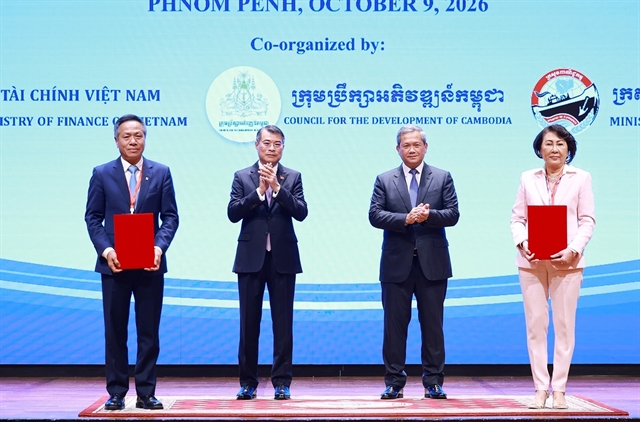
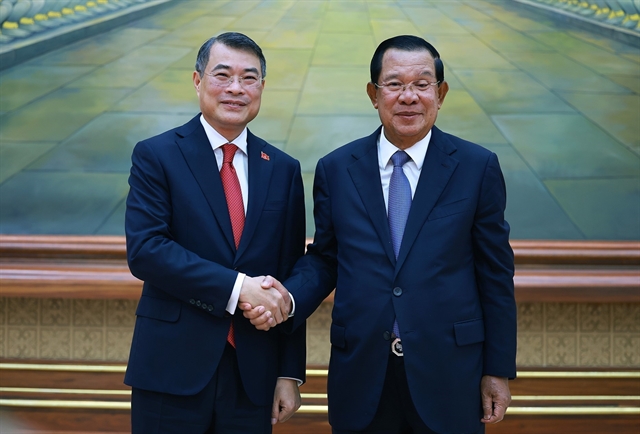
Vietnamese Prime Minister meets Cambodian National Assembly President
1.
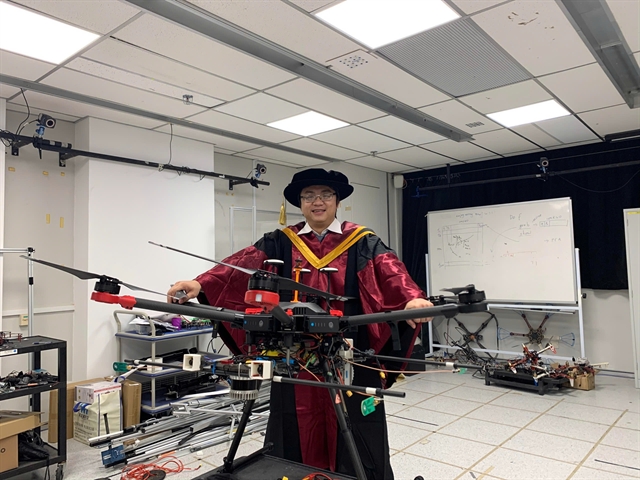 |
| Dr Nguyễn Phạm Nhất Thiên Minh poses with an autonomous survey UAV during the NTU VIRAL project. Photos courtesy of Thiên Minh |
By Chu Lan Hương
HÀ NỘI — During the Easter holiday weekend, as on most weekends, Nguyễn Phạm Nhất Thiên Minh spent his free time researching robot training.
For the 35-year-old, scientific research is a daily pursuit, one that involves constant brainstorming and an unending search for new ideas.
Minh is a lecturer at the Robotics Faculty of the University of Queensland, where he is the youngest among seven faculty members. He was recently honoured as one of the Top 10 Vietnamese Outstanding Young Faces of 2025.
With a gentle smile and bright, determined eyes behind his glasses, the young scientist has built an impressive academic record.
He is the lead author of 11 out of the 23 papers he has published in top-quartile international journals. He has also contributed 12 top-tier (A*) conference papers, five of which he authored as first author.
Among his most notable contributions is his research on multi-modal sensor fusion for robot perception, which has been applied in robotic and autonomous systems. This work is helping to lay a solid foundation for positioning and perception in autonomous vehicles operating in dense and complex urban environments, such as those found in Việt Nam.
These achievements stem from a long-standing commitment to his passion, shaped by clear goals set from an early age.
A journey of scientific research
Born and raised in Cần Thơ City, Minh has spent 17 years studying away from home since he graduated from HCM City University of Technology in 2014.
“Since I was a second-year student in the Faculty of Electrical and Electronics Engineering, majoring in automation and control under the university's Talented Engineer Programme, I nurtured a dream of studying abroad when I graduated,” he said.
“I admired my lecturers in the university who studied abroad, because they possessed a broad vision and a dignified, confident demeanour."
So, unlike other students who looked for jobs after university, Minh spent about one year searching for and applying to international scholarships. In 2015, he received a scholarship for a PhD programme at Singapore’s Nanyang Technological University (NTU).
“I was very fortunate to be accepted as a PhD fellow by Professor Xie Lihua at NTU, a world-leading expert in control systems theory and autonomous systems,” Minh said.
“I still remember the interview, when he asked me a theoretical question I had not thought about for a long time, so I could not answer. At that moment, I thought I had failed—but fortunately, he was just asking for fun.”
After relearning the fundamentals, Minh redeemed himself by earning an A+ in the very course Xie taught.
Even ten years later, he still remembers that story.
“My PhD years at NTU could be considered brilliant, where I was trained intensively and gained valuable knowledge, skills and memorable experiences,” Minh said.
After completing his PhD, Minh received the Wallenberg–NTU Presidential Post-doctoral Fellowship, which allowed him to pursue independent research: one year at NTU and one year at Sweden’s Royal Institute of Technology (KTH).
“At KTH, I joined the Division of Robotics, Perception and Learning led by Professor Patric Jensfelt, who supported me greatly, not only in research but also in shaping my path as a scientist and educator,” he said.
Afterwards, Minh was appointed a research fellow and then research assistant professor at the CARTIN robotics centre from 2023 to 2025.
Four months ago, he officially joined the University of Queensland as a lecturer in robotics, beginning a new journey as both a teacher and research supervisor.
“I found that I was very lucky in my education journey. During my university years away from home, my parents always supported and created the best conditions for me to achieve good results. They trusted and encouraged me to pursue my chosen path,” Minh said.
“My mother – a primary school teacher – encouraged me to learn English at a very young age. I specialised in mathematics, but I was once an excellent English student in secondary school. English is one of the factors that helped me find a scholarship to study abroad,” he noted.
“The second advantage, and perhaps the most valuable, was the colleagues who have shared the same passion throughout my research journey.
“I would not have achieved what I have today without their support. Many of them are now researchers at major universities and institutes worldwide, and we continue to support one another. This is truly my academic family."
Why robotics?
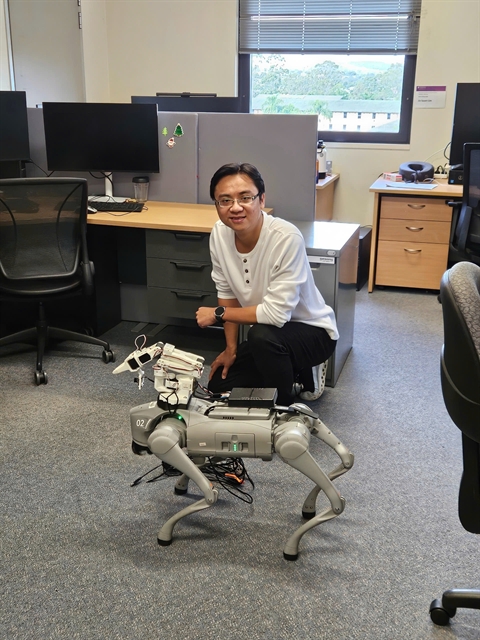 |
| Minh with his robot dog. |
“My passion for robotics began in my final undergraduate year while doing my graduation thesis at university. I chose to design an autonomous robot,” Minh said.
“What seemed like a simple topic actually required building a system from A to Z: from mechanical design and motor selection to power electronics, microcontrollers, communication programming and developing localisation and motion planning algorithms on a robotic operating system."
At the time, Minh lacked experience and chose a rather ambitious topic for an undergraduate student.
Later, when supervising students, he learned to advise them to focus on a specific module.
However, his bold choice gave him a very memorable experience and sparked a long-lasting interest in robotics.
After months of work, the robot was completed and could navigate accurately to positions on a given map.
“I still remember the moment when my robot could automatically turn to avoid a chair not on the map – that was truly special,” he recalled.
During his thesis defence, he also saw other impressive projects, including millimetre-accurate 3D scanning, voice-controlled systems and simultaneous localisation and mapping using cameras.
“These inspired me to pursue deeper research into advanced robotics technologies,” Minh said.
However, becoming a true roboticist takes a longer journey. The field intersects with many disciplines, from mechanical and electrical engineering to computer science, requiring continuous learning.
A key milestone for Minh was joining the Institute of Electrical and Electronics Engineers (IEEE) Robotics and Automation Society in 2018.
“At that time, my research group with Professor Xie began dipping into robotics. I was among the early contributors submitting work to IEEE Robotics and Automation venues. Looking back, I feel that the community and I have grown together," he said.
Many people currently believe that robotics or AI products will steal their jobs, Minh noted, adding that his research aims to create products that do the work people cannot do, so that people will only benefit.
Achievements
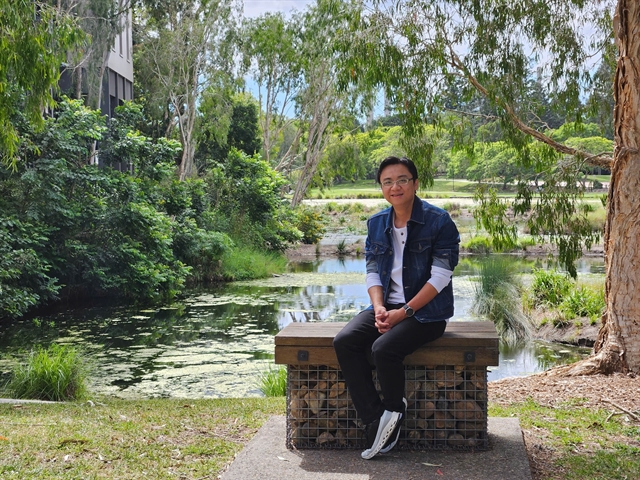 |
| Minh enjoys Australia's green environment. |
The research group led by Professor Xie worked in control theory and systems, but Minh’s PhD cohort marked their expansion into robotics.
“I took pride in being the first in Professor Xie’s group to publish in the IEEE Robotics and Automation Society,” he said.
His work formed a series on adaptive navigation, combining theory and experiments to address multi-agent control problems. This later became his PhD thesis, which received the Doctorate Innovation Award – his most memorable achievement so far, according to Minh.
Minh also received the Wallenberg-NTU Presidential Postdoctoral Fellowship worth over US$233,000 to support two major research directions.
One was a multi-sensor fusion for robust robot operation in dynamic environments. This became foundational for drone inspection systems and led to influential sensor research.
The other is a multi-campus dataset published at the Conference on Computer Vision and Pattern Recognition 2024 – a large dataset for robot perception developed over three years across three countries with 13 authors.
The dataset has been adopted by leading institutions like NTU, KTH, Carnegie Mellon University and the Federal Institute of Technology Zurich.
“This work helped me build expertise in localisation and mapping,” Minh said.
Minh has participated as a speaker at several international seminars in the US, Canada, Germany, Spain, Macau, Sweden and Australia.
He is also currently an associate editor for IEEE Robotics and Automation Letters in this area.
Minh won the Golden Globe Award for Science and Technology and was honoured with a Promising Young Vietnamese Talent title in 2025.
“However, my greatest award is being recognised by society as a researcher,” Minh said.
“Researchers, in my view, are paid to play, 'play' meaning to explore, discover and experience new knowledge,” he added.
“Research is a privilege. I see service as my way of practising science: serving my 'hive' of students, colleagues and environment, while producing 'honey' – research – and spreading 'pollen' – through mentoring, reviewing and academic activities, contributing to the broader research ecosystem and society." — VNS
Society
 Society
 Society
 Society
 Society
 Society
 Society
 Society
 Society
 Society
 Society
 Society
 Society
 Society
 Society