 Society

European higher education week opens new opportunities
1.
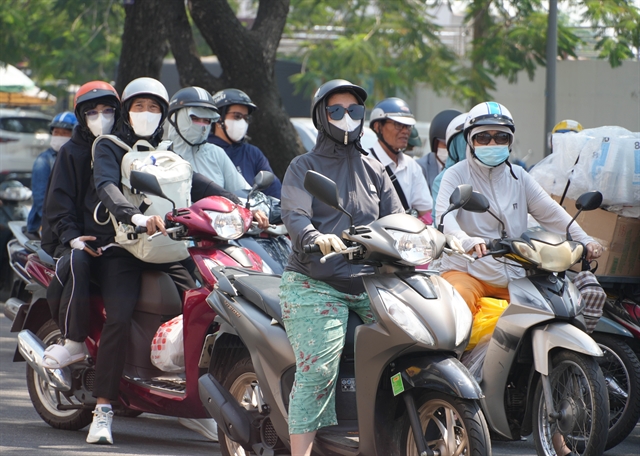 |
| Motorbike riders in Huế City wear sun-protective gear as they travel along Trần Hưng Đạo Street amid the intense heatwave. — VNA/VNS Photo |
HÀ NỘI — A prolonged spell of extreme heat is sweeping across much of Việt Nam, with temperatures climbing above 40 degrees Celsius in parts of the central region and forecasters warning of heightened risks to public health, energy demand and wildfire outbreaks.
The heatwave has been driven by a persistent low-pressure system over the country’s west, combined with a strong foehn wind effect that has intensified conditions across the central provinces and cities in recent days, according to the National Centre for Hydro-Meteorological Forecasting.
From April 6 to 8, temperatures from Nghệ An to Quảng Trị surged to around 40 degrees, with some localities exceeding 41 degrees. Tây Hiếu Ward in Nghệ An recorded 41.9 degrees, while Con Cuông Commune reached 41.3 degrees.
The heat has not been confined to the central belt. In the north-western region, temperatures have hovered between 36 and 38 degrees, with peaks above 39 degrees recorded in areas such as Mường Tè in Lai Châu and Phù Yên in Sơn La.
Meanwhile, the Central Highlands and southern regions have seen widespread heat of between 35 to 37 degrees.
Forecasters say the current pattern is unlikely to ease immediately. The western low-pressure system remains active, while a subtropical high-pressure ridge continues to dominate the south, locking in stable, hot conditions.
From April 9 to 13, the north-west is expected to endure another stretch of intense heat, with temperatures ranging from 36 to 39 degrees and locally higher.
In the Red River Delta, hot conditions are forecast to expand from April 10, with daytime highs of between 35 to 37 degrees.
The central region is set to bear the brunt. From Thanh Hóa to Đà Nẵng, and parts of Quảng Ngãi and Gia Lai, temperatures of between 36 to 39 degrees are expected through April 14.
In the corridor from Nghệ An to Huế, conditions may become particularly severe, with highs of approximately 40 degrees and isolated areas exceeding 41 degrees.
The Central Highlands and the south are also expected to remain under widespread heat, with temperatures holding steady at between 35 to 37 degrees over the same period.
Forecasters have classified the heat risk at level 1 across most regions, rising to level 2 in central provinces and cities from Nghệ An to Huế – a threshold reached when temperatures exceed 37 degrees for several consecutive days across a broad area.
 |
| A forest fire prevention drill at Bù Gia Mập National Park in the southern province of Đồng Nai, as prolonged extreme heat heightens wildfire risks to red alert levels. — VNA/VNS Photo |
At this level, forecasters say, heat begins to have clear impacts on public health and daily economic activity.
“The assessment also takes into account low humidity, the foehn wind effect and the duration of the heatwave,” said Mai Văn Khiêm, director of the centre.
“After April 14, temperatures are expected to gradually ease.”
Looking further ahead, April is expected to bring above-average temperatures nationwide, with the north and central provinces forecast to run around 1.5 to 2.5 degrees higher than seasonal norms. Other regions are likely to be between 0.5 and 1.5 degrees warmer than usual.
Heatwaves are projected to intensify from May, particularly in the north and central regions, peaking during the summer months through August before easing from September.
Overall, 2026 is expected to see more frequent and more severe heat events than in 2025.
Experts warn that prolonged high temperatures, coupled with dry winds, could sharply increase electricity demand, raising the risk of fires in residential areas and forests.
“Extended exposure to extreme heat also heightens the danger of dehydration and heat exhaustion, particularly among vulnerable groups”, an expert said. — VNS
Society
Society
 Society
 Society
 Society
 Society
 Society
 Society
 Society
 Society
 Society
 Society
 Society
 Society
 Society