 Society
Hà Nội Liberation Day: From historical memory to a modern “City for Peace”
1.
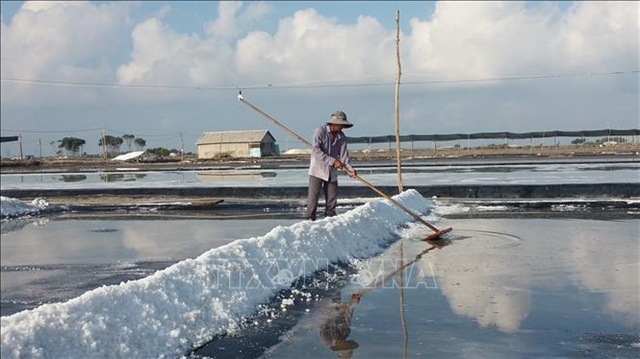 |
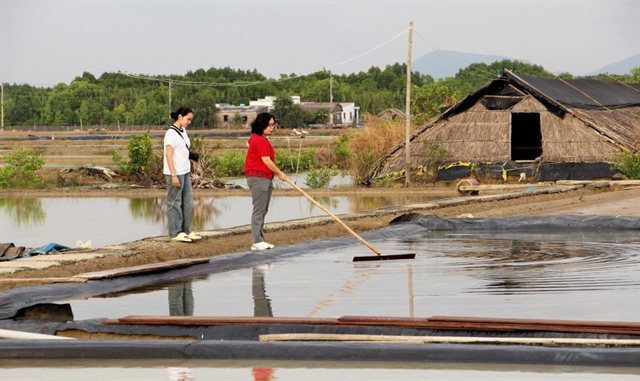
| Farmers at a coastal salt field in HCM City’s Tam An Commune. — VNA/VNS Photo Hoàng Nhị |
HCM CITY — Salt farmers living in the coastal communes of HCM City are experiencing renewed optimism as steady demand, improved production methods and community-based tourism bring fresh vitality to an old and traditional craft.
Salt fields there are currently busy with harvesting, processing and purchasing activities going on in full swing.
Lower stockpiles than in past years have created a positive outlook among the farmers.
Preserving a traditional craft
Working under the harsh midday sun in An Thới Đông Commune, Ngô Minh Chiến said salt prices are now at VNĐ105,000-110,000 per quintal.
His family has two hectares of salt fields and expects to produce around 2,200 quintals this season.
Strong market demand has enabled farmers to sell our their products quickly instead of being stuck with unsold stockpiles unlike in previous years.
Lê Quý, a veteran salt farmer who was born and raised in An Thới Đông, said investment in storage facilities and improved crystallisation fields has also helped enhance salt quality and get higher prices.
Local farmers said salt production in An Thới Đông dates back to the late 1960s, when people collected saline water from ponds and canals near mangrove forests, filtered it and boiled it into salt.
By 1977 production had shifted to crystallised salt fields, and since 2007 farmers have gradually adopted tarp-lined methods to improve efficiency and quality.
Salt-making is now considered one of the two key economic sectors of An Thới Đông Commune, alongside aquaculture.
In October 2024 the city People’s Committee recognised An Thới Đông as a traditional salt-making village, seeking to preserve cultural values in outlying areas and also promote the industry.
 |
| Tourists experience traditional salt-making in Thiềng Liềng island hamlet in HCM City’s Thạnh An Commune. — VNA/VNS Photo Hồng Đạt |
Thiềng Liềng island hamlet in Thạnh An Commune is surrounded by nearly 13,000ha of mangrove forest.
Salt production here began in the 1970s when settlers reclaimed land to expand salt fields, and Thạnh An now has around 400ha of salt farms.
Salt-making remains labour-intensive and highly dependent on weather conditions, while transport and fuel costs continue to affect incomes.
But in recent years community-based tourism in Thiềng Liềng has opened up new opportunities for local residents.
Farmers have diversified their products to make salts with shrimp, chilli, pepper, and herbs, many of which have achieved three-star One Commune One Product (OCOP) certification.
Tourism has also become an effective channel for promoting and selling these products.
Nguyễn Thị Bạch Tuyết, director of the Thiềng Liềng Agriculture–Trade–Service–Tourism Cooperative, said the island has received tens of thousands of visitors since launching its community tourism model.
Currently 18 households are involved in tourism activities, with 16 continuing traditional salt production, she said.
“Combining tourism with salt-making helps residents increase incomes while preserving their old craft.”
Thiềng Liềng island hamlet has 243 households, more than 150 of which still depend on salt-making as their main livelihood.
Visitors can enjoy the fresh air of the mangrove forest, walk through salt fields and experience the traditional craft that has sustained generations of locals. — VNS
Society
 Society
 Society
 Society
 Society
 Society
 Society
 Society
 Society
 Society
 Society
 Society
 Society
 Society
 Society