 Society

Top Vietnamese leader meets with Belgian Senate Speaker, House President
1.
|
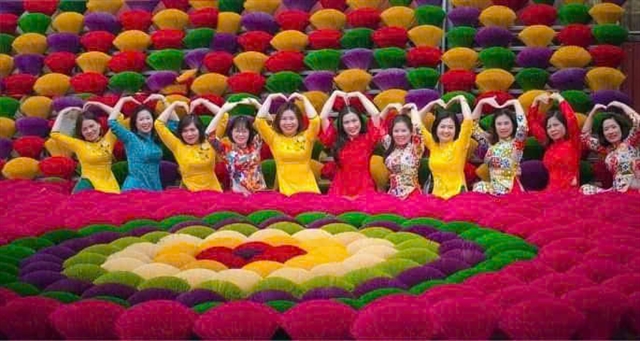
| Tourists pose for a photo with colourful incense sticks in Quảng Phú Cầu Incense Village in Ứng Thiên Commune, Hà Nội. — VNS Photo Tố Như |
Trần Như
HÀ NỘI — Combining traditional production and tourism, craft villages in Hà Nội have seen a recent revival, opening up chances for sustainable development in the process.
As Tết (Lunar New Year) approaches, visitors to Ứng Thiên Commune in Hà Nội's southwestern area find it easy to spot blazing blacksmiths' forges, vibrant incense drying under the winter sun or the rhythmic sound of toothpick making machines mingling with the lively conversations of the craftsmen.
The rhythm of life in this traditional craft commune remains as enduring as an underground stream flowing through generations.
With 13 recognised craft villages, the commune is famously home to traditional production including Vũ Ngoại blacksmithing, Đống Vũ bamboo and rattan weaving, Quảng Phú Cầu incense and the manufacture of other handicrafts.
In Vũ Ngoại Blacksmithing Village, the traditional craft has passed from generation to generation with a well-known saying among master craftsmen: "First the sound, second the shape, and third the plating."
It is not just about technique, but also about experience accumulated over time, requiring a keen sense of touch in every hammer blow and every steel tempering process.
Nowadays, alongside hand hammers and iron anvils, many households have invested in power hammers, electric ventilation systems and cutting machines to reduce physical labour, boost productivity and improve working conditions.
However, according to master craftsmen, core factors remain the same: skill and professional ethics.
Machinery can support a variety of tasks, but product quality still depends on the experience and meticulousness of the craftsman.
Not far away, in Đống Vũ Bamboo and Rattan Weaving Village, people follow a different rhythm – gentle, meticulous and rich in creativity.
From slender bamboo strips sourced from the Red River Delta, artisans craft baskets, trays, gift boxes, decorative items and export products.
Lê Thị Hải, who has been attached to the craft for many years, said: “Preserving the craft is not about nostalgia, but about ensuring it can continue in modern life. When there are visitors and hands-on experiences, products sell better, and artisans gain more motivation to stick with the job.”
According to local statistics, thousands of workers in the commune are directly or indirectly involved in craft village activities. During the year-end peak season, average incomes can reach up to VNĐ10 million per person per month (US$385), contributing to improved living standards and helping to curb the outwards migration of young workers.
From livelihood to cultural symbol
If blacksmithing and bamboo weaving maintain a steady traditional production rhythm, Quảng Phú Cầu Incense Village presents a more vibrant image by harmoniously combining production with experiential tourism.
Quiet and unassuming, the incense-making craft in Quảng Phú Cầu has been maintained through the perseverance and patience of village artisans – people who see 'keeping the incense burning' as synonymous with preserving the character and soul of the Red River Delta countryside.
According to local records, incense making in Quảng Phú Cầu emerged in the early 20th century. After more than 100 years, it has become the main livelihood of local residents.
The commune currently has around 3,000 households, of which more than 70 per cent are directly or indirectly engaged in the incense trade.
During the peak period ahead of Tết, output rises by around 30 per cent, with many workshops having to run evening shifts to meet orders.
Nguyễn Tiến Thi, director of the Xà Cầu Craft Village Incense Production Co-operative, said that nearly 20 years in the trade had allowed him to witness many ups and downs.
“Every craft has difficult times, but when it is a family-inherited trade, you have to love it and stick with it,” Thi said.
From an initial 20 members, the co-operative has gradually invested in machinery and standardised production processes, while still preserving its traditional formula: crushed trám resin and charcoal, with no chemical fragrances.
According to the director, the trend of consumers returning to natural and safe products has been a key factor in helping Xà Cầu's black incense gain market acceptance.
In the cultural and spiritual life of Vietnamese people, an incense stick is not merely an item for worship, but a spiritual bridge between humans, ancestors and the heavens.
Incense appears in all sacred spaces – from family altars to communal houses, pagodas and festivals, especially during Tết.
This spiritual value underpins the enduring vitality of the craft village.
To enhance product standing, local authorities are completing procedures to secure collective trademark protection for 'Hương Xà Cầu'.
Once the brand is protected and widely promoted, opportunities to expand markets and move towards exports will become clearer.
Amid the rush of modern life, when many traditional craft villages face the risk of fading away, incense villages in Ứng Thiên still glow with activity whenever Tết approaches and spring arrives.
Bundles of incense dyed red and spread across village courtyards to dry in the winter sun not only meet the market’s rising spiritual demand, but also stand as a vivid symbol of a spiritual craft that has accompanied Vietnamese cultural life for generations.
Craft villages with experiential tourism
Recognising its advantages, Ứng Thiên Commune has identified craft village tourism development as a strategic direction.
The Quảng Phú Cầu incense-stick craft tourism site has been recognised by the Hà Nội People’s Committee, becoming a destination on the capital's southern tourism route.
Exhibition spaces, experience zones and photo activities amid a colourful 'forest of incense' attract large numbers of domestic and international visitors.
Local residents sell products and also tell the story of the craft, guide visitors in rolling incense sticks, drying incense and learning about natural materials. This friendliness creates a distinctive impression.
Deputy Chairman of the Ứng Thiên Commune People’s Committee Nguyễn Anh Tuấn said the locality is coordinating the implementation of phase two of the Xà Cầu – Cầu Bầu Industrial Cluster, gradually relocating production facilities out of residential areas to address environmental issues and create favourable conditions for tourism development.
“Developing craft village tourism is not only about exploiting economic potential, but is also a solution for heritage preservation. We are orienting production towards green, clean and sustainable practices, enhancing brand value and cultural experiences,” Tuấn said.
From a cultural and market perspective, artist Vũ Hy Thiều said that Tết is the most favourable period for commerce. People increase spending on essentials as well as on decoration, gift-giving and worship.
According to Thiều, Tết products can be divided into two main groups: items serving households directly, such as altar displays and decorative objects, and gift items – a segment with high symbolic value that helps maintain and strengthen social relationships. This is a major advantage for handicraft products, as each item carries not only material value, but also a cultural message.
In this context, craft villages in Ứng Thiên have plenty of opportunities to expand their markets, if they can combine traditional elements with creative design, modern packaging and clear brand storytelling.
From Vũ Ngoại blacksmithing and Đống Vũ bamboo weaving to Quảng Phú Cầu incense, these craft symbols are helping to shape a new image for Ứng Thiên.
Preserving crafts, renewing production, linking with tourism and protecting the environment – this is how the commune is awakening its cultural potential, transforming traditional values into drivers of sustainable economic development.
Although many craft villages currently face the risk of decline, Ứng Thiên demonstrates a different path of development rooted in identity.
Each incense stick, bamboo product and hammer blow at the forge is not only the crystallisation of labour, but also proof of the enduring vitality of Vietnamese culture in the process of integration. — VNS
Society
 Society
 Society
 Society
 Society
 Society
 Society
 Society
 Society
 Society
 Society
 Society
 Society
 Society
 Society