|
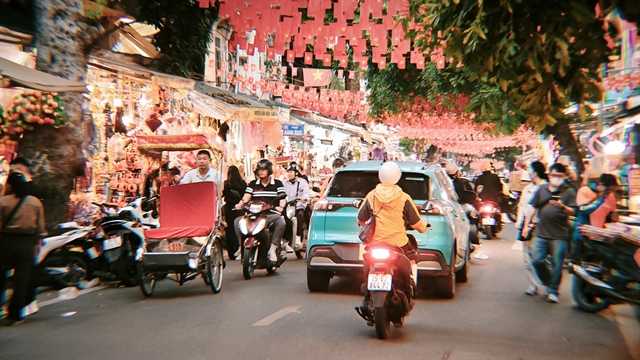
| Hà Nội's Old Quarter. — VNS Photos Khánh Dương |
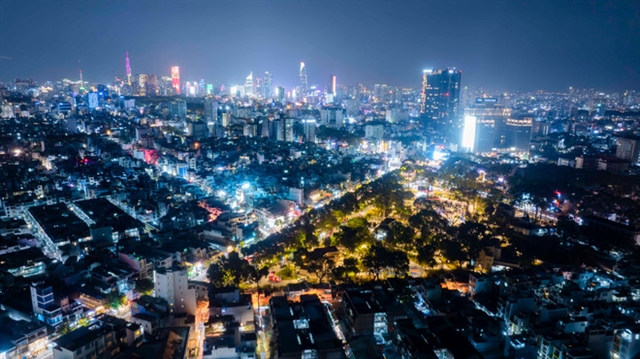
HÀ NỘI — Hà Nội authorities have recently approved a master plan for the 2026-45 period in which more than 860,000 local residents from the urban core area inside Ring Road 3 will be relocated to serve the capital’s urban restructuring plan.
After many years living with a family of four members in a cramped apartment of less than 20sq.m in the city’s historic Old Quarter, Nguyễn Thị Loan dreams of moving to a more spacious home.
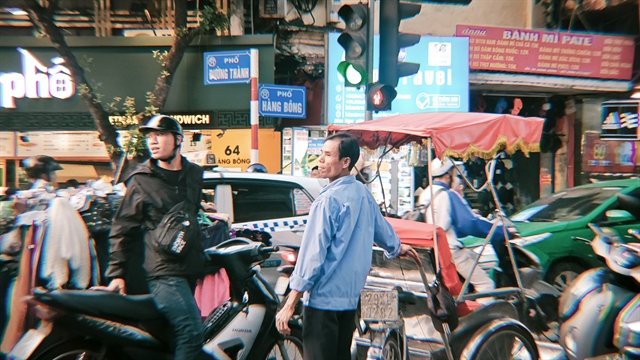
Under the plan, the Old Quarter, overloaded with an extremely high population density and numerous deteriorating heritage houses, will be an area of focus for city authorities to carry out population relocation in support of conservation efforts.
In the next 10 years, 200,000 residents will be relocated from the Red River area, 200,000 from West Lake and surrounding areas and 42,000 from several streets within Ring Road 3.
From 2036 to 2045, the city will relocate 26,730 residents from the Old Quarter, 23,000 from old inner-city neighbourhoods and 370,000 from other areas within Ring Road 3 as part of urban restructuring.
Loan said she strongly supports the plan to relocate residents from the Old Quarter.
“However, I still raise concerns about whether the resettlement area will truly be better than our current place, whether it will be close to our workplace and how my children’s schooling will be affected,” she said.
Phạm Thuỳ Linh, a resident in the former Hai Bà Trưng District, agreed. Linh said she will not be overly worried if her household is relocated, but she remains concerned about compensation policies and livelihoods at the new location.
“First, there must be a suitable roadmap. Second, people need psychological stability. At the same time, compensation policies must be reasonable. If resettlement conditions are better, people will be more willing to accept it,” she told the Voice of Vietnam.
Architect Đào Ngọc Nghiêm, vice chairman of the Việt Nam Urban Planning and Development Association, said the need to reduce population density in Hà Nội’s urban core was raised more than 30 years ago. The city had approved several population dispersal schemes, but implementation has been limited.
This latest plan marks a restart of key urban planning requirements, with a core goal of improving residents’ quality of life, he said.
“Population dispersal is a necessary requirement throughout Hà Nội’s development history, especially in the central area. With today’s integrated urban model, we hope this plan can succeed. If population issues are resolved, Hà Nội will become more attractive and develop on par with cities that have even longer histories,” he said.
|
| The Old Quarter is overloaded with an extremely high population density and numerous deteriorating heritage houses, prompting city authorities to carry out population relocation in support of conservation efforts. |
Architect Trần Huy Ánh from the Hà Nội Association of Architects said the population of the Old Quarter has declined by 30–50 per cent over the past 20 years due to spontaneous population dispersal.
Residents have sold small houses to buy larger ones in outer areas, with this process regulated by flexible financial mechanisms rather than administrative orders. If successfully implemented, the upcoming relocation could create a revolution in the city's architectural landscape and fundamentally address infrastructure bottlenecks, he said.
“We must continue to improve the average quality of life, both in the urban core and surrounding areas, while developing adequate infrastructure. This also includes expanding roads, building urban railways and improving flood control,” he said.
To ensure the success of population dispersal and reduce pressure on the urban core, Đặng Hùng Võ, former deputy minister of natural resources and environment, said that alongside residential relocation, Hà Nội must continue and complete the relocation of hospitals and schools out of the inner city, as these facilities attract large numbers of residents, students and commuters to central Hà Nội.
“We need to clearly commit to what benefits relocating residents will receive, and how the urban core will be rebuilt – whether its historical and cultural foundations can be preserved, or whether everything will be demolished and rebuilt,” he said.
According to Associate Professor Nguyễn Đức Lộc, director of the Institute for Social Life Studies, successful relocation aimed at 'decompressing' the urban core requires recognising that relocation is not merely about housing, but about moving an entire living environment. These invisible and less tangible factors can create psychological concerns among affected residents.
“This is not simply about moving from one house to another. We must consider the entire surrounding community framework, including education, recreation, religious practices and spiritual life. All of these elements must be incorporated into the planning process for a relocated community,” he said. — VNS
 Society