 Society
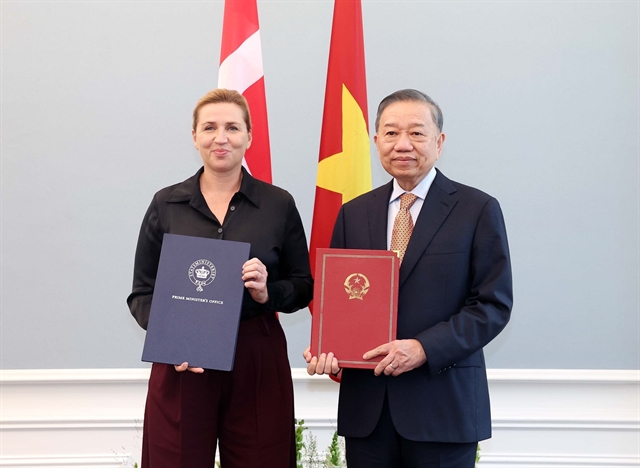
Việt Nam, Denmark issue joint statement on establishment of Comprehensive Strategic Partnership
1.
|
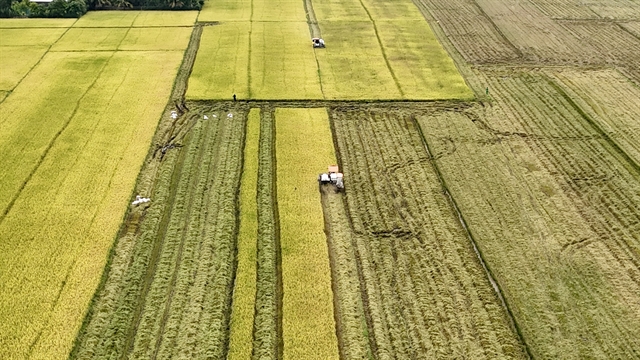
| Rice fields in An Giang Province. — VNA/VNS Photo Thanh Sang |
AN GIANG — An Giang Province has affirmed its position as the Cửu Long (Mekong) Delta’s leading agricultural production hub, making important contributions to national food security and exports.
Over the past four decades its agriculture has undergone a comprehensive transformation following the implementation of the Party’s renewal policy.
Rice, fruit trees, vegetables, aquaculture, and livestock have all developed in a coordinated manner, linking agricultural growth with commodity exports that earn foreign currency for the country.
As the country’s largest rice producer, the province has more than 600,000ha under rice, with total annual output exceeding 9 million tonnes in 2021–25, according to its Department of Agriculture and Environment.
With a dense river network, a relatively complete irrigation system, fertile soil, and sound policies to restructure production from single rice crops to two or three crops of high-quality rice a year, the province has made a major contribution to national food security.
It has shifted from traditional rice farming that depended largely on nature and manual labour to smart, organic and high-quality rice production.
This transition has helped enhance rice value and expand access to international markets, providing clear evidence of the province’s agricultural renewal.
Lê Hữu Toàn, director of the Department of Agriculture and Environment, said rice production has been reorganised in line with the strengths of each area, with expanded high-quality models, wider application of smart farming and development of large-field models linked with consumption.
Safe production standards are being applied more widely, alongside residue control, traceability, growing area codes and brand building for both domestic and export markets, he said.
The province has focused not only on productivity and output, but also on value, he added.
In 2025 high-quality rice accounted for nearly 60 per cent of the total output of almost 8.8 million tonnes, up 9.63 per cent from 2024.
Popular export varieties such as OM 18, OM 5451, OM 6976, Jasmine 85, Đài Thơm 8, ST24, and ST25 are widely grown across fields from the Long Xuyên Quadrangle and the western bank of the Hậu River, a tributary of the Mekong, to the U Minh Thượng and Miệt Thứ regions.
Applying standards such as the Sustainable Rice Platform (SRP), organic farming, Vietnamese and global good agricultural practices (VietGAP and GlobalGAP) has helped An Giang’s rice reach demanding markets including the EU, the US and Japan.
Farmers have also quickly adopted technology, including the use of drones for spraying, fertilising and sowing, helping reduce costs and protect the environment.
The province has also effectively implemented a Ministry of Agriculture and Environment project for the development of one million hectares of high-quality, low-emission rice associated with green growth in the delta by 2030.
Last year it developed more than 150,150ha under the project.
Many rice farming models implemented under public–private partnership arrangements have delivered high efficiency and met the strict quality standards of export markets.
Effective irrigation works
A major highlight is the strong focus by both the province and the central government on investing in large-scale irrigation works, especially the flood drainage system to the western sea.
These have helped stabilise production and reduce disaster risks, and play a strategic role in agricultural development across the delta.
Farmer Nguyễn Văn Hùng, who has lived in the Long Xuyên Quadrangle in Hòn Đất Commune for more than 60 years, said that, thanks to flood drainage and waterlogging control, people can now farm proactively, expand rice and vegetable areas, farm shrimp and fish, reduce losses, increase incomes, and reduce poverty.
“The Long Xuyên Quadrangle used to be alum-affected, abandoned land with deep flooding, and so farmers grew only one seasonal rice crop a year, yielding about 1–1.5 tonnes per hectare.
“Later, thanks to flood drainage canals to the western sea and irrigation and dyke systems, they began producing two or three rice crops a year, with yields rising to 5–6 tonnes per hectare per crop.
“Today, some areas achieve more than 10 tonnes per hectare in the winter–spring crop.”
The flood drainage into the western sea in the Long Xuyên Quadrangle was implemented under the direction of late Prime Minister Võ Văn Kiệt.
The first key project was the T5 Canal, completed in 1997, which marked an initial step in unlocking land potential and controlling floods.
The drainage system has reduced flooding and protected production and livelihoods, according to local authorities.
Freshwater from the Vĩnh Tế Canal and the irrigation network has helped wash away acidic alum and improve soil quality, turning hundreds of thousands of hectares of wasteland into fertile rice and fruit farms.
The merger of Kiên Giang Province with An Giang on July 1, 2025, opened up a broader development space, forming an agricultural economy linking the “delta – border – western sea”.
The province aims to maintain annual rice output of around 9 million tonnes while making a strong shift towards modern and sustainable agriculture, affirming its role in food security and rural economic development amid climate change challenges.
It will continue with the large-scale field model, applying technology, strengthening value chain linkages and developing ecological, nature-based models such as rice–shrimp farming. — VNS
Society
 Society
 Society
 Society
 Society
 Society
 Society
 Society
 Society
 Society
 Society
 Society
 Society
 Society
 Society