 Society
84 individuals investigated for transnational online frauds
1.
|
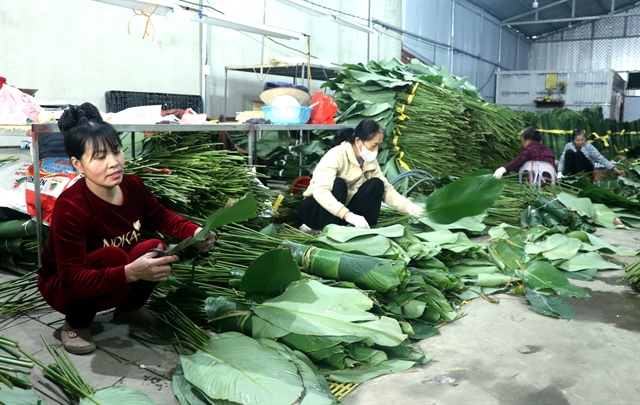
| Residents of Hồng Châu Ward, Hưng Yên Province, sort dong leaves for the Tết demand. — VNA/VNS Photo Đinh Văn Nhiều |
HƯNG YÊN — As the Lunar New Year (Tết) approaches, the floodplains along the Hồng (Red) River in Hồng Châu Ward, Hưng Yên Province, turn into a sweeping carpet of green, where farmers move briskly between narrow garden rows, cutting, sorting and bundling dong leaves destined for kitchens at home and abroad.
For generations, dong leaves here were grown mainly to meet local needs. Today, however, they are reaching markets in Europe, Japan and the Republic of Korea, opening a new chapter for a crop once seen as little more than a garden extra.
This shift has been driven by closer links between growers and professional purchasing facilities, which handle cleaning, grading and packaging to export standards. Beyond higher incomes, the trade also carries cultural meaning, helping overseas Vietnamese preserve the taste and rituals of traditional Tết, according to VietnamPlus online newspaper.
Nguyễn Văn Hoạt, who runs a collection facility in residential cluster 1 of Hồng Châu Ward, is among those connecting farm gardens with foreign markets. His business buys about 30 tonnes of dong leaves each month, rising sharply in the weeks ahead of Tết.
This year alone, Hoạt has purchased hundreds of tonnes from local farmers. His facility supplies the domestic market and exports to Germany, the Czech Republic, Japan and the Republic of Korea. The journey from riverbank garden to overseas shelf, however, requires strict quality control.
“Leaves for export must be large, deep green and completely unbroken,” Hoạt said. “Freshness and flexibility matter most, because the leaves have to withstand long transport without drying out.”
|
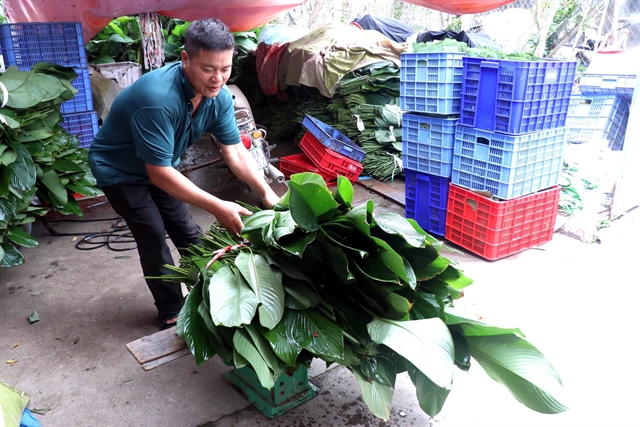
| After harvesting, local people bring dong leaves to collection points for sale. |
To meet these requirements, his operation follows a closed process, from selecting leaves at source to cleaning and grading them. Cold storage and vacuum sealing are crucial steps in preserving colour and texture. Around 50 tonnes of dong leaves were shipped abroad during this Tết season.
Local worker Nguyễn Thị Phương said size standards are tightly enforced, with leaves required to measure between 24cm and 27cm in width and between 45cm and 47cm in length. Once sorted, they are vacuum-packed into uniform bundles, allowing them to lie flat and retain their natural green sheen.
Across Hồng Châu Ward, more than 20 hectares are now devoted to dong leaf cultivation, concentrated largely in residential cluster 1. According to cluster head Dương Thị Miến, the area has more than 600 households, about 90 per cent of which grow dong leaves.
“Dong leaves used to be a secondary crop,” Miến said. “Now they provide the main income for many families.”
Large-scale planting has replaced former mixed gardens, creating a concentrated production zone with consistent quality. This shift has helped farmers meet bulk orders and secure export contracts.
“The fact that dong leaves are now exported shows how people’s thinking has changed,” Miến added. “They pay more attention to safety standards and professional packaging. The ward is encouraging residents to expand specialised cultivation.”
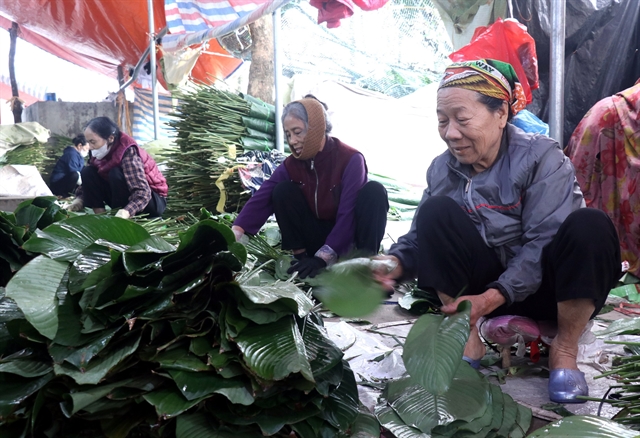
In backyard gardens, elderly women can still be seen carefully selecting each leaf by hand.
|
| Elderly residents also take part in the leaf-sorting process. |
At 85, Dương Thị Vang still tends her plot every day. For her, the garden is both a livelihood and a quiet pleasure in old age.
She said Hồng Châu dong leaves owe their reputation to the Red River’s fertile alluvial soil, which produces thin, broad and supple leaves. Wrapped around bánh chưng (square glutinous rice cakes), they give the cakes a natural green colour and a distinctive aroma, unlike forest-grown alternatives.
Harvesting is the most demanding stage, as a first-grade leaf must be glossy, pest-free and free of even the smallest tear, requiring patience and steady hands, she said.
Resident Trần Thị Nga said dong plants thrive in shade and moist conditions. Growing them under fruit canopies protects the leaves from direct sunlight while improving flexibility and colour.
The crop requires relatively little care, mainly regular weeding and moisture retention, yet brings dependable returns, especially during the Tết rush. This season, Nga’s family harvested 720 square metres of leaves, earning about VNĐ30 million (US$1,150).
For farmer Nguyễn Thị Ân, dong leaves began as a small household crop planted under fruit trees to suppress weeds. When the leaves thrived, traders began visiting her garden directly. Her family gradually expanded production, turning unused plots into dong leaf beds.
Today, what was once a sideline has become her family’s main source of year-end income. — VNS
Society
 Society
 Society
 Society
 Society
 Society
 Society
 Society
 Society
.jfif) Society
Society
 Society
 Society
 Society
 Society
 Society