 Society
Youth-led initiative opens up opportunities for disadvantaged children
1.
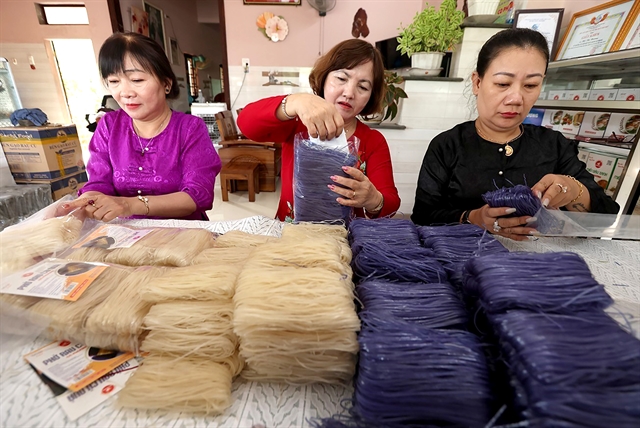 |
| Women package dried rice noodles at the An Phong Traditional Village, Phù Cát Commune, Gia Lai Province.— VNA/VNS Photo Vũ Sinh |
Tố Như
HÀ NỘI — Starting this year, Việt Nam’s new-style rural area development programme will move beyond expanding coverage to focus on improving living standards.
The programme is embedded more deeply in the restructuring of the agriculture and environment sector and aligned with the goals of sustainable poverty reduction, ecological development and rural well-being.
Rather than remaining a standalone, support-oriented target programme, new-style rural area development is now being positioned as a foundational pillar in the transformation of the agriculture and environment sector’s growth model.
Under development orientations for this year, the Ministry of Agriculture and Environment has set targets to cut the multidimensional poverty rate by 1-1.5 per cent and raise the proportion of communes meeting new rural area standards by at least 15 per cent.
These are not isolated indicators, but interconnected objectives designed within an integrated framework of socio-economic and environmental development.
The Government’s action programme implementing Resolutions 01 and 02 clearly defines rural development as a modern, ecological process centred on local people.
In this context, the new rural development programme is directly linked to production restructuring and the renewal of growth models across the entire sector.
Ecological and circular agriculture, along with multi-value integrated farming models, are identified as the main pathway to boosting productivity, quality and competitiveness of agricultural products, while cutting emissions and minimising environmental impacts.
Social and environmental criteria continue to be treated as inseparable components of new rural development.
Specifically, by the end of this year, the agriculture and environment sector aims for 62 per cent of rural households to have access to clean water meeting national standards; 95 per cent of urban solid waste to be collected and treated in line with regulations; and forest cover to remain stable at over 42 per cent.
Investment in climate-resilient rural infrastructure will remain a key pillar in 2026.
Priority will be given to irrigation works, domestic water supply systems and facilities for flood, drought and landslide prevention, with the aim of safeguarding water security and community safety in rural areas.
The online monitoring and supervision of all large hydropower reservoirs, along with the determination and public disclosure of minimum environmental flows for around 700 hydropower and irrigation projects, is expected to support water resource management while directly protecting downstream livelihoods and living environments.
In addition, the development of co-operative economic models, co-operatives and value chain links continues to be seen as a crucial solution for raising incomes and achieving sustainable poverty reduction in rural areas.
Poverty reduction
Nguyễn Đình Hòa, an expert from the Việt Nam Institute of Economics and World Economy under the Việt Nam Academy of Social Sciences, said the country’s poverty reduction policies have gone through several phases of transformation.
These include going from direct assistance to address immediate shortages to livelihood support and eventually helping people organise production and generate income independently.
At the current stage, he describes the approach as a “Version 4.0”, where the objective is no longer simply to help individual households escape poverty, but to build capacity and aspiration for advancement across entire communities.
The approach is consistent with the development goals set out at the 13th National Congress of the Communist Party of Việt Nam and further specified in National Assembly Resolution 257/2025/QH15 and Government Resolution 424/2025/NQ-CP.
“Poverty reduction is no longer viewed as a compensatory policy, but as an integral component of the national development strategy,” he said.
A key shift has been the move from broad-based assistance to a more targeted, address-based approach.
As poverty rates fall to low levels, poverty is no longer widespread but increasingly concentrated in structurally disadvantaged pockets, typically in remote and border areas where infrastructure, markets and social services remain limited.
In this context, poverty reduction cannot rely solely on short-term support packages, but requires long-term, focused public investment to establish sustainable development foundations.
The poverty line for the 2026-2035 period will continue to adopt a multidimensional approach, with additional and adjusted indicators reflecting deprivation in social services.
Hòa added that the greatest challenge lies not in issuing criteria, but in accurately identifying “less visible yet decisive” forms of deprivation.
One such factor is digital capacity and adaptive skills.
While telecommunications infrastructure is now widespread, people’s ability to use it varies significantly.
In some areas, smartphones have become tools for accessing markets, public services and organising production; elsewhere, they are used mainly for entertainment and generate little economic value.
Another issue is access to information and participation in formal social networks.
Today, poverty is not only about a lack of income, but also about the absence of channels to convert information into livelihoods, he said.
As poverty rates decline, many forms of deprivation risk being overlooked if assessments focus solely on income, including chronic poverty in isolated regions, urban poverty in informal settlements and poverty related to culture and skills.
According to Hòa, poverty reduction in the next few years should not be measured simply by whether households are removed from official lists, but by their capacity to withstand risks and sustain livelihoods.
If every market shock or natural disaster pushes people back into poverty, progress remains largely superficial.
Việt Nam thus needs to develop shared databases for beneficiary groups, increase policy personalisation based on regional characteristics and accelerate digital transformation, the expert said.
With appropriate State coordination, the digital economy and e-commerce could help low-income groups overcome geographical barriers and gain more direct access to markets.— VNS
Society
 Society
 Society
 Society
 Society
 Society
 Society
 Society
 Society
 Society
 Society
 Society
 Society
 Society
 Society



.jpg)



