 Society

SMS Tan Kiat How, Rosianna Silalahi and Glenda Gloria to speak at PRISM Summit 2026
1.
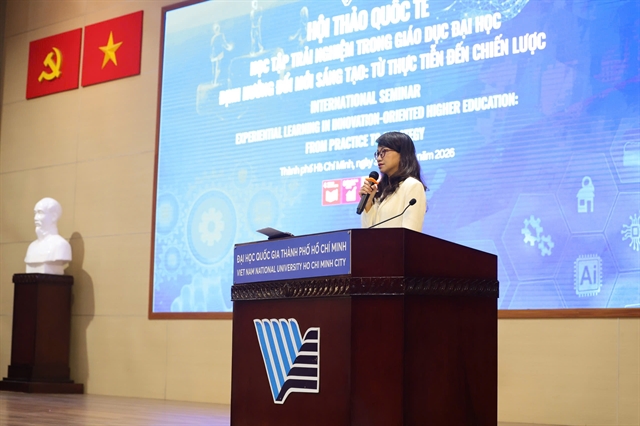 |
| Nguyễn Thị Thanh Mai, Chancellor of Việt Nam National University-HCM City, delivers remarks at the seminar on experiential learning in higher education on January 31. — Photo courtesy of VNU-HCM |
HCM CITY — Calling for breakthroughs in higher education reform in line with Politburo Resolution No. 71-NQ/TW, Nguyễn Thị Thanh Mai, chancellor of Việt Nam National University-HCM City (VNU-HCM), said at an international seminar on January 31 that experiential learning must be elevated from short-term practice to a system-level strategy.
VNU-HCM held the seminar called “Experiential Learning in Innovation-Oriented Higher Education: From Practice to Strategy,” drawing more than 600 leaders, lecturers and researchers from VNU-HCM and partner universities at home and abroad.
Mai said universities can hardly become drivers of development if training focuses mainly on knowledge transmission, students have limited opportunities to engage in research and innovation, and teaching remains disconnected from the needs of enterprises and local communities.
“Experiential learning needs to be systematically designed, embedded in curricula from the outset and rigorously quality-assured, under a clear leadership vision,” she said.
The event provided a forum to discuss how experiential learning can be elevated to a system-level strategy in higher education reform.
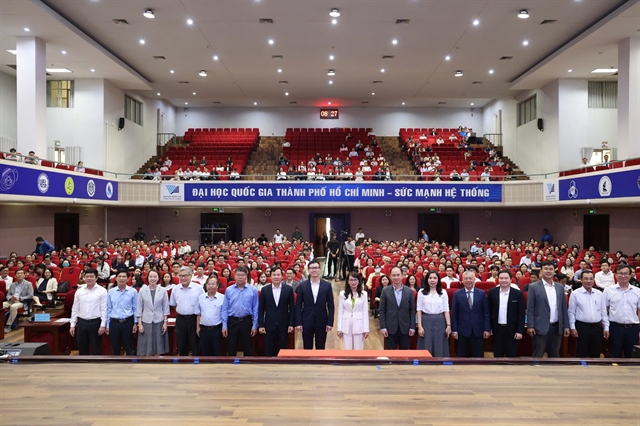 |
| University leaders, academics and industry representatives attend the seminar held at Việt Nam National University-HCM City on January 31. — Photo courtesy of VNU-HCM |
The event was also seen as a practical step in implementing Politburo Resolution No. 71-NQ/TW, which calls for breakthroughs in education and training and stresses closer links between theory and practice, and between schools and society.
Participants emphasised the importance of integrating experiential learning into curricula and aligning it with assessment and quality assurance frameworks, in order to strengthen linkages among teaching, research, innovation and real-world problem-solving.
Sharing international perspectives, Sukhwant Jhaj, Vice Provost of Academic Innovation and Student Achievement at Arizona State University (ASU) in the US, said experiential learning lies at the heart of ASU’s mission to link education with real-world impact rather than classroom-bound teaching.
“ASU defines success not by selectivity, but by inclusiveness and learners’ ability to succeed.”
Through work-integrated learning, students gain hands-on experience while contributing to solutions for societal and industry challenges.
With more than US$1 billion in annual research funding, ASU leverages experiential education to drive innovation and sustainable development by aligning teaching, research and community engagement to deliver measurable social outcomes.
At Singapore Management University (SMU), experiential learning has evolved from a pilot initiative into an institutional capability embedded across the curriculum, Kevin Koh, head of SMU-X at the Office of the Provost at SMU, said.
Built around industry project-based education, SMU-X allows students to tackle real business problems from an early stage of their studies.
“Close collaboration with industry partners helps ensure learning outcomes remain relevant to labour market needs while maintaining academic rigour,” he said.
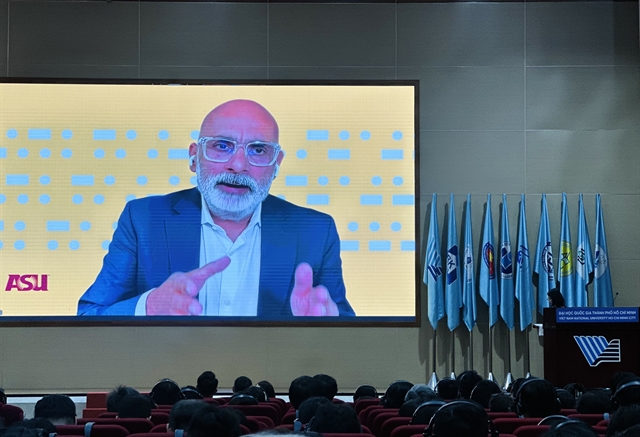 |
| Sukhwant Jhaj, Vice Provost of Academic Innovation and Student Achievement at Arizona State University (ASU) in the US, addresses a seminar held at Việt Nam National University-HCM City on January 31. — Photo courtesy of VNU-HCM |
Meanwhile, Wu Qi, Associate Professor at City University of Hong Kong (CityUHK), highlighted that experiential learning in non-STEM disciplines focuses on real-world engagement rather than laboratories or technical simulations.
At CityUHK, the BBA Global Business programme integrates experiential learning as a flagship component, offering students global exposure through project-based learning in diverse cultural and business contexts.
“By combining strong academic foundations with practical experience, the model enhances problem-solving and cross-cultural competencies needed to navigate complex global challenges,” he said.
Nguyễn Quốc Chính, director of the Centre for Educational Testing and Quality Assessment at VNU-HCM, said experiential learning activities within the university system remain fragmented and require clearer definitions, assessment frameworks and stronger coordination.
Under its 2026-30 development strategy, VNU-HCM aims to cooperate with at least 100 enterprises each year and gradually integrate enterprise-linked experiential learning into its training programmes.
“This is not merely a numerical target, but a clear direction for transforming the training model of the entire system,” Mai said.
Based on conference discussions, VNU-HCM plans to develop a common implementation framework, promote scalable experiential learning models and strengthen collaboration with enterprises, localities and international partners to ensure long-term sustainability. — VNS
Society
 Society
 Society
 Society
 Society
 Society
 Society
 Society
 Society
 Society
 Society
 Society
 Society
 Society
 Society