 Society

Phenikaa wins fifth consecutive Vietnam National Brand title
1.
|
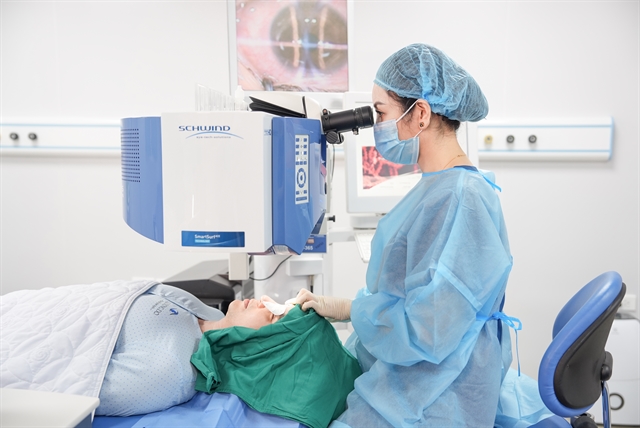
| Doctor performs eye surgery for a patient with refractive error at the Đông Đô Hospital in Hà Nội. — Photo courtesy of the hospital |
HÀ NỘI — Đông Đô General Hospital in Hà Nội will apply SMILE Pro Vision ID, a new-generation technology from the ZEISS Group, to treat refractive errors, according to the hospital's CEO, Đinh Thị Phương Thủy.
Dr Thủy was speaking at a ceremony on Monday to transfer the SMILE Pro Vision ID refractive surgery technology from the German Carl Zeiss Group to Đông Đô General Hospital.
SMILE Pro is currently considered one of the leading safe and effective refractive surgery solutions in the world. It offers many outstanding advantages, such as minimal invasiveness, preservation of corneal structure, reduced risk of dry eyes after surgery, early vision recovery and increased long-term visual stability.
"The technology is considered a new step forward in the trend of personalised refractive treatment, applying artificial intelligence (AI) to the entire process of analysing examination data, calculating and planning surgery for each patient and supporting the prediction of changes in vision over time," Dr Thủy said.
The laser treatment time is only about eight to 10 seconds, significantly shorter than previous technologies. The method uses a micro-incision, helping to preserve the corneal structure and reduce dry eyes. As a result, patients can recover their vision within 24 hours of surgery.
According to statistics of the health sector, the rate of refractive errors (mainly myopia) in Việt Nam is increasing rapidly, at around 15 to 40 per cent of the population, equivalent to 14-36 million people needing corrective lenses. This rate is higher in urban areas (30-40 per cent), compared to 15-20 per cent in rural areas.
In big cities like Hà Nội or HCM City, over 50 per cent of children suffer from refractive errors, with children and students aged between six and 15 years old having a rate of about 20-40 per cent in urban areas and 10-15 per cent in rural areas.
Among students at some major universities, the rate of myopia reaches over 70 per cent. This situation shows that the demand for refractive surgery in Việt Nam is growing strongly, especially among young people.
Introducing the new technology into treatment will provide patients with internationally standardised treatment solutions right in their own country, instead of having to travel far or accept less optimal options, according to Dr Thủy. — VNS
Society
 Society
 Society
 Society
 Society
 Society
 Society
 Society
 Society
 Society
 Society
 Society
 Society
 Society
 Society