 Society
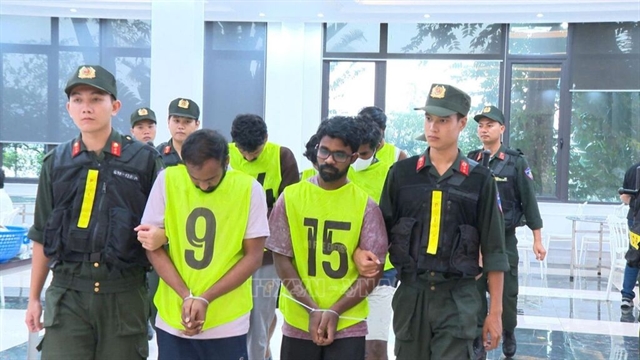
84 individuals investigated for transnational online frauds
1.
|
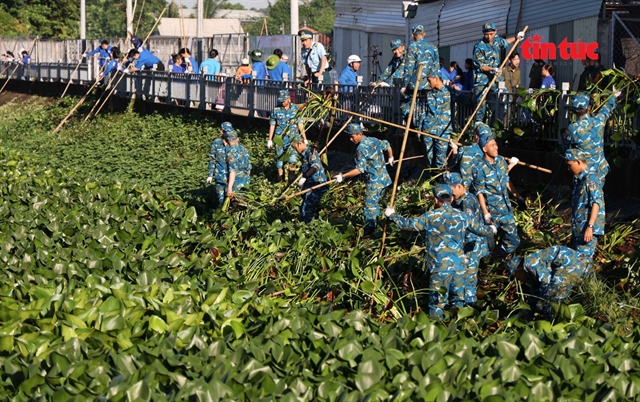
| HCM City’s Green Sunday movement has drawn not only Youth Union members but also personnel from the armed forces, highlighting broad community participation in environmental protection. — VNA/VNS Photos An Hiếu |
HCM CITY — For more than three decades, the Chủ nhật xanh (Green Sunday) movement has been a hallmark of youth volunteerism in HCM City, reflecting the young people of the city's long-standing commitment to environmental protection and to building a modern, civilised and compassionate urban space.
Launched in 1994 amid rapid urbanisation, the movement took shape as the city faced mounting waste, polluted canals and a shortage of public green spaces.
What began as small, spontaneous clean-up activities gradually evolved into a well-organised and enduring programme, sustained by generations of Youth Union members, students and volunteers.
Each campaign mobilises thousands of young people in blue volunteer shirts to collect waste, clean streets, dredge canals, plant trees and improve neighbourhood landscapes.
Over the past 31 years, millions of tonnes of waste have been removed and thousands of green spaces created, contributing to better environmental quality and public health across the city.
Dương Ngọc Tuấn, director of the HCM City Youth Social Work Centre, says the development of Green Sunday mirrors the broader transformation of youth volunteer work.
A key milestone was integrating environmental protection into regular Youth Union and Youth Association activities, ensuring continuity and long-term impact rather than one-off campaigns.
As the movement gained traction, it expanded beyond HCM City and gradually developed into a nationwide volunteer initiative.
Its sustainability lies in responding to real community needs, placing youth at the core while mobilising society as a whole, and maintaining momentum through persistence and innovation.
|
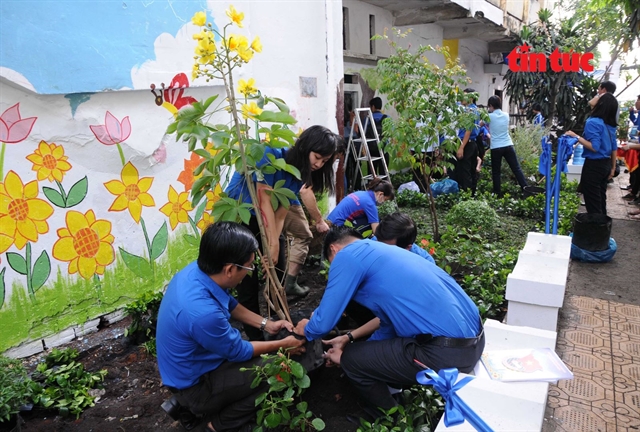
| Youth volunteers plant trees to help improve the environmental landscape in a residential area in HCM City’s Khánh Hội Ward. |
From clean-up drives to green living
Over time, Green Sunday has moved beyond basic environmental clean-ups to become a comprehensive programme that combines education, practical action and public awareness.
Alongside traditional activities such as canal cleaning and tree planting, the movement has introduced new models including waste sorting at source, recycling initiatives, green residential areas, green alleys and green schools.
These initiatives are closely linked to life-skills education and civic responsibility, helping children and young people translate environmental awareness into concrete action.
Between 2021 and 2024, organisers adopted a more focused approach by concentrating efforts each year on a single locality.
This allowed pollution hotspots to be addressed comprehensively while encouraging residents to help preserve results.
The strategy significantly reduced pollution in several neighbourhoods, while digital platforms and social media helped broaden outreach, particularly among young people.
Beyond statistics and infrastructure, the programme’s greatest impact lies in changing mindsets. Ngọc Hiền, a 12th-grade student in An Phú Đông Ward, says her participation since grade 10 reshaped her understanding of environmental responsibility.
“I’ve learned that protecting the environment is not someone else’s job but a shared responsibility,” she says.
Similarly, Thanh Duy, a student at the University of Science and Health under Việt Nam National University HCM City, says Green Sunday allows students to contribute meaningfully while promoting greener lifestyles within communities.
.jpg)
|
| Youth Union members remove water hyacinth, helping restore water flow along a canal in HCM City’s An Phú Đông Ward. |
Building a green lifestyle
Amid climate change and worsening environmental pollution in major cities, the sustained engagement of HCM City’s youth carries long-term significance.
Lê Tuấn Anh, Deputy Secretary of the HCM City Youth Union, says that after more than three decades, Green Sunday has helped embed green living practices within communities.
Youth volunteers now play a central role not only in environmental clean-ups but also in encouraging residents to change habits and protect shared spaces.
The movement’s resilience, he adds, stems from its flexibility and its ability to integrate multiple goals aligned with each stage of the city’s development, ensuring practical outcomes and avoiding formality.
In 2025, Green Sunday further expanded its scope to include support for rural transport infrastructure, social welfare activities and livelihood assistance for disadvantaged residents and young people.
Volunteer teams promoting scientific and technological transfer and rural digital transformation were also deployed to improve quality of life alongside environmental protection.
Since July 2025, the expansion of HCM City has brought new challenges as urban and rural areas increasingly intersect.
In response, Green Sunday has continued to link youth with communities through practical initiatives such as citywide clean-ups, canal restoration, removal of illegal advertisements, tree planting and the rollout of models like “flowering power poles,” “green corners” and “streets of flowers.”
Alongside hands-on activities, campaigns promoting waste sorting at source, plastic reduction and recycling-for-plants have further strengthened community responsibility for environmental protection.
Going forward, the city’s Youth Union aims to replicate effective models and position Green Sunday as a platform for young people to help advance climate adaptation, pollution control, the circular economy and balanced urban-rural development. — VNS
Society
 Society
 Society
 Society
 Society
 Society
 Society
 Society
 Society
 Society
 Society
 Society
 Society
 Society
 Society