 Society

SMS Tan Kiat How, Rosianna Silalahi and Glenda Gloria to speak at PRISM Summit 2026
1.
|
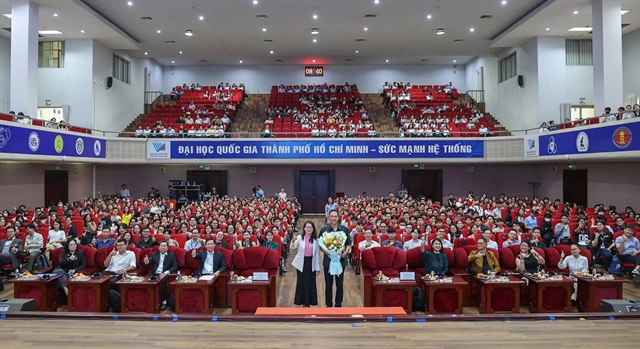
| More than 700 students, lecturers and researchers attend an academic exchange on emerging issues in sustainable development in Southeast Asia at Việt Nam National University-HCM City on January 16. — Photo Courtesy of VNU-HCM |
HCM CITY — Việt Nam National University–HCM City (VNU-HCM) on January 16 hosted an academic exchange on emerging issues in sustainable development in Southeast Asia, drawing more than 700 participants both in person and online.
Held under the theme “What It Takes for Southeast Asia to Rise,” the programme brought together Gita Wirjawan, a Stanford University visiting scholar and former Indonesian minister of trade, alongside VNU-HCM students and lecturers and international experts.
Speaking at the event, Nguyễn Thị Thanh Mai, chancellor of VNU-HCM, said the theme was particularly timely as the region and the world face growing uncertainty and increasingly complex development challenges.
|
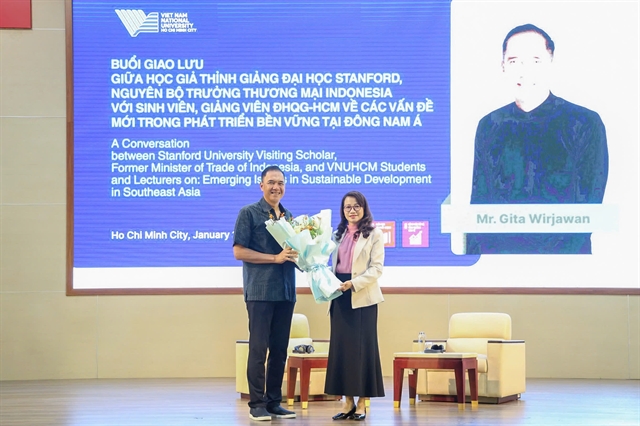
| Nguyễn Thị Thanh Mai, chancellor of Việt Nam National University-HCM City, presents flowers to Gita Wirjawan, Stanford University visiting scholar and former Indonesian minister of trade, at the academic exchange held in HCM City on January 16. — VNS Photo Courtesy of VNU-HCM |
She highlighted mounting climate risks in low-lying delta and coastal areas, rapid urbanisation, persistent environmental pollution and more frequent extreme weather events, stressing that these pressures require “wise and thoughtful responses” in a volatile global context.
Emphasising the role of universities, she said higher education institutions would play a critical part in preparing a new generation of leaders capable of addressing sustainability challenges.
She encouraged students to engage actively in discussions, think critically and connect academic knowledge with real-world issues.
“Students should reflect on how today’s discussions relate to their fields of study, their communities and their future careers,” she said, noting that such an approach is essential for applied research, innovation and start-up development.
Referring to Việt Nam’s development path, she warned that without timely reforms, innovation-driven growth and a strong commitment to sustainability, the country risks falling into the middle-income trap.
At the same time, she pointed to Southeast Asia’s long-term potential, citing its strategic geopolitical position, rich natural resources, diverse ecosystems and expanding human capital.
She also urged students to see themselves as future change-makers contributing not only to national development but also to regional and global progress through cross-disciplinary cooperation and international engagement.
|
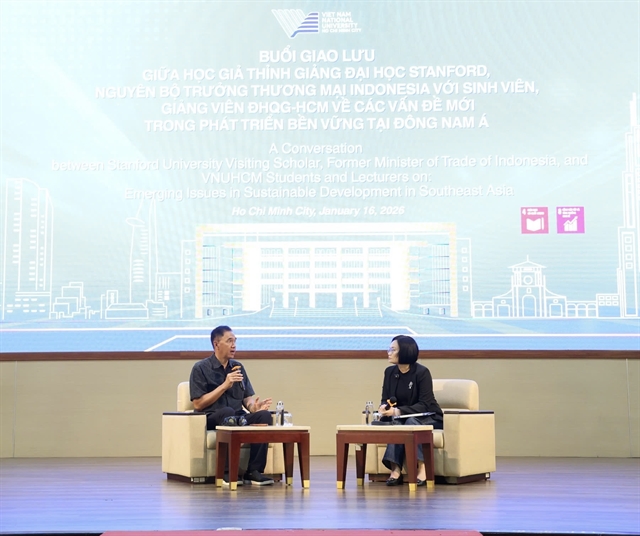
| Gita Wirjawan (left), Stanford University visiting scholar and former Indonesian minister of trade, shares insights on sustainable development in Southeast Asia during a dialogue with VNU-HCM students and lecturers on January 16. — VNS Photo Courtesy of VNU-HCM |
The programme featured a keynote presentation by Wirjawan on major trends shaping sustainable development in Southeast Asia, followed by a panel discussion on transnational issues such as energy transition, sustainable economic growth and social inequality.
Wirjawan served as Indonesia’s minister of trade from 2011 to 2014 and as chairman of the Indonesian Investment Coordinating Board.
He is currently affiliated with the Precourt Institute for Energy at Stanford University’s Doerr School of Sustainability, focusing on development pathways in Southeast Asia.
In his remarks, he said the region’s rise would depend on how effectively it addresses economic and educational disparities among its countries.
“Education, particularly in science, technology, engineering and mathematics (STEM), is the key driver of long-term competitiveness and inclusive growth,” he said.
He noted that many Southeast Asian economies still lacked sufficient human capital to meet the demands of digital transformation and green development, while rapid growth continued to rely heavily on carbon-intensive energy sources.
Limited electrification and infrastructure gaps, he added, remained structural barriers to industrial upgrading and the effective application of artificial intelligence.
He also warned of an “Internet paradox,” in which greater access to information does not necessarily translate into better public discourse or shared understanding.
On geopolitics, he described Southeast Asia as a strategic swing region in an emerging multipolar world, positioned between major economic blocs.
He concluded that stronger institutions, the rule of law and sustained investment in education would be essential for the region’s sustainable and resilient future.
Through its interdisciplinary approach, the exchange created a platform for direct dialogue between students, lecturers, researchers and an international expert, underscoring the importance of leadership, innovation and human development in addressing sustainability challenges in Việt Nam and the wider region.
More than 600 participants attended the event in person at VNU-HCM’s Trần Chí Đáo Hall, while others joined online from VNU-HCM member universities. — VNS
Society
 Society
 Society
 Society
 Society
 Society
 Society
 Society
 Society
 Society
 Society
 Society
 Society
 Society
 Society