 Society
European business confidence remains at historic high in Q3
1.
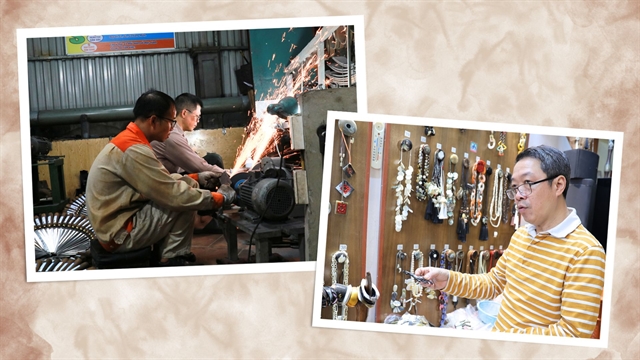 |
| The journeys of artisans like Lê Ngọc Lâm and Phạm Xuân Cường reflect how Vietnamese craftsmanship is finding new life in the modern world. — VNA/VNS Photo Hải Anh |
HÀ NỘI — In years gone by, Lê Ngọc Lâm spent most of his days with the rhythm of hammers striking steel echoing in his ears, forging knife after knife from dawn to dusk.
Across the city, in another part of Hà Nội, Phạm Xuân Cường was transforming discarded buffalo horns into objects of beauty, crafting them into durable items with a clear purpose.
For years, the work of these skilled artisans, and thousands like them across the country, often went unnoticed.
Not anymore.
Today, craftsmen like Lâm and Cường perform their craft before visitors eager to learn about the skill, patience and dedication required to create pieces that are both practical and beautiful.
This transformation has been driven by new initiatives that not only attract more tourists but also help bring traditional Vietnamese craftsmanship to global markets.
The change is evident in the story of Lâm, who now introduces visitors to traditional Vietnamese knife-making through hands-on cultural experiences. It is also reflected in the work of Cường, whose buffalo horn creations have reached international markets and led to collaborations with global brands.
Forging a new path
In the sweltering heat of the forge, amateur blacksmiths get to work, heating metal rods and hammering them into shape. The process is demanding and slow, but for many visitors it is nothing short of exhilarating.
Tourists are now flocking to Đa Sỹ Village to try their hand at becoming a blacksmith for a day.
“It was my first time in a forge like this, and it was a great experience. I learned so much and everything felt safe. We tried every tool and worked in every corner of the forge. After three hours, I’m leaving with wonderful memories,” said Madeleine, a visitor from France.
Such experiences are the result of Lâm’s vision to share his village’s centuries-old craft with the world. At the helm of Lê Lâm Forge, the craftsman is blending tradition with modern ideas, turning the ancient trade into a unique cultural adventure for travellers.
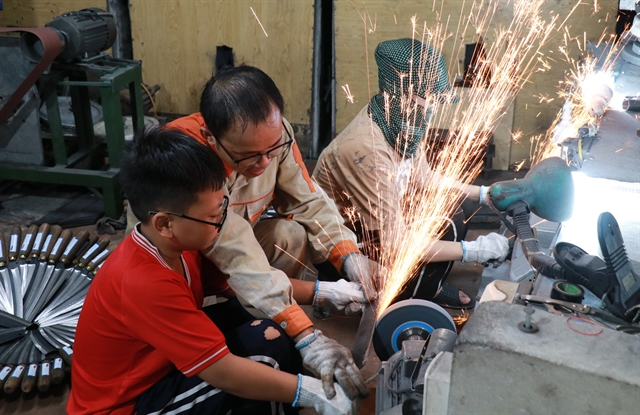 |
| By opening his forge as a place of learning and cultural discovery, Lâm hopes to introduce the craft village to the world. — VNA/VNS Photo Minh Phương |
Born into a family of blacksmiths, Lâm grew up surrounded by the steady rhythm of hammer and anvil.
“Even as a boy, I helped with small jobs like working the bellows, cleaning knives and oiling blades,” said the 44-year-old craftsman.
After graduating, Lâm briefly worked in construction. But his passion eventually drew him back to the family forge.
“When I returned, it was difficult at first. I went to the master craftsmen in the village to ask questions. By day, I worked. By night, I visited them to learn,” he recalled.
Đa Sỹ’s blades are famous across Việt Nam, particularly its thin kitchen knives. “They stay sharp for a long time. If they become dull, you can simply run them along the edge of a bowl and they will sharpen again,” Lâm said.
For Lâm, and for many people in Đa Sỹ, blacksmithing is far more than a livelihood. It is a living heritage that the community takes great pride in preserving.
With that belief, he is determined not only to keep the craft alive but also to pass it on to younger generations, opening his forge as a place of learning and cultural discovery.
The father of three daughters said he once faced criticism. “Some people told me this work is dirty and sweaty. But I see it differently. Every craft carries its own cultural value.
“When I open workshops, I don’t even charge visitors. Whether they are local or foreign, I welcome them and guide them through all 12 steps of making a knife.”
At the final stage, Lâm helps visitors engrave their names on their knives as a keepsake. For many amateur blacksmiths, the experience goes far beyond simply admiring skilled craftsmanship. It offers a rare chance to step into the shoes of generations of blacksmiths and better understand the spirit of a Vietnamese craft village – its people, traditions and heartbeat.
Mario, a tourist from France, could hardly contain his excitement as he gripped a glowing blade with tongs and pressed it beneath a mechanical hammer.
“It’s so different from anything else you can do here, and it’s an experience I’ll carry with me,” he said.
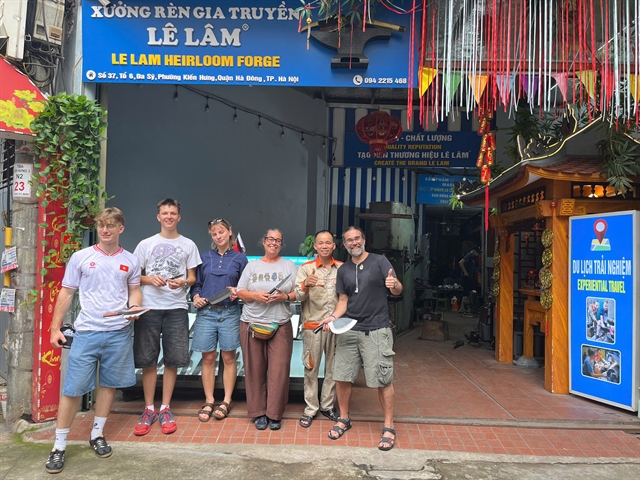 |
| Visitors experience knife making at Lê Lâm forge. — Photo courtesy of Lê Ngọc Lâm |
From discarded horns to global design
If glowing steel defines the forge of Đa Sỹ, another artisan in Việt Nam is working with a very different material: buffalo horn.
At first glance, it is hard to imagine that the elegant objects displayed in Phạm Xuân Cường’s workshop were once considered little more than agricultural waste.
“Horns are a by-product of livestock farming, essentially agricultural waste. People raise cattle for meat, not for their horns. A pair of horns, along with the bones and skin, is usually discarded,” he explained.
Yet in the hands of this artisan, those discarded horns are reborn as objects of beauty, transformed into home décor, fashion accessories and carefully crafted design pieces.
Cường has spent nearly four decades refining his craft, while his family’s connection to the trade stretches back even further. His grandfather sold handcrafted products to the French during the colonial period, and his father later carried on the tradition.
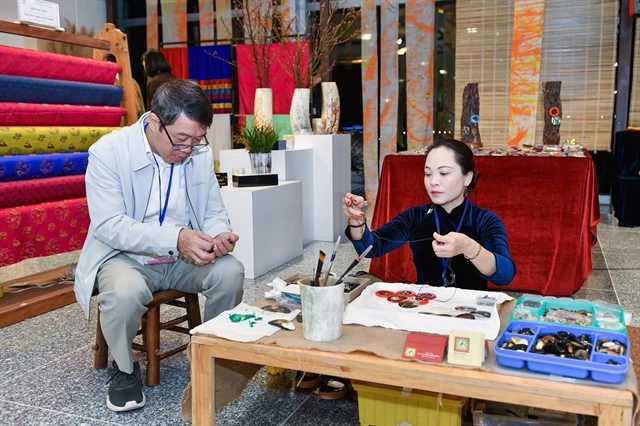 |
| Artisan Phạm Xuân Cường showcases and demonstrates handcrafted products at Nội Bài International Airport. — Photo courtesy of Phạm Xuân Cường |
For Cường, the material itself offers endless creative possibilities.
“Horn can be combined with many different materials,” said the 55-year-old artisan. “Silver, wood or stone, each has its own characteristics.”
His creations have been sold around the world for decades. Many pieces have been exported or produced for international brands, though consumers often do not realise their Vietnamese origins.
“Many Vietnamese people travel abroad and buy handicraft products. Sometimes they are actually made by artisans in Việt Nam,” Cường said.
That realisation encouraged him to share the story behind his craft more openly.
“I want Vietnamese people to know that there are many artisans here creating products that you may only encounter through big international brands,” he said. “When you realise that, you begin to appreciate them more, value them more and feel more inclined to support Vietnamese artisans.”
At the workshop, Cường’s daughter, Phạm Thùy Linh, is also helping carry the family tradition forward. She explained that the most distinctive feature of horn craftsmanship lies in its individuality.
“Every buffalo is like a human being. Each person has different hair, skin or eye colour, and each buffalo’s horns also have different colours and patterns,” she said.
“That’s why every product we make has its own unique colour and character.”
.jpg) |
| Discarded buffalo horns are reborn as home decor and fashion accessories. — VNA/VNS Photo Hải Anh |
Heritage in motion
Today, many traditional crafts in Việt Nam face mounting challenges. By the end of 2025, Tôn Gia Hóa, Vice President of the Craft Villages Association, noted that while the country still has 168 traditional crafts and more than 5,400 craft villages, around 50 villages have already ceased operations or are on the verge of disappearing.
Shifting consumer habits and intense competition from mass-produced goods have placed growing pressure on traditional artisans.
Amid these difficulties, new approaches are beginning to emerge. Collaborations with fashion and lifestyle brands, the use of social media and the adoption of modern machinery are increasingly seen as ways to overcome the limitations of traditional production models and enhance the value of craft products.
Lê Bá Ngọc, Vice President and General Secretary of the Việt Nam Handicraft Exporters Association (VIETCRAFT), emphasised that digital transformation should not be viewed as a threat to craftsmanship. Instead, in an increasingly competitive environment, technology can act as a catalyst to optimise operations, reduce waste and connect products more effectively with their target consumers.
The shift can already be seen in places like Đa Sỹ, where the sound of hammers striking steel still echoes through the village streets, although the rhythm has begun to change.
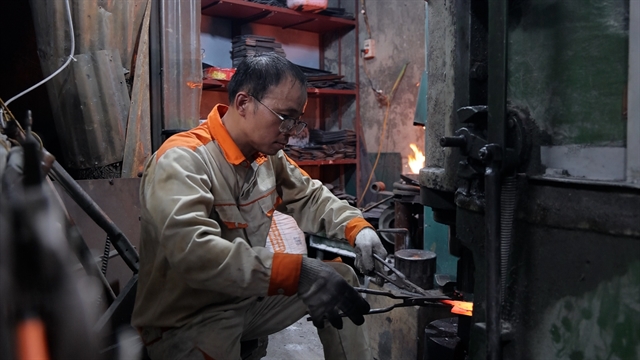 |
| Lâm has adopted modern machinery to make the work more efficient.— VNA/VNS Photo Hải Anh |
In the past, making a single knife required three men swinging heavy hammers in the heat of the forge. Today, mechanical hammers powered by air pressure handle much of the heavy work. Production has become faster and more precise, yet Lâm insists that some traditional techniques must remain.
“Certain steps can only be done by hand. Without them, you cannot create a truly sharp knife,” he said.
Elsewhere, materials once considered waste are undergoing a similar transformation. Computer-aided design and precision cutting machines now help artisans achieve greater accuracy, refine details and speed up the shaping of buffalo horn products.
The results have begun to resonate strongly with younger audiences. Polished horn accessories and decorative items have gained attention on social media, where the story behind the craft often proves just as compelling as the products themselves.
“When we started sharing information and stories about our family’s craft, we received a lot of support from young people,” Linh said. “Many domestic brands also reached out to work with us directly and collaborate.” — VNS
Society
 Society
 Society
 Society
 Society
 Society
 Society
 Society
 Society
 Society
 Society
 Society
 Society
 Society
 Society