 World
World

AXA Global Healthcare Mind Health Report reveals global differences in how cost and stigma affect access to professional mental health care
1.
|
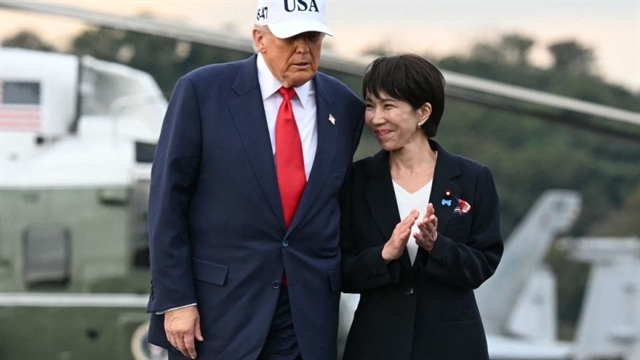
| US President Donald Trump and Japan's Prime Minister Sanae Takaichi arrive on board the US Navy's USS George Washington aircraft carrier at the US naval base in Yokosuka on October 28, 2025. — AFP/VNA Photo |
TOKYO — Japan’s response to the US-Israel military operation against Iran, including support measures, is likely to be the focal point of the upcoming Japan-US summit.
The hurdles are high for applying Japan’s security-related legislation to the dispatch of the Self-Defense Forces to support the United States, as there are various requirements to be fulfilled for such a move.
Prime Minister Sanae Takaichi is likely to face a difficult decision if US President Donald Trump requests substantial support during the summit, which is scheduled for March 19 in the United States.
Speaking at a House of Representatives Budget Committee meeting on Monday, Takaichi stressed that she will first listen to the president’s views during the summit. “I have not spoken with him. The United States must have its reasons. I will listen to him,” Takaichi said.
The Japanese government appears to be avoiding comment on the legitimacy of the US-Israel attacks, seeking instead to fulfill its role by contributing to diplomatic efforts to calm the situation.
However, Trump may demand substantial support from the prime minister, for example urging Japan to deploy the SDF to escort tankers through the Strait of Hormuz or engage in minesweeping operations there.
A senior government official said, “We must clarify what we can and cannot do before conveying this to Washington.”
Foreign Minister Toshimitsu Motegi will travel to the United States with the prime minister to prepare for requests from Trump, who is widely seen as unpredictable.
As to the form of Japan’s international contributions, measures based on the security-related laws enacted in 2015 are drawing attention. This is because a blockade of the Strait of Hormuz was discussed during the Diet deliberations on the laws and now it has actually occurred. The blockade was talked about as an example of “survival-threatening situations” enabling the use of collective self-defence.
Former Defense Minister Gen Nakatani explained at that time how a blockade of the strait could stop crude oil imports, thereby disrupting lifelines – for example, causing a shortage of electric power – and having a serious impact on the lives of the Japanese people. Such a case, Nakatani said, would constitute a survival-threatening situation.
Japan has about 250 days’ worth of crude oil reserves, so it cannot be said that immediate, critical harm would result from the blockade. Chief Cabinet Secretary Minoru Kihara said, “We have not deemed that we are in a [survival-threatening] situation” allowing Japan to exercise its right to exercise collective self-defence.
Even if the situation was recogniSed as a survival-threatening situation, the SDF activities envisioned during the debate over the legislation were limited to tasks such as removing sea mines during a “de facto ceasefire.” Escorting ships in combat requires more sophisticated political judgments, as it would be a highly dangerous operation.
Another option is to recogniSe the situation as a “case that has an important influence on Japan’s peace and security,” which is not as serious as a survival-threatening situation and would allow the SDF to provide logistics support such as refueling US vessels. Even in that case, however, a senior Foreign Ministry official said Japan would need to consider such factors as how Middle Eastern countries would perceive such a move. — The Yomiuri Shimbun/ANN
World
 World
World
 World
World
 World
World
 World
World
 World
World
 World
World
 World
World
 World
World
.jpeg) World
World
 World
World
 World
World
 World
World
 World
World
 World
World