 World
World
Việt Nam, Denmark elevate ties to Comprehensive Strategic Partnership
1.
|
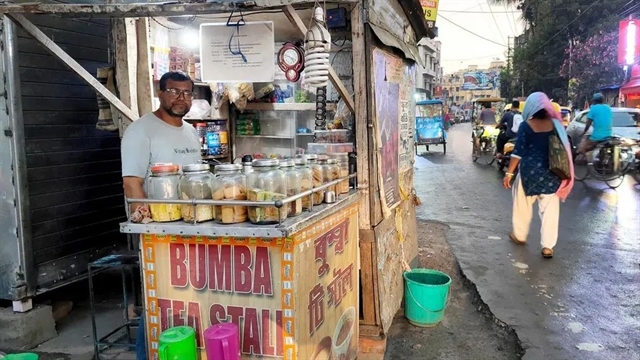
| Mr Abhijit Chakraborty, who owns a tea stall in Kolkata, India, is worried that rising cooking gas prices could hurt his earnings. PHOTO: THE STRAITS TIMES |
KOLKATA/MANILA – The bombs have been falling in the Middle East for over a week, but a nondescript tea stall in Kolkata is among those feeling the aftershocks rippling through Asia since the war began.
The stall’s owner, Mr Abhijit Chakraborty, 45, is worried that rising cooking gas prices could hurt his earnings. Indian state-run oil marketing companies raised the price of domestic cooking gas by 60 rupees (83 Singapore cents) for a 14.2kg liquefied petroleum gas (LPG) cylinder from March 7, pushing rates to their highest level in over two years.
The country imports roughly two-thirds of its LPG requirements, mostly from the Middle East. About 90 per cent of these imports transit through the Strait of Hormuz, a critical shipping line linking the Persian Gulf to the Indian Ocean, now effectively closed by the conflict.
This has left India, a fast-growing energy consumer, highly vulnerable to supply constraints and price shocks.
Mr Chakraborty uses up one cylinder of LPG each month, and he fears further price hikes could trim his monthly take-home earnings of around 12,000 rupees. “A price rise will hit everyone. If someone had three cups of tea a day, he will now have just one” he said. “I will be the one to lose.”
The price of commercial 19kg LPG cylinders also went up by about 115 rupees, but a supply crunch has forced companies to divert commercial supplies to domestic and other essential sectors. As a result, restaurants and hotels in several Indian cities, including Bengaluru and Mumbai, are running low and have threatened to shut.
Black marketeers have also started hoarding cylinders, driving up the scarcity despite a mandatory gap of 25 days between two domestic cylinder bookings.
If the war in Iran persists, there are fears that cooking gas prices could go up further, forcing price-sensitive households to reduce their LPG consumption and switch to cheaper and more polluting fuels such as firewood and cow dung cakes.
“This can significantly cause back sliding on the huge gains on clean cooking access that India has been able to achieve in the last decade,” said Mr Sunil Mani, a policy adviser at the International Institute for Sustainable Development.
In Noida, a city adjacent to Delhi, Ms Ranjana Devi is among many in the country who are now thinking of firing up their chulahs, a traditional Indian cooking stove, typically made of mud or brick and used commonly in rural areas.
The 35-year-old’s stove is built on the terrace of her home as a backup for when gas runs out, and she may soon feed it with firewood sourced from the roadside and fields or cheap dung cakes.
Her family, which sells vegetables at a roadside stall, has yet to secure a government gas subscription and buys cylinders from unauthorised market dealers. While it cost 1,100 rupees per cylinder earlier, the family forked out 250 rupees more for one after the recent hike in prices, she told The Straits Times.
Health concerns from using her smoke-belching chula are now secondary for her. “What choice do I have if gas becomes so expensive?”
Families and businesses across Asia are feeling the pinch as US-Israeli attacks on Iran and its retaliatory actions across the Persian Gulf, including on oil fields, have significantly disrupted fuel production and supply.
Around a fifth of global crude and natural gas supply is already suspended, throwing oil markets into turmoil, especially in Asia, which buys close to 90 per cent of West Asian oil exports.
Japan and the Philippines rely on the Middle East for around 90 per cent of their oil needs, while South Korea and India import roughly 70 per cent and 55 per cent, respectively, from that region. China depends on the Middle East for roughly 54 per cent of its total crude oil imports.
There are concerns that the fuel shortages could also mean higher inflation and rising interest rates.
In the Philippines, transport groups say the impact of rising global oil prices is already being felt by drivers despite the government rolling out measures to cushion the blow.
Mr Mar Valbuena, chairman of Manibela, a group representing about 50,000 jeepney drivers and operators, told ST that drivers’ earnings have already been squeezed.
“This week alone, drivers have been losing about 300 pesos ($6.50) in daily income,” he said, adding that many now take home only about 400 pesos after 12 to 15 hours on the road. They usually earn up to double that.
They are expecting heavier losses next week, with diesel prices expected to spike by more than 20 pesos per litre to 75 pesos, and gas by around 12 pesos per litre to 66 pesos.
University of the Philippines-Diliman School of Economics Assistant Professor JC Punongbayan estimated that rising fuel costs could push up the price of transportation, electricity and food, with inflation – which stood at 2.4 per cent in February – possibly climbing further.
Since Feb 28, when the war began, crude prices surged by more than a third past US$100 (S$127) per barrel, before falling to less than US$90 on March 9 after US President Donald Trump said he would hit Iran “twenty times harder” if it stops the flow of oil through the Strait of Hormuz. But fears persist that prices could even touch US$150 if the conflict drags on.
Countries in Asia have already announced a host of measures to shield themselves.
Bangladesh has introduced fuel rationing at petrol stations to stop panic buying, while the Philippines, Vietnam and Thailand have pivoted to work-from-home arrangements to reduce fuel and electricity consumption.
On March 9, Dhaka said it will also close all universities from Monday, bringing forward the Eid al-Fitr holidays as part of emergency measures to conserve electricity and fuel.
Pakistan, which produces only a small fraction of the oil it consumes, jacked up petrol and diesel prices on March 6 by 55 Pakistani rupees (25 Singapore cents), or about 20 per cent, to 321 rupees per litre for petrol and 335.86 rupees for diesel. This is one of the sharpest single increases in recent years.
Panic buying and long queues have been reported at petrol stations in the country, where the steep increase in pump prices has been dubbed a “petrol bomb”.
In India, farmers have started hoarding diesel ahead of the wheat harvest and paddy sowing season, fearing a price hike even though the government has said there are no such plans.
Long queues have also been reported at petrol and gas stations in India and Bangladesh, as customers stock up in anticipation of price hikes.
Similar scenes have unfolded ahead of the Hari Raya Aidilfitri travel rush in Indonesia, which has just over 20 days of fuel reserves.
Long queues were seen at petrol stations in the country, particularly in the provinces of Aceh and North Sumatra. In Aceh’s Bener Meriah and neighbouring Aceh Tengah, videos circulating online show residents flocking to petrol stations carrying jerry cans to stockpile fuel.
Fuel stockpiling and petrol rationing are also occurring in Australia, where farmers have warned that fuel shortages could lead to reduced food supplies and higher grocery prices.
Concerns about fuel flows have led to queues at petrol stations in major cities, and prompted some stations in regional areas to introduce limits of A$20 (S$18) per customer. Some stations have run out of fuel due to the sudden surge in demand.
Australia imports about 90 per cent of its refined oil, mainly from suppliers in South Korea, Singapore and Malaysia.
Federal Energy Minister Chris Bowen on March 10 held a meeting of a national fuel task force – including farmers and oil and trucking companies – to discuss joint efforts to address supply chain issues.
“This is managing a huge spike in demand, not an impact on supply at this point,” he told reporters. “There is absolutely no need for panic.”
Mr Hamish McIntyre, president of the National Farmers’ Federation that represents the nation’s 85,000 farm businesses, said: “If farmers can’t access reliable and affordable fuel and fertiliser, some may be forced to scale back plantings… That hits farm incomes, agricultural production and food availability.”
Nearly 70 per cent of Australia’s urea imports come from the Middle East.
In South Korea, many car owners also flocked to stations to fill up their tanks before prices rose further, with some petrol station operators reporting a 20 per cent increase in sales.
Prices there have jumped more than 10 per cent over the past week, with petrol hitting 1,890 won (S$1.63) per litre, while diesel surpassed 1,900 won as at March 7. The government is even considering doing something it has not in over 30 years – mandating a fuel price ceiling.
Several Asian economies have announced protectionist measures. Thailand has already suspended its crude and petroleum exports, while China on March 5 ordered its largest oil refineries to halt diesel and petrol exports.
On March 10, petrol and diesel prices in China rose for the fourth consecutive time this year, marking the largest increase since March 2022. Videos on Chinese social media showed long lines at some petrol stations the night before pump prices were set to rise.
India, which imports over 85 per cent of its crude oil and around half of its natural gas needs, is trying to source LPG from outside the Middle East. While it has a 50-day strategic reserve of crude oil, it does not have such reserves for LPG.
“This vulnerability is amplified by low LPG inventory cover of around 10 days. While the US could serve as an alternative supplier, cargoes from the US Gulf Coast take about 40 days to reach India, limiting near-term flexibility,” Mr Manish Sejwal, senior vice-president of commodity markets for oil at Rystad Energy, told ST.
India, the world’s fourth-largest liquefied natural gas (LNG) importer, also informed industrial customers they would receive lower gas supply last week.
More than 80 per cent of the LNG passing through the Strait of Hormuz in 2024 was destined for Asian markets, according to the US Energy Information Administration.
Countries across the region have sought to reassure their citizens of adequate supplies.
PT Pertamina, Indonesia’s state-owned oil and gas company, said the national fuel supply is secure, with an operational stock of around 21 days.
Japan’s oil reserves are among the largest, covering 254 days of consumption, while South Korea’s fuel reserves can last about seven months.
Similarly, while about half of China’s crude oil imports and almost a third of its LNG come from the Middle East, it has large oil stockpiles, estimated at over 100 days of consumption.
China has also taken steps to boost domestic oil and gas production, while a record renewable energy build-out has reduced fossil fuels’ role in power generation. But anxiety has been building as the war’s inflationary effects have started to impact pump prices in China.
This crisis could represent an opportunity for some, including Malaysia, which is a net petroleum exporter. Kenanga Research economist Wan Suhaimie Saidie said higher oil prices could benefit the country through stronger energy export earnings.
“Crude above US$100 per barrel is broadly positive for Malaysia because LNG contracts in Asia are still partly linked to oil prices. That means higher oil typically lifts LNG selling prices as well,” he told ST. “Malaysia could see stronger export revenues and higher earnings for Petronas, which also supports government revenue and the current account.”
However, he said the gains would likely filter through gradually, as most Malaysian LNG is sold under long-term contracts.
Malaysia is the world’s fifth-largest exporter of LNG. But the country still imports crude for domestic transport needs, with about 30 per cent of mineral fuel imports originating from the Middle East.
Prime Minister Anwar Ibrahim admitted that the cost of doing business may rise due to the conflict but also added the government can maintain subsidies for up to two months for entry-level baseline fuels.
But experts have sought more clarity. Socio-Economic Research Centre executive director Lee Heng Guie told ST that the government should be more transparent about its contingency plans as well as its ability to both supply and subsidise fuel, given the knock-on impact on inflation.
“Saying we can maintain the pump price for ‘one or two months’ is too vague for smaller enterprises that run on tight cash flows and margins,” the economist said.
Surging crude oil prices could also be a double-edged sword for Indonesia. As a major LNG exporter, the country benefits from automatic price adjustments since LNG pricing is typically pegged to crude oil.
On the other hand, Indonesia imports significantly more crude oil and refined fuel than it exports, meaning higher global prices drive up its import costs.
“Although LNG exports generate additional income, the net revenue windfall from elevated oil and LNG prices is insufficient to offset the expanding burden of domestic energy subsidies,” Mr Fabby Tumiwa, chief executive officer of Jakarta-based think-tank Institute for Essential Services Reform, told ST.
The government subsidises fuel at the pump below market cost, covering the difference from state coffers. When global crude prices rise, this subsidy burden balloons because the government is typically reluctant to immediately raise retail fuel prices for fear of sparking social unrest.
“Every US$1 increase in global crude oil prices triggers an estimated 6.5 trillion rupiah (S$490 million) to 6.7 trillion rupiah in additional subsidy costs,” Mr Fabby added.
Uncertainty is rife with no end yet in sight for the conflict, potentially forcing Asian economies – big and small – to absorb further shocks.
Qatar, which supplies a fifth of global LNG, has said it may take at least a month to return to normal production levels, according to a Reuters report. And Saudi Aramco’s mammoth Ras Tanura refinery and crude export terminal has also closed due to attacks, it added.
Overall fuel oil exports via the Strait of Hormuz usually total about 3.7 million metric tonnes per month, but tanker transits are now about 90 per cent lower than last week, according to data from analytics firm Kpler.
Taking a cautious long-term view, Asian countries have been diversifying their energy sources away from the Middle East.
India, for instance, is now looking at buying more oil not just from the United States and Venezuela, but also Russia, something it had cut down on as part of its ongoing bilateral trade agreement with the US.
Countries are also trying to increase their domestic energy production, including in renewable energy. In fact, the recent disruptions in oil and gas markets has led many to call for more resilient and diversified energy systems, including through renewables and regional grid interconnections.
“This conflict will impact Asia’s energy security considerations and deepen the need for energy independence, especially through renewables,” said Ms Aarti Khosla, founder of Climate Trends, a consultancy focused on sustainability and environmental issues.
“Many countries in the region have massive import dependence for crude oil and LNG, and are now looking at making power generation adjustments and diversifying supplies,” she added. (ANN/THE STRAITS TIMES)
World
 World
World
 World
World
 World
World
 World
World
 World
World
 World
World
 World
World
.jpeg) World
World
 World
World
 World
World
 World
World
 World
World
 World
World
 World
World