 Society

Lotte, Phát Đạt combine strengths in Thu Thiem project
1.
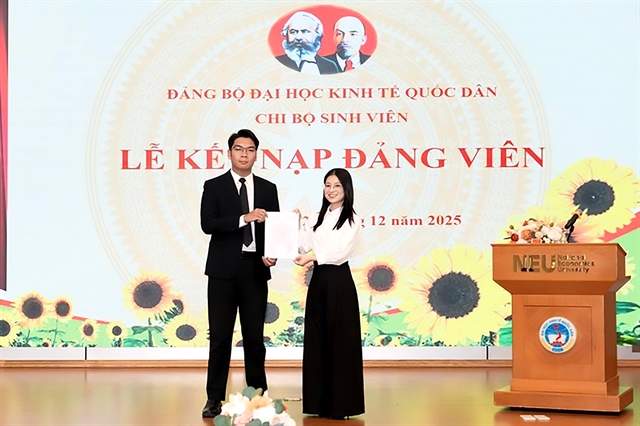 |
| Nhật Anh at his induction ceremony into the Communist Party of Việt Nam, December, 2025. — Photo daihoidangtoanquoc.vn |
Thu Mai & Ngọc Vy
HÀ NỘI — As Việt Nam moves closer to the 14th National Congress of the Communist Party of Việt Nam, attention is increasingly focused on a younger generation of Party members whose careers are developing well beyond traditional political tracks and into research, technology and international academia.
Their trajectories reflect a broader national shift towards a more knowledge-based economy and a growing emphasis on expertise, innovation and global engagement.
Nguyễn Đức Nhật Anh, 22, is one example.
A student at the National Economics University in Hà Nội and a Party member, Anh has already built an academic profile more commonly associated with mid-career researchers.
He has contributed to 26 research papers, presented at national and international conferences and published five articles in specialist journals.
His work lies at the intersection of economics, digital technology and market governance, with a strong emphasis on practical application rather than abstract theory.
Much of his research explores how businesses function in real-world conditions, including how firms respond to incentives, how consumers build trust and how data can be used to improve transparency in fragmented markets.
Among the projects he considers most significant is a study analysing the role of strategic direction and innovation in corporate performance.
The research seeks to provide empirical evidence to help companies improve efficiency and governance, while offering insights for policymakers working to strengthen the business environment.
This applied mindset extends beyond academic publishing.
Anh has also been involved in developing technology-based solutions, including QSAC One, a data platform designed to support quality monitoring and anti-counterfeiting efforts.
By collecting and analysing data across supply chains, the platform aims to help small and medium-sized enterprises protect brands, standardise production and build credibility with consumers, long-standing challenges in Việt Nam’s domestic market.
For Anh, research and technology are tools for addressing structural problems rather than ends in themselves.
He describes his approach as beginning with behavioural analysis, examining how businesses, consumers and regulators actually interact, before moving towards technical or institutional solutions.
As a Party member, he says this focus on application reflects a sense of responsibility to turn knowledge into tangible outcomes.
A different but equally illustrative path is that of Nguyễn Như Quỳnh, a young Party member from the northern province of Quảng Ninh whose academic journey has taken her beyond Việt Nam’s borders.
Currently studying law in the Russian Federation under a government scholarship programme, Quỳnh represents a growing cohort of Vietnamese students pursuing advanced training in law and the social sciences overseas.
 |
| Nguyễn Như Quỳnh (second to left) and her friends in the Russian Federation. — Photo svvn.tienphong.vn |
Before leaving for Moscow, Quỳnh had already built a strong academic and extracurricular profile at home.
She graduated as valedictorian of the Vietnam Youth Academy in 2024 and was recognised by Hà Nội as one of the city’s top graduates and gained national visibility through student competitions in law and leadership.
These achievements helped secure her place at Kutafin Moscow State Law University, where she is completing a Russian-language preparatory programme before entering postgraduate legal studies.
Quỳnh says her initial decision to apply to study in Russia was driven less by long-term planning than by curiosity.
She was attracted by the country’s reputation for rigorous academic training and strong theoretical foundations, particularly in law and the social sciences.
The reality, she says, proved both visually striking and academically demanding, marked by sub-zero winters, intensive language study and a highly disciplined classroom culture.
The transition was not without challenges. Academic pressure, cultural adjustment and the practical demands of living abroad led to moments of self-doubt, especially in the early months. Support from fellow Vietnamese students, she says, played a crucial role in helping her adapt and regain confidence.
Over time, the experience reshaped her understanding of education. Studying abroad, she argues, is less about accumulating credentials than about developing independence, resilience and perspective.
Those qualities, she believes, are as important as formal legal knowledge for anyone seeking to contribute meaningfully to society.
Looking ahead, Quỳnh hopes to continue along an academic path and may pursue doctoral research in law. She sees legal training not only as a professional qualification but as a foundation for broader social engagement, particularly in countries navigating legal and institutional change.
She also remains active in mentoring younger students in Việt Nam, sharing practical advice on preparing for overseas study, from language training to mental and physical readiness for demanding environments.
In her view, international education is not reserved for a privileged few but is within reach for students who are well prepared and persistent.
The trajectories of Anh and Quỳnh offer a snapshot of how younger Vietnamese professionals are building careers today.
Their paths are shaped by research, technology and global academic exchange, fields expected to influence the country’s development in the coming decades. — VNS
Society
 Society
 Society
 Society
 Society
 Society
 Society
 Society
 Society
 Society
 Society
 Society
 Society
 Society
 Society