 Society
84 individuals investigated for transnational online frauds
1.
|
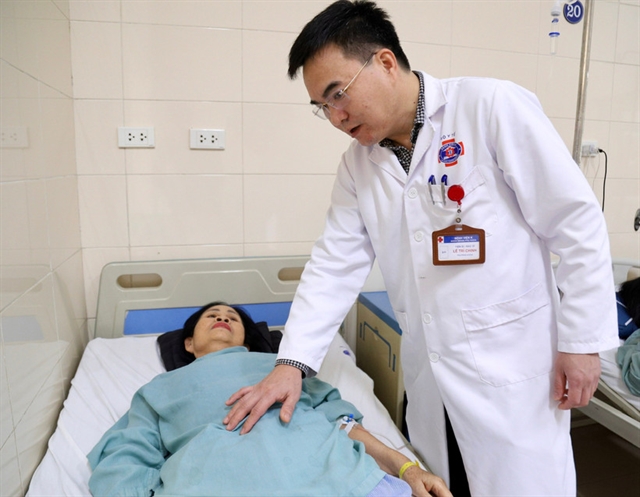
| A doctor monitors the patient's health at Việt Nam's National Cancer Hospital in Hà Nội.— Photo vietnamplus.vn |
HÀ NỘI — Doctors at Việt Nam's National Cancer Hospital have successfully performed a novel technique combining retroperitoneal sentinel lymph node biopsy using indocyanine green (ICG) with transvaginal natural orifice transluminal endoscopic surgery (vNOTES) in a patient with early-stage endometrial cancer.
The perform is believed to mark a significant milestone in the treatment of gynaecological cancers in Việt Nam.
This is the first time in Việt Nam that an advanced lymph node assessment technique has been carried out entirely via the vaginal route, allowing direct access to the retroperitoneal space without any incisions on the abdominal wall.
The patient, a 69-year-old woman with a history of hypertension, was admitted after experiencing abnormal postmenopausal vaginal bleeding.
Following comprehensive examination and evaluation, she was diagnosed with early-stage endometrial cancer.
After a multidisciplinary consultation, the surgical team opted to perform a retroperitoneal sentinel lymph node biopsy using ICG via the vNOTES approach, combined with a total hysterectomy and bilateral salpingo-oophorectomy.
Lê Trí Chinh, head of the Department of Gynaecological Surgery at the hospital, said the achievement was built on extensive experience gained from hundreds of vNOTES procedures.
He noted that the hospital’s surgeons have continued to learn, innovate and refine their skills in order to bring the world’s most advanced surgical techniques into clinical practice.
vNOTES is considered a next-generation minimally invasive surgical approach, using the vaginal route to access the abdominal cavity.
The technique offers several clear advantages, including the absence of visible surgical scars, superior cosmetic outcomes, reduced postoperative pain, faster recovery and shorter hospital stays.
Meanwhile, sentinel lymph node biopsy using ICG has been widely recognised as the most effective method for assessing lymph node status.
The technique enables accurate identification of the first lymph nodes at risk of metastasis, helping to avoid unnecessary systematic lymphadenectomy and significantly reducing the risk of lymphoedema and long-term vascular or neurological complications.
Experts say the integration of the two techniques represents not only a technological synergy but also a strategic advance in modern gynaecological cancer treatment, ensuring radical oncological control while preserving anatomical structures and improving patients’ quality of life.
With more than 200 vNOTES procedures successfully performed to date, the hospital continues to reinforce its position as a national leader in the application and development of minimally invasive surgical techniques for the treatment of gynaecological cancers in Việt Nam.— VNS
Society
 Society
 Society
 Society
 Society
 Society
 Society
 Society
 Society
 Society
 Society
 Society
 Society
 Society
 Society