 Society

Vietnamese, Belgian leaders agree to enhance multifaceted collaboration
1.
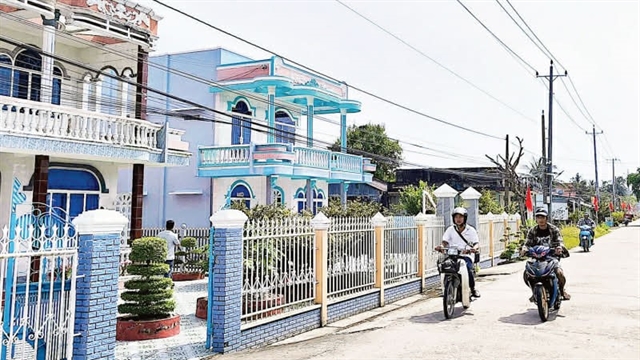 |
| Row upon row of sturdy houses in Nhà Lầu 1 and Nhà Lầu 2 villages in Ninh Thanh Lợi Commune, Cà Mau Province. — Photo nhandan.vn |
CÀ MAU — Once a poverty-stricken region with barren land and toxic soil, through persistent hard work and good policy decisions, the residents of Ninh Thạnh Lợi Commune have turned their hardships into motivation for progress.
They have revived the area's acid sulphate soil and saline land, creating a new landscape with row upon row of well-built houses and aspirations for lasting prosperity.
Acid sulphate soil occurs naturally in waterlogged conditions and contains minerals that react with oxygen to create sulfuric acid when exposed to air, killing vegetation and seeping into groundwater.
Saline soil is often caused by saltwater intrusion, a common problem in Cà Mau Province, which is located on the southernmost tip of the country and is surrounded by sea on three sides.
But in this inhospitable environment, residents are doing their best to reclaim the land.
Nhà Lầu 1 and Nhà Lầu 2 villages in Ninh Thạnh Lợi Commune, Cà Mau Province, can be reached by travelling upstream along the Phó Sinh-Cạnh Đền drainage canal.
One new rural road is flanked on both sides by multi-storey villas featuring lavish designs, leaving first-time visitors in awe.
Deputy Secretary of Nhà Lầu 1 Village Party Cell Nguyễn Trung Hiếu said: “Few know that today's abundance is the result of a long journey fuelled by the residents' fierce desire to assert themselves. Nowadays, the area is filled with solid brick houses, but in the past, there wasn't a single multi-storey home in the entire region.”
For many years, visitors to the area would see only ramshackle thatched roofs amid muddy puddles. Young people who grew up on this barren land began paddling boats elsewhere to seek ways to earn a living and learn how to combat the soil's acidity.
One of these intrepid youths was Năm Nguyên.
In 1995, when Năm was 30 years old, he built a sturdy two-storey house, the first in the village in nearly half a century.
Lê Văn Thể, 72, who owns a solid brick house and has witnessed decades of deprivation in the region, recalled with emotion: "Nguyên’s house ignited a flame of faith across the poverty-stricken countryside, fuelling the determination to make the acid land bloom with fragrance."
This transformation is not just about building sturdy houses, but the harmony between the Party's intentions and the people's hearts.
Thể recalled the historic milestone of 1995, when then-Prime Minister Võ Văn Kiệt advocated digging the Phó Sinh-Cạnh Đền drainage canal, along with a chequerboard network of transverse canals.
These fresh waters helped drain stagnant areas, flush out acidity and bring rice, pineapples and other crops to land that previously only saw grazing buffalo.
By 2000, the shift to shrimp farming truly sparked a revolution in the landscape of this challenging region.
"When we first switched, my family harvested dozens of kilos of black tiger prawns every night – enough to buy more than an ounce of gold was normal," Thể said with enthusiasm.
Thanks to the shrimp boom, he not only built a brick house in 2003, but also acquired over 4ha of farmland.
Nguyễn Văn Võ, the 83-year-old deputy head of the Nhà Lầu 2 Village Veterans' Association, built a brick house worth over 60 taels of gold in 2004 – a unimaginable sum at the time – thanks to a single shrimp harvest.
Excitement pervaded every path in the village as households competed to get rich, hosting feasts to celebrate successful harvests and strengthen neighbourly bonds.
Strategic decisions
According to the secretary of the Nhà Lầu 2 Village Party Cell Nguyễn Văn Dự, the key to prosperity lies in shifting mindsets from subsistence farming to a market economy.
Ninh Thạnh Lợi Commune authorities worked alongside farmers, using income efficiency as a yardstick.
Exemplary wealth creation by local cadres and Party members lent weight and credibility to mobilisation efforts, inspiring voluntary participation.
Two turning points for Ninh Thạnh Lợi came in 1995 and 2000, with investments in canals for drainage and de-acidification, followed by the switch to shrimp farming.
Thanks to effective cultivation, the commune's average per capita income now stands at VNĐ95 million (US$3,600) per year.
More than 3,800 of the nearly 5,400 households in the commune own solid brick houses (over 70 per cent).
These figures testify to the robust resurgence of this acid sulphate lowland.
Over 10,000ha of low-yield land from years past are now covered in promising shrimp and rice farming models, integrated with crab farming.
Throughout this journey, authorities have been active partners, providing planning, capital support, technical training and model demonstrations.
Yet for the people in Ninh Thạnh Lợi Commune, this is just the beginning. The commune aims to build a liveable new rural area, a sustainable community, offering long-term livelihoods for poor households and systematic investments in education, health care and culture.
"The aspirations for wealth that our forefathers entrusted to us now rest on the young generation's shoulders. Youth today bring modern thinking, daring to dream and act. They are eagerly exploring and implementing high-tech eel and crocodile farming models. They are the ones continuing the story of human will on this acid saline land," said one Ninh Thạnh Lợi commune leader.
As dusk fell, the multi-storey houses were reflected in the Phó Sinh-Cạnh Đền canal, painting a serene and proud scene. Residents' dreams of solid houses are no longer illusory, but embodied in every home and every contented smile of the area's honest and hard-working people. — VNS
Society
 Society
 Society
 Society
 Society
 Society
 Society
 Society
 Society
 Society
 Society
 Society
 Society
 Society
 Society