 Society

HKSTP Partners with Leading Science and Technology Company Merck to Open a New Chapter in I&T Collaboration
1.
|
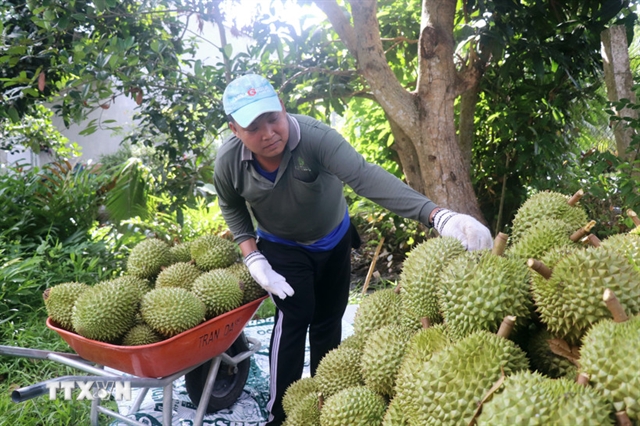
| Durian has been selected as the first product for origin tracking. VNA/VNS Photo Thu Hiền |
HÀ NỘI — The Ministry of Agriculture and Environment has set a target to build and pilot a national agricultural product traceability system by the end of 2026, with durian selected as the first product to be covered.
Minister of Agriculture and Environment Trần Đức Thắng has signed Decision No.25/QĐ-BNNMT approving a plan to implement traceability for agricultural, forestry and fishery products. The plan seeks to ensure quality and food safety, protect consumer health and the environment and support Việt Nam’s proactive international integration.
Under the plan, the ministry will develop and operate a unified agricultural product traceability system that will be used centrally and consistently from the national level to local authorities, producers and consumers, ensuring transparency and public access to information on product origins.
By the end of 2026, the agriculture and environment sector aims to complete and pilot the system, with initial application focused on durian traceability.
By July 1, the ministry plans to assess, refine and roll out the system for most key agricultural products used as food.
The system will include a minimum dataset covering information on farming households involved in the supply chain, details of production areas or facilities and production and harvest timelines, stages within the plan’s scope and data on electronic authentication labels and traceability stamps. Basic search functions and traceability via QR codes or other suitable data carriers on product labels will also be introduced.
The ministry also plans to develop and issue nationwide standards for agricultural traceability data and information exchange. Pilot applications will include digital logs for growing areas and cultivation activities, covering control of input materials such as fertilisers, animal feed, plant protection products, veterinary drugs and chemicals. The objective is to largely complete traceability application for durian and other products.
During the 2027–2030 period, the focus will shift to upgrading and refining system functions to enable recording and management of information across all key stages of the supply chain, including production zones, procurement, preliminary processing, packaging, transportation and distribution, while continuing the use of QR codes or appropriate data carriers on product labels.
In parallel, the Ministry of Agriculture and Environment will establish technical infrastructure, including servers, network connections and cybersecurity systems, along with digital solutions to support traceability. This includes investing in or leasing equipment and technical infrastructure to ensure stable, secure and uninterrupted system operations that meet state management requirements.
Based on standardised data, the ministry will also deploy analytical, aggregation, monitoring and early-warning tools to support management and decision-making, identify anomalies and risks in agricultural supply chains and apply data analytics and artificial intelligence at a supportive level for traceability, quality and food safety monitoring and market management in line with regulations.
The traceability system will apply to agricultural, forestry and fishery products as well as agricultural inputs under the ministry’s state management authority, covering all stages from production and harvest to processing, preservation, transportation and consumption.
Priority will be given to key products, high-risk items, export commodities and goods participating in modern supply chains. — VNS
Society
 Society
 Society
 Society
 Society
 Society
 Society
 Society
 Society
 Society
 Society
 Society
 Society
 Society
 Society