 Society

SMS Tan Kiat How, Rosianna Silalahi and Glenda Gloria to speak at PRISM Summit 2026
1.

|
| Nguyễn Tấn Được in Mai Vàng Hamlet in Tây Ninh Province’s Tân Tây Commune tends his bonsai yellow ochna garden. — VNA/VNS Photo Đức Hạnh |
TÂY NINH — Tân Tây yellow ochna growing village in Tây Ninh Province’s Tân Tây Commune is transforming its production and business, diversifying products and applying e-commerce.
As the southern province’s large yellow ochna growing area, the village is gradually developing the value of yellow ochna trees in a diverse and sustainable direction.
In this development process, the role of young people, together with clear orientation from local authorities, is opening up many prospects for this “yellow ochna capital”.
Nguyễn Thị Kiều Trang, born in 2001, is the first person in the commune’s Mai Vàng Hamlet to produce handicraft products from yellow ochna tree wood.
She makes bead bracelets, necklaces, scented incense from ochna wood, and keychains from yellow ochna flowers and leaves.
She invested about VNĐ350 million (US$13,300) in a production workshop and supplies products to more than 20 retailers.
“At first, it was simply because I liked wearing bead bracelets, so I tried making them from dried ochna wood,” Trang said.
In the coming time, she plans to continue renewing products, selling products through e-commerce channels and expanding the market.
Along with product diversification, ochna growers in Tân Tây are quickly adopting modern business methods.
The village now has more than 20 ochna shops that regularly livestream sales on the TikTok Shop platform.
Instead of depending on traders as before, ochna farmers now actively advertise products, receive orders and proactively manage their sales.
According to Nguyễn Tấn Được, born in 1987 in Mai Vàng Hamlet, livestreaming helps increase profits by 20–30 per cent compared to selling through traders.
“We grow ochna trees and sell them ourselves, so there is no extra middle stage,” he said.
Many households have also shifted to make bonsai ochna trees and grow ochna trees in pots, aiming to sell finished products suitable for customers with limited time for care.
The village’s ochna cultivation developed strongly in 2005-19, especially in 2019 when traders came to the village every day to buy ochna trees.
Compared with rice farming, its economic efficiency was hundreds of times higher. At its peak, with just 1ha of land, ochna farmers could earn VNĐ3–4 billion ($114,000–152,100) after five years, with annual profits of several hundred million, according to local farmers.
However, after the COVID-19 pandemic, the market slowed and selling prices fell by about 30 per cent. With no further expansion of land area, growers were forced to find new directions.
“We have to create more unique products that match consumer requirements, so our products can sell faster,” Được said.
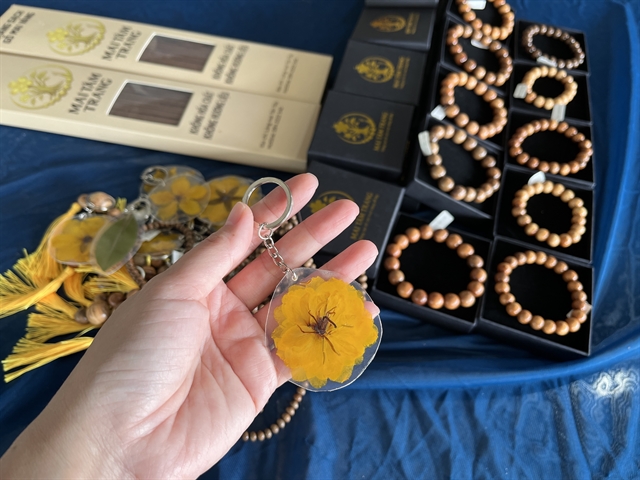
|
| Handicraft products made from yellow ochna trees in Tân Tây yellow ochna growing village in Tây Ninh Province’s Tân Tây Commune. — VNA/VNS Photo Đức Hạnh |
Further development
To effectively tap its potential, Tân Tây Commune has developed an action programme for rural tourism linked to the ochna craft village for the 2025–30 period.
The craft village currently has 430ha of ochna trees with 516 participating households, concentrated in Bà Sở and Mai Vàng hamlets.
Transport, irrigation, electricity and water infrastructure have been gradually invested in.
The commune has been granted “Tân Tây Yellow Ochna” trademark certification and established its Yellow Ochna Co-operative, with 31 members.
It has formed two rural tourism sites, along with service groups for transport, đờn ca tài tử (Southern traditional music) performances, tourism guiding and advertising, creating an initial foundation for developing craft village tourism.
According to Hồ Thị Ngọc Lan, secretary of the Tân Tây Commune Party Committee, the commune aims to expand ochna growing area to at least 460ha and increase the number of farming households to 605 by 2030.
By 2030, the commune aims to develop at least two products rated three stars or higher under the country’s “One Commue – One Product” programme, increase the average income of workers by 1.6 times compared to 2021, and establish a rural tourism site with at least 20 households joining the service chain, she said.
The action programme focuses on sustainable, multi-value tourism, with local people as the core. It will promote digital transformation and create experiential products linked to craft village culture, agricultural ecology and souvenir gifts made from yellow ochna, she said.
The commune will first focus on building and diversifying experiential tourism products, encouraging visitors to take part in producing products, making souvenirs and experiencing traditional cultural activities, she said.
At the same time, it will develop farmstay models, community tourism and eco-tourism combined with health care services, she said.
It will invest in essential infrastructure and facilities such as roads, parking areas, dining areas and toilets, while strengthening promotion, advertising, and digital transformation.
It will also apply technology in communication, management and tourism development, while issuing appropriate mechanisms and policies to attract investment. — VNS
Society
 Society
 Society
 Society
 Society
 Society
 Society
 Society
 Society
 Society
 Society
 Society
 Society
 Society
 Society