 Society

Sun PhuQuoc Airways expands Russian partner network ahead of Moscow route launch
1.

|
| Deputy Minister of Health Trần Văn Thuấn speaks at the workshop in Hà Nội on December 11. — Photo courtesy of the organiser |
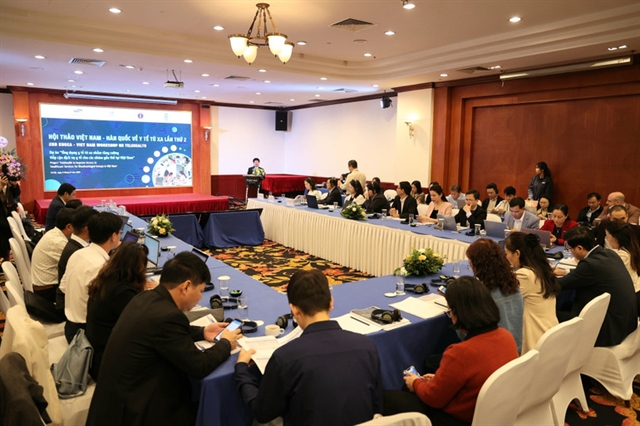
HÀ NỘI — Vietnamese and South Korean health care sectors shared experiences in applying telemedicine to improve access to health care services for vulnerable groups at a workshop on December 11.
The second Việt Nam–Korea Telemedicine Workshop was jointly organised by the Medical Service Administration (MSA) of the Ministry of Health in collaboration with UNDP, KOFIH, and Kangbuk Samsung Hospital in South Korea.
The event forms part of the project Applying Telemedicine to Enhance Access to Healthcare Services for Vulnerable Groups in Việt Nam.
Speaking at the event, Deputy Minister of Health Trần Văn Thuấn said telemedicine is not just a technical solution but a method of reorganising health care services in a patient-centred way, shortening geographical distances, sharing professional knowledge and enhancing the capacity of the healthcare system closest to the people.
“However, for telemedicine to develop sustainably, we cannot stop at just connecting. The biggest challenges now lie in standardising data, ensuring information security, building digital trust and designing long-term operating mechanisms,” Thuấn said.
At the workshop, representatives from Kangbuk Samsung Hospital shared their experiences in standardising and interconnecting electronic health records, information security, personal data protection, and the application of artificial intelligence (AI) in health care.
Experts said telemedicine offers significant benefits to individuals and society but also creates risks, a wider scope for cyberattacks and challenges in protecting personal data. Therefore, to ensure the safety of medical data, personal data and patient privacy, a synchronised approach is needed in telemedicine: technology, processes, legal regulations and raising awareness.
|
| The event is within the framework of the project "Applying Telemedicine to Enhance Access to Healthcare Services for Vulnerable Groups in Việt Nam". — Photo courtesy of the organiser |
Việt Nam is facing the challenge of a lack of standardised Vietnamese data for building large-scale Vietnamese language models. Furthermore, ensuring data accuracy and integrity is crucial, requiring a process of cleaning raw data to guarantee the integrity of input data. Consistency in labelling is also vital for AI to learn from the data correctly.
MSA Deputy Director Dr Nguyễn Trọng Khoa said standardising medical examination and treatment data at health care facilities is crucial for the application of electronic medical records to serve remote medical examination and treatment.
Therefore, Khoa said, hospitals need to upgrade their hardware infrastructure and management processes to meet operational and information security standards at level 2 (currently) and level 3; refer to appropriate specialised medical record templates; and participate in providing feedback on the standards drafted and issued by the Ministry of Health.
At the same time, hospitals need to prepare resources to upgrade electronic medical record software to meet interoperability and terminology standards.
Deputy Director of the National Centre for Health Information Nguyễn Trường Nam said Việt Nam currently faces a shortage of high-quality data for artificial intelligence in health care.
“The amount of data available for AI applications is very limited and most of this data exists in unstructured form (a mixed collection of images, videos, audio and free-form text that is not neatly organised and cannot be immediately used to train AI models),” said Nam.
Nam said that, to effectively utilise and manage AI in health care, it is necessary to perfect the legal framework governing the use of AI in medicine.
Accordingly, the Ministry of Health will develop regulations on the verification, licensing and quality control of AI in medical examination and treatment, ensuring that only AI systems meeting standards are deployed in clinical practice.
In addition, the Ministry of Health will issue ethical guidelines on AI in health care, clearly defining the responsibilities of all stakeholders. All final treatment decisions must be overseen and confirmed by a physician, ensuring professional accountability and protecting the rights of patients.
To enhance the quality of medical data and protect patient data, the Ministry of Health will also coordinate with relevant agencies to ensure AI systems strictly comply with information security regulations, preventing the risk of personal data leaks. — VNS
Society
 Society
 Society
 Society
 Society
 Society
 Society
 Society
 Society
 Society
 Society
 Society
 Society
 Society
 Society