 Society

Triton Crown launch draws more than 400 prospective buyers
1.
|
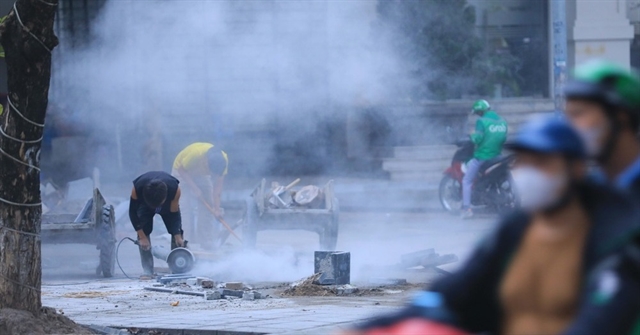
| Workers cut paving stones as they relay a sidewalk in Hà Nội. — VNA/VNS Photo |
HÀ NỘI — Hà Nội has ordered an immediate freeze on new permits for road and sidewalk excavation as the capital grapples with alarming levels of air pollution.
The move is part of an emergency directive issued this week by the city's Chairman Vũ Đại Thắng, who warned that rapid urbanisation has compounded emissions from traffic and construction, pushing air quality to 'bad' and 'very bad' levels across much of the city. The situation is particularly severe in the winter months, where thermal inversion traps pollutants in the air.
Under Directive 19, departments and local authorities must roll out a series of containment measures through December.
The Department of Agriculture and Environment has been tasked with inspecting all solid-waste treatment sites, ensuring round-the-clock operation and preventing dust or odour leaks.
Sanitation teams must also step up mist-spraying and road-washing to suppress fine dust, with weekly reports submitted throughout the month.

|
| A woman covers her nose against the dust as she walks past a sidewalk excavation site. |
The Department of Construction must ensure every building site deploys strict dust-control measures, from vehicle washing to full shielding and on-site misting, and installs sensor and camera-based dust-monitoring systems at all projects larger than one hectare.
These requirements must be completed by December.
Crucially, the city has suspended permit issuance for digging into roadbeds and pavements except in emergencies during the year-end months when pollution tends to spike.
Schools have been instructed to limit outdoor activities whenever air quality deteriorates to 'bad' or above and to adjust timetables if the Department of Agriculture and Environment issues severe-pollution alerts.
At ward and commune level, officials must intensify inspections, crack down on garbage and straw burning, clean streets during off-peak hours and review emission sources at craft villages and factories.
Any violations, the directive states, will be the responsibility of the local leader.
Facilities with large exhaust volumes have been ordered to run their emission-treatment systems at maximum capacity, avoid breakdowns and scale back production when pollution worsens.
Plants must also transmit full environmental monitoring data to regulators.
All agencies are required to implement the directive immediately, complete urgent tasks by December and file weekly updates to the Department of Agriculture and Environment for consolidation and reporting to the city government. — VNS
Society
 Society
 Society
 Society
 Society
 Society
 Society
 Society
 Society
 Society
 Society
 Society
 Society
 Society
 Society


.jpg)




