TPBank secures $50 million in long-term funding from DEG
1.

|
| A participant speaks about ways to prevent online scams during a session organised by the HCM City Police to educate students about social media fraud and so-called 'online kidnappings' at schools across the city. — VNA/VNS Photos Linh Sơn |
HÀ NỘI — Children in Việt Nam are stepping into the digital world earlier and more frequently than ever, but many do so without the skills to protect themselves.
Recent surveys by the Ministry of Home Affairs show that 87 per cent of internet users aged 12 to 17 go online every day, yet only 36 per cent know how to stay safe.
UNICEF highlights a similar gap, noting that two thirds of Vietnamese children are unaware of any helpline they can contact when facing online bullying, with those aged 10 to 14 the most at risk.
During the first half of this year, authorities detected dozens of cases involving online scams, grooming, psychological manipulation and even digital forms of kidnapping aimed at children and students.
What looks like harmless entertainment – a game, a chatroom, a social media feed – is increasingly becoming a cover for threats that children struggle to recognise.
Psychologist and Associate Professor Dr. Trần Thành Nam warned that the overwhelming spread of harmful and unsuitable content is now one of the biggest challenges facing families and schools. Children lack the analytical ability to filter online information, making them highly susceptible to toxic content that can affect their thinking, mental wellbeing and long-term development.
At the same time, cyberspace has become a flashpoint for new kinds of conflict. Sensationalised short videos, violent storytelling trends and the habit of using abbreviations or symbols in everyday chats often create confusion among young users. Hours spent behind screens also erode their confidence and competence in real-world social interactions.
Dr. Nam said that the only sustainable solution is for families and schools to join forces, creating clear expectations for digital behaviour. Parents need to set boundaries through time limits and access filters, while still giving their children a sense of autonomy and privacy.
These concerns have moved to the centre of policy discussions.
Speaking at a sitting of the current 10th session of the 15th National Assembly, Deputy Nguyễn Thị Việt Nga of Hải Phòng City pointed to deep fractures in social values. School and domestic violence remain persistent, while online fraud, gambling and addiction to gaming and social media are spreading at an alarming pace. Public behaviour, both in physical and digital environments, is becoming more erratic, while child-protection systems online are struggling to keep up.
She emphasised that children grow and form their values within four interconnected settings: their families, their schools, their wider communities and the digital world. However, each faces significant challenges. Families are stretched thin, schools face overcrowded classes and teacher shortages, cyberspace is saturated with harmful content and cultural facilities at the local level are deteriorating.
Fundamental cultural values – ethical standards, behavioural norms or human character – remain undefined and unsupported by the kind of robust long-term strategy that today’s digital era demands.
She called for the adoption of a National Strategy on Culture and Lifestyle in the Digital Age, along with a set of compulsory national indicators to assess cultural standards, social ethics and patterns of behaviour.
Towards a stronger digital shield
In classrooms, the need for digital safety education is becoming urgent. Schools are partnering with relevant agencies to offer online safety briefings, included in homeroom periods and weekly rituals.
|
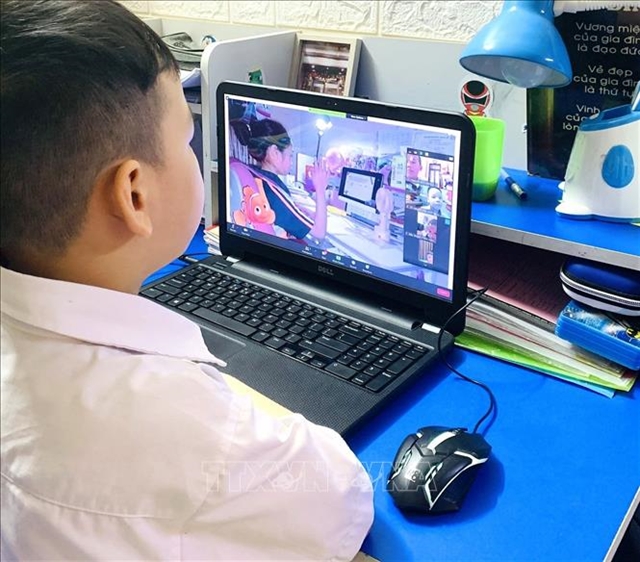
| A student at Thăng Long Primary School in Hà Nội during an online lesson. |
At Ngô Gia Tự Secondary School in Hải Phòng City, teacher Nguyễn Thị Lan Hương said these activities help students build practical life skills, recognise online threats and spread positive behaviour within their school community.
With stronger digital knowledge, teachers can better identify signs of risk, guide students through difficult situations and work closely with parents.
The education sector has already introduced a circular outlining standards in digital competency, including basic skills in artificial intelligence. Work is under way to build an AI competency framework for learners and teachers, alongside the future Law on Artificial Intelligence.
According to Dr. Nam, building a 'digital vaccine' for society depends heavily on each individual’s willingness to update their skills, not only in using devices but in applying digital tools to career development, accessing open learning resources and creating culturally appropriate content.
Young people must understand that online behaviour does not always reflect real-world norms, he added. Digital competence includes the ability to read subtle cues, interact respectfully, recognise risks, safeguard personal data and resist manipulation.
Experts say building a safe online environment for children must be treated as a national mission in the digital transformation era. At the school level, online safety education should move beyond lectures and instead be taught like any essential life skill, using real-life case studies and hands-on practice.
But the first layer of protection remains the family. Parents play a decisive role in supervising social media use, setting reasonable limits and nurturing healthy online habits. Society must reject harmful platforms, while authorities must crack down more effectively on those who spread toxic content.
With teachers guiding them, parents supporting them and communities working together, children can navigate the digital world with confidence. When well protected, the internet becomes not a threat but an opportunity, a place where young people can learn, explore and build the foundations of Việt Nam’s future digital society. — VNS
 Society
 Society
 Society
 Society
 Society
 Society
 Society
 Society
 Society
 Society
 Society
 Society
 Society
 Society