 Society

Triton Crown launch draws more than 400 prospective buyers
1.
 |
| Prime Minister Phạm Minh Chính (second from left) speaks during the dialogue on Wednesday. — VNA/VNS Photo |
HÀ NỘI — Prime Minister Phạm Minh Chính said science, innovation and digital transformation are central to helping Việt Nam reach US$100 billion in agricultural exports and stressed the need to better support farmers in applying technology in production and sales.
Speaking at his fourth national dialogue with farmers of the current term, held in Hà Nội on Wednesday and connected online to 34 provinces and cities, the PM described farmers as ‘soldiers on the agricultural front’ who must constantly adapt in an increasingly competitive landscape.
"The agricultural sector has always been the backbone of our economy," he said, noting agriculture's role in helping Việt Nam escape post-war poverty and maintain political stability over nearly four decades of reform.
"But to move from a middle-income country today to a high-income country by 2045, we must rely on science and technology, innovation and digital transformation."
The 2025 dialogue, themed Applying science and technology, innovation and digital transformation in farmers’ lives, mixed celebration of the countryside’s achievements with blunt accounts from cooperative leaders, smallholders and agribusiness executives about the costs and risks of going high-tech.
Farmers and cooperative leaders repeatedly returned to a familiar complaint: a large gap between research and reality.
Phạm Thị Lý, a scientist recognised in 2024 as a ‘farmer’s scientist’ and a member of the Union of Vietnamese Herbal Medicine and Organic Agriculture Cooperatives, said many successful research projects still struggle to reach the field.
"Science and technology are clearly crucial for agriculture and rural development, but there is still a big gap between research and its practical transfer to farmers," she said. "Many projects are completed but slow to be transferred or face serious obstacles in practice."
Lý urged the Government to create mechanisms to fill the gap, turning research results into pilot models in rural areas. She also called for a formal coordination mechanism linking scientists and the Farmers’ Union so that new techniques and technologies are systematically delivered to farmers.
Deputy Minister of Science and Technology Bùi Thế Duy acknowledged the criticism, calling the research-to-practice gap a pressing issue for his sector.
He said Politburo Resolution 57 on science, technology and innovation had put this challenge at the centre of reform and that in 2025 the Government plans to amend 10 core laws, including those on science and technology.
He pointed to two emerging models the ministry wants to scale up: value-chain partnerships, in which firms adopt new technologies from research institutes and spread them through associated cooperatives and farmers, and innovation clubs, in which farmers connect with scientists online in the evenings after work in the fields to discuss new techniques, digital tools and business models.
While the dialogue’s main theme was science and technology, some of the most vivid interventions were about something more prosaic: patchy internet and the hidden costs of selling online.
In the northern province of Lạng Sơn, cooperative director Vương Thị Thương has built a business around a speciality product she calls ‘hồng vành khuyên treo gió’ — wind-dried persimmons.
"Selling agricultural products online is now a popular trend and it fits perfectly with the policy of digital transformation," she said. "But in reality, it’s difficult for cooperatives like ours in mountainous areas. We lack people to write scripts, create content and we need ‘livestream warriors’ to help make promotional videos."
More fundamentally, she said the internet is so unstable in some remote hamlets that she sometimes has to climb to a high spot just to get a signal for livestream sales.
She proposed Government-backed training in online sales skills, priority investment in rural internet infrastructure and the creation of dedicated e-commerce gateways for farmers and cooperatives with lower transaction costs than commercial platforms.
Deputy Minister of Industry and Trade Nguyễn Sinh Nhật Tân said the ministry is already partnering with provinces and major e-commerce platforms to train farmers, young entrepreneurs and cooperative staff, organising more than 100 courses for some 10,000 participants on topics from brand building and livestreaming to using artificial intelligence for marketing.
"The best KOLs for farm produce are often the farmers themselves. When they tell their own story from the field, it resonates," he said.
He also noted that the National Assembly is expected to pass a new E-Commerce Law with specific provisions to support farmers and small businesses in remote areas and that his ministry is working with localities on joint online marketplaces for agricultural products.
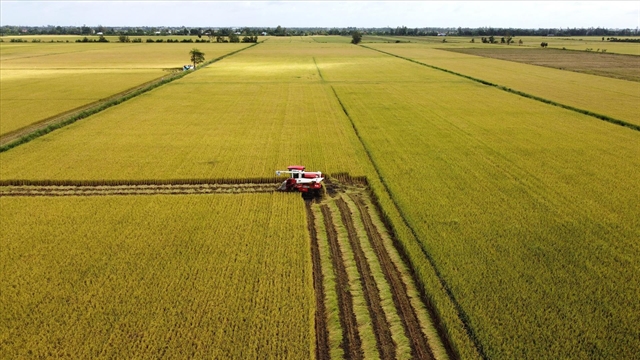 |
| Farmers harvest rice in a pilot high-quality, low-emissions rice field in the southern province of Đồng Tháp. |
On connectivity, Deputy Minister Duy said the Government is piloting two additional solutions: subsidies from the universal telecoms fund to expand mobile coverage to remote villages and trial licences for low-Earth-orbit satellite internet services such as Starlink and OneWeb to reach deep rural and island areas.
Access to credit was another recurring theme, especially for farmers trying to shift from traditional cultivation to high-tech, low-emission or organic models.
Nguyễn Thị Trâm, a farmer from Bắc Ninh Province specialising in high-tech agriculture, said initial investment costs are enormous while most farmers lack land titles or assets large enough to secure commercial loans.
"Most of us lease land, so we have nothing substantial to mortgage," she said. "Support from farmer assistance funds is limited. We hope the Government can create dedicated credit lines, perhaps via the Farmers’ Union, that directly finance high-tech agricultural projects and science-based production."
Farmers also pushed for simpler, more accessible agricultural insurance schemes as climate change brings more frequent floods, storms and extreme weather.
Deputy Governor of the State Bank of Vietnam Nguyễn Ngọc Cảnh said agriculture and rural development remain among the country’s top credit priorities, with outstanding loans to the sector reaching nearly VNĐ4 quadrillion ($151 billion) by the end of August 2025 and accounting for almost a quarter of total lending.
He highlighted decrees that allow unsecured loans of up to billions of đồng for rural borrowers, higher unsecured ratios for projects using high-tech or organic methods and special debt-restructuring rules for borrowers affected by natural disasters and disease outbreaks.
Preferential credit programmes for agriculture and rural areas now total hundreds of trillions of đồng, he added, alongside 23 policy credit programmes run by the Vietnam Bank for Social Policies.
Nevertheless, Deputy Governor Cảnh acknowledged that bottlenecks persist and said the central bank will continue working with ministries and the Farmers’ Union to expand green credit, simplify procedures and align loan products with new business models in agriculture.
Farmer representative Phạm Đức Trọng from Hà Nội proposed an additional, more visible measure: building ‘high-tech agricultural villages’ that act as live demonstration hubs for smart farming, digital tools and new techniques, where farmers, cooperatives and businesses can learn, test and connect.
Minister of Agriculture and Environment Trần Đức Thắng noted that the existing law recognises high-tech agricultural zones but not yet high-tech villages. Only 12 such zones have been formally established nationwide.
"The idea of high-tech villages is interesting and broader in scope," he said. "We support further research so these can become places to trial, learn and spread new technologies and connect institutes and universities with cooperatives and farmers."
Throughout the dialogue, PM Chính returned to a broader political message that agriculture, rural areas and farmers, the so-called ‘tam nông,’ continue to play an important role as a pillar of the economy and social stability.
For ministries and local governments, he called for several priorities, including further legal and regulatory reform to clear bottlenecks in land, credit and digital transformation in agriculture, stronger investment in strategic infrastructure and faster development of agricultural insurance markets to protect farmers from crop failures, price crashes and natural disasters.
For the Farmers’ Union, he urged strengthening 'three-pillar' linkages between the State, schools and enterprises to train high-quality human resources, while positioning farmers as the driving force of development and expanding training to raise farmers’ skills and knowledge.
"Resources begin with vision and thinking; momentum comes from innovation and creativity and strength comes from people and enterprises," he said, calling for three forms of companionship with farmers – in knowledge and technology, in policies and livelihoods and in market access and branding. — VNS
Society
 Society
 Society
 Society
 Society
 Society
 Society
 Society
 Society
 Society
 Society
 Society
 Society
 Society
 Society

.jpg)